The Belt and Road Initiative: A Key Pillar of the Global Community of Shared Future
The State Council Information Office of the People’s Republic of China
October 2023
Contents
Preamble
I. Proposed by China but Belonging to the Whole World
II. Paving the Way Towards Shared Development and Prosperity
III. Promoting All-Round Connectivity in Multiple Fields
IV. Injecting Positive Energy into World Peace and Development
V. Pursuing Steady and Sustained Progress in High-Quality BRI Cooperation
Conclusion
Preamble
Over two millennia ago, inspired by a sincere wish for friendship, our ancestors travelled across grasslands and deserts to create a land Silk Road connecting Asia, Europe and Africa, leading the world into an era of extensive cultural exchanges. More than 1,000 years ago, our ancestors set sail and braved the waves to open a maritime Silk Road linking the East and the West, beginning a new phase of closer communication among peoples.
Spanning thousands of miles and years, the ancient silk routes were not only routes for trade but also roads for cultural exchanges. They made a great contribution to human progress. In the 1980s, the United Nations and some countries began to envisage the Eurasian Land Bridge, the Silk Road Initiative, and other plans, reflecting a common wish to engage in communication and cooperation.
In March 2013, President Xi Jinping proposed the vision of a global community of shared future; in September and October that year, he raised the initiatives of joining with others to build a Silk Road Economic Belt and a 21st Century Maritime Silk Road (Belt and Road Initiative, or BRI). The Belt and Road Initiative is a creative development that takes on and carries forward the spirit of the ancient silk routes – two of the great achievements in human history and civilization. It enriches the ancient spirit with the zeitgeist and culture of the new era, and provides a platform for building a global community of shared future.
Since its launch 10 years ago, thanks to the combined efforts of all parties, cooperation under the BRI framework has expanded beyond the borders of China to become an international effort. It has evolved from ideas into actions, from a vision into reality, and from a general framework into concrete projects. It has been welcomed by the international community both as a public good and a cooperation platform, and has achieved solid results.
Over the past decade, BRI cooperation has delivered real gains to participating countries. It has contributed to the sound development of economic globalization and helped to resolve global development challenges and improve the global governance system. It has also opened up a new path for all humanity to realize modernization, and ensured that the efforts of building a global community of shared future are delivering real results.
The Chinese government is publishing this white paper to present the achievements of the BRI during the past 10 years. It will give the international community a better understanding of the value of the initiative, facilitate high-quality cooperation under it, and ultimately deliver benefits to more countries and peoples.
I. Proposed by China but Belonging to the Whole World
The world today is going through profound change on a scale unseen in a century. Problems and challenges continue to threaten the progress of human civilization. In response to a changing global situation and the expectations of the international community, and with the future and overall interests of humanity in mind, China proposed the Belt and Road Initiative (BRI). Committed to the Silk Road spirit, a great heritage of human civilization, the BRI connects the past, the present, and the future. This initiative was launched by China, but it belongs to the world and benefits the whole of humanity.
1. Rooted in history, the BRI carries forward the Silk Road spirit
At around 140 BC during China’s Han Dynasty, Zhang Qian, a royal emissary, made a journey to the West from Chang’an (present-day Xi’an in Shaanxi Province), opening an overland route linking the East and the West. Centuries later, in the years of the Tang, Song and Yuan dynasties, silk routes boomed both over land and at sea, facilitating trade between the East and the West. In the early 15th century, Zheng He, the famous Chinese navigator of the Ming Dynasty, made seven voyages to the Western Seas, which boosted trade along the maritime silk routes.
For thousands of years the ancient silk routes served as major arteries of interaction, spanning the valleys of the Nile, the Tigris and Euphrates, the Indus and Ganges, and the Yellow and Yangtze rivers. They connected the birthplaces of the Egyptian, Babylonian, Indian and Chinese civilizations, the lands of the believers of Buddhism, Christianity and Islam, and the homes of peoples of different nationalities and races. These routes increased connectivity among countries on the Eurasian continent, facilitated exchanges and mutual learning between Eastern and Western civilizations, boosted regional development and prosperity, and shaped the Silk Road spirit characterized by peace and cooperation, openness and inclusiveness, mutual learning and mutual benefit.
Symbolizing communication and cooperation between the East and the West, the millennia-old silk routes demonstrated that by upholding solidarity and mutual trust, equality and mutual benefit, inclusiveness and mutual learning, and win-win cooperation, countries of different ethnic groups, beliefs and cultural backgrounds could share peace and achieve development together. The Silk Road spirit is consistent with the ideal of “all states joining together in harmony and peace” long upheld by the Chinese nation, with the Chinese people’s principles of amity, good neighborliness and “helping others to succeed while seeking our own success”, and with the call of the times for peace, development and win-win cooperation.
The Communist Party of China is a major political party with a global vision, and China is a major country pursuing peaceful development. The BRI, which carries forward the Silk Road spirit in the new era, evokes the pleasant memories of the past and has fired many countries’ enthusiasm for connectivity.
The BRI pays respect to history and tries to recreate the bustling scenes of untiring envoys and businessmen over land and countless ships calling at ports along the ancient silk routes. It is also navigating a way to the future by drawing wisdom and strength from the ancient silk routes and the Silk Road spirit. Enlightened by history, we will continue to move forward and integrate the Chinese Dream with the world’s dreams, in order to realize the aspiration of all peoples for exchanges between civilizations, peace and tranquility, common development, and better lives.
2. In response to reality, the BRI resolves problems in development
Development holds the master key to solving all problems. Economic globalization has given strong momentum to the world economy. Over 500 years ago, after the ancient silk routes had been interrupted for more than a half century, the Age of Discovery arrived, fundamentally changing the course of human society. Since the advent of modern times, technological revolutions and development of the productive forces have made economic globalization a surging historical trend. In particular, since the 1990s, the rapid advance of economic globalization has greatly facilitated trade, investment, flows of people, and technological progress, making an important contribution to the progress of human society.
However, the economic globalization dominated by a few countries has not contributed to the common development that delivers benefits to all. Instead, it has widened the wealth gap between rich and poor, between developed and developing countries, and within developed countries. Many developing countries have benefited little from economic globalization and even lost their capacity for independent development, making it hard for them to access the track of modernization. Certain countries have practiced unilateralism, protectionism and hegemonism, hampering economic globalization and threatening a global economic recession.
It is imperative to address such global problems as sluggish economic growth, shortcomings in economic governance, and imbalanced economic development. It is no longer acceptable that only a few countries dominate world economic development, control economic rules, and enjoy development fruits.
The BRI targets development not only for China but for the world at large. Economic globalization remains an irreversible trend. It is unthinkable for countries to return to a state of seclusion or isolation. However, economic globalization must undergo adjustments in both form and substance. It should be made more open, inclusive, balanced and beneficial to all.
China has not only benefited from economic globalization but also contributed to it. As an active participant in economic globalization, China has achieved rapid economic growth through positive interactions with the rest of the world and explored a unique path towards modernization, expanding the options for other developing countries to achieve modernization. China’s rapid economic growth and steady progress in reform and opening up has provided a strong driving force for global economic stability and growth as well as an open world economy.
China has been a firm advocate and defender of economic globalization. The BRI dovetails with the UN 2030 Agenda for Sustainable Development in concept, measures and goals. A major step taken by China, the BRI aims to promote higher-quality development through higher-standard opening up, and share China’s development opportunities with the rest of the world. The BRI is also a Chinese solution to global development issues, which aims to advance modernization in participating countries in tandem, make economic globalization more dynamic, inclusive and sustainable, and ensure that more of the fruits will be shared more equitably by people across the world.
3. Oriented towards the future, the BRI creates a better world
Today, the world is moving ever closer towards greater multipolarity, economic globalization, and cultural diversity, and becoming increasingly information-orientated in the process. Countries are more frequently connected and closely interdependent than at any time in the past. It is increasingly clear that humanity is a community of shared future in which everyone’s interests are inseparably entwined.
However, a growing deficit in peace, development, security and governance, together with interwinding conventional and non-conventional security issues such as regional conflicts, arms races, food security, terrorism, cyber-attacks, climate change, energy crises, major infectious diseases, and artificial intelligence problems, poses a grave threat to the beautiful planet on which all humans live.
In the face of emerging global difficulties and challenges, human society needs new ideas, new concepts, and a more just, equitable, balanced, resilient and effective global governance system. What kind of world to build and which way to take to create a brighter future are issues that have a bearing on every country and every person. We must respond to the challenges presented by the times and make the right historic choice.
As a major developing country that meets its responsibilities, China keeps in mind the future and the common interests of humanity. China has therefore proposed building a global community of shared future, with the goal of creating an open, inclusive, clean and beautiful world that enjoys lasting peace, universal security and common prosperity, charting a bright future for human development.
The ultimate goal of the BRI is to help build a global community of shared future. As an important public good for improving global governance, the initiative provides a platform for turning the vision into reality. The BRI involves countries in different regions, at different development stages, and with different cultures. It transcends differences in ideologies and social systems. It enables different countries to share opportunities, realize common development and prosperity, and build a community of shared interests, responsibility and destiny characterized by mutual political trust, economic integration and cultural inclusiveness. As a practical means of building a global community of shared future, the BRI has created new understanding and inspired the imagination of the world, and contributed new ideas and new approaches to international exchanges. It will produce a fairer and more equitable global governance system, and take humanity to a better future.
II. Paving the Way Towards Shared Development and Prosperity
The BRI is in alignment with the concept of a global community of shared future. It promotes and puts into action ideas that are relevant to the present era, the world, development, security, openness, cooperation, civilization, and governance. It provides not only a conceptual framework but also a practical roadmap for all nations to achieve shared development and prosperity.
1. Principles: extensive consultation, joint contribution, and shared benefits
The BRI is founded on the principles of extensive consultation, joint contribution, and shared benefits. It advocates win-win cooperation in pursuit of the greater good and shared interests. It emphasizes that all countries are equal participants, contributors and beneficiaries, and encourages economic integration, interconnected development, and the sharing of achievements.
The principle of extensive consultation signifies that the BRI is not a solo endeavor by China, but a collaborative effort involving all stakeholders. This principle promotes and activates authentic multilateralism, encouraging collective decision-making while fully respecting the varying levels of development, economic structures, legal systems, and cultural traditions of different nations. It emphasizes equal participation, effective communication, collective wisdom, freedom from any political or economic preconditions, and voluntary engagement to foster maximum consensus. Irrespective of size, strength and wealth, all countries participate on an equal footing and can provide opinions and proposals in bilateral and multilateral cooperation.
Under this principle, economies at different stages of development will reinforce bilateral or multilateral communication, jointly identify and establish innovative cooperation mechanisms, and provide a platform for dialogue, cooperation and participation in global governance.
The principle of joint contribution highlights that the BRI is not one of China’s international aid programs or geopolitical tool, but a collaborative effort for shared development. It aims to align with existing regional mechanisms rather than becoming their substitute and leverage complementary strengths. This principle emphasizes the participation of all parties involved, substantial coordination with the development strategies of relevant countries and regions, and the identification and utilization of their respective development potential and comparative strengths. The objective is to collectively create new opportunities, driving forces, and development space while achieving complementary and interactive growth by capitalizing on each party’s strengths and capabilities.
To promote extensive participation, this principle encourages countries and businesses to engage through various forms such as bilateral cooperation, third-party market cooperation and multilateral cooperation, thereby creating synergy for development. This principle values market forces and promotes market-oriented operations to further the interests and meet the expectations of all parties involved. In this context, businesses play a central role as the main actors, while the government’s responsibility lies in building platforms, establishing mechanisms, and providing policy guidance. China’s key role in BRI cooperation stems from its economic size, market scale, experience in infrastructure construction, capacity to produce low-cost, high-quality, high-performance equipment, and comprehensive strengths in industry, capital, technology, talent and management.
The principle of shared benefits underscores the importance of win-win cooperation. It aims to identify common interests and grounds for cooperation, meet the development needs of all parties, and address the real concerns of the people. This principle emphasizes sharing development opportunities and outcomes among all participating countries, ensuring that none of them is left behind. Most participants are developing countries, all seeking to leverage collective strengths to address challenges such as inadequate infrastructure, lagging industrial development, limited industrialization, insufficient capital and technology, and a shortage of skilled workers, to promote their own economic and social development.
Under the BRI framework, China pursues the greater good and shared interests, with the former taking precedence, by providing assistance to partner countries within its capabilities and genuinely supporting other developing countries to accelerate development. Simultaneously, through BRI cooperation, China aims to foster all-round opening up by building connections with other countries over land and sea while creating synergy between its eastern and western regions. It seeks to build a more advanced open economy and create a double development dynamic with the domestic economy as the mainstay and the domestic economy and international engagement providing mutual reinforcement.
2. Concepts: open, green and clean cooperation
The BRI is committed to open, green and clean cooperation towards inclusive and sustainable development. It has zero tolerance for corruption and promotes steady and high-quality growth.
The BRI is a public road open to all, not a private path owned by any single party. It is free from geopolitical calculations. It does not aim to create an exclusive club, nor does it target at any party. It does not form cliques based on specific ideological standards. It has no intention of establishing military alliances. Countries from Eurasia, Africa, the Americas, and Oceania are all welcome to participate in the initiative, regardless of their political system, historical background, culture, development stage, ideology, or religious beliefs, as long as they seek common development. All participants uphold principles of openness and inclusiveness, while firmly opposing protectionism, unilateralism and hegemonism, and working together to create an all-round, three-dimensional landscape of interconnectivity. The goals are to develop a new model of cooperation based on win-win outcomes, shared responsibility, and collective participation, build a global network of partnerships, and nurture a harmonious coexistence for humanity.
The BRI embraces the global trend of green and low-carbon development, emphasizes respecting and protecting nature and following its laws, and respects the right of all parties to pursue sustainable and eco-friendly growth.
Based on a shared commitment to eco-environmental considerations, the parties involved have carried out policy dialogues, and shared ideas and achievements in green development. Through closer cooperation in areas such as green infrastructure, renewable energy, eco-friendly transport, and sustainable finance, all parties work together to broaden consensus and take concrete steps towards green development. The ultimate goal is to establish a resource-efficient, eco-conscious and low-carbon Silk Road, thereby making a significant contribution to protecting the eco-environment, achieving peak carbon and neutrality goals and addressing climate change.
Leveraging its expertise in renewable energy, energy conservation, environmental protection and clean production, and employing Chinese technology, products and experience, China actively promotes BRI cooperation in green development.
Clean governance is considered an intrinsic and necessary condition for the steady and sustained development of the BRI, with a commitment to transparency in cooperation. All participants joined to combat corruption, strengthening their legal systems and mechanisms, harmonizing their laws and regulations, and fostering international cooperation. Furthermore, all participants stand united against all forms of corruption and other international criminal activities, and work consistently to combat commercial bribery. This ensures that financial resources and projects are managed with integrity and efficiency, leading to greater outcomes and making BRI cooperation an example of clean governance.
In April 2019, together with relevant countries, international organizations, and representatives from the business and academic communities, China launched the Beijing Initiative for the Clean Silk Road. This initiative calls for a clean Silk Road characterized by extensive consultation, joint contribution, and shared benefits. Chinese companies expanding globally are committed to compliance and lawful operations, adhering to the laws of both China and the host countries and to international norms. They have particularly heightened their capacity to mitigate overseas operational risks, strengthening project supervision and management to ensure the delivery of clean, cost-efficient and high-quality projects.
State-owned enterprises (SOEs) directly under the central government have released 868 guidelines of compliance in key areas, and defined 5,000-plus job compliance responsibilities; SOEs and financial institutions directly under the central government and their branches have formulated and updated more than 15,000 rules for managing overseas operations. In November 2020, more than 60 Chinese enterprises engaged in extensive BRI cooperation joined in launching the Integrity and Compliance Initiative for BRI Enterprises.
3. Objectives: high standards, sustainability, and better lives
The BRI aims at high standards, sustainability, and better lives by raising cooperation standard, investment effectiveness, supply quality, and development resilience, delivering real and substantive results for all participants.
The BRI introduces universally accepted rules and standards to guide business practices in project tendering, procurement, development and operation. It promotes high-standard cooperation and construction in various sectors. It advocates establishing free trade zones in alignment with international rules and standards, and implementing policies to promote trade and investment liberalization and facilitation to a higher level. This will ensure safe, smooth and orderly flows of people, goods, funds and data, and enable greater interconnectivity and deeper exchanges and cooperation. The approach emphasizes world-class standards, practicality, and cost-effectiveness. Pilot projects precede wider implementation, and participating countries are encouraged to adopt rules and the path adapted to their national conditions. China has established a high-level leadership organization and issued policy documents to consistently improve BRI design and implementation.
In alignment with the UN 2030 Agenda for Sustainable Development, the BRI promotes coordinated economic, social, and eco-environmental development. Its aims are to address the root causes and obstacles that hinder development and boost the self-driven development of participating countries. It strives to achieve lasting, inclusive and sustainable economic growth, integrating sustainable development principles into project selection, implementation and management. Following international practices and debt sustainability principles, it is working to create a long-term, stable, sustainable and risk-controlled investment and financing system with innovative models and diverse channels in order to establish a stable, transparent and high-quality funding guarantee system that ensures commercial and fiscal sustainability. No participating country has fallen into a debt crisis as a result of BRI cooperation.
The BRI takes a people-centered approach, with the focus on poverty eradication, job creation, and improvement of people’s wellbeing to ensure that the benefits of cooperation reach all individuals. Deeper cooperation is encouraged in areas such as public health, poverty reduction, disaster mitigation, green development, science and technology, education, culture, arts, and health care. Closer exchanges are promoted among political parties, social organizations, think tanks, youth, women, and sub-national communities. These efforts aim to create projects that are grounded in the needs of the people, increasing their sense of gain and fulfillment. China actively promotes small-scale yet impactful projects through foreign aid, benefiting people’s lives. From Asia to Africa, Latin America to the South Pacific, the construction of roads, railways, schools, hospitals and agricultural facilities contributes to poverty reduction and improves the people’s wellbeing in participating countries.
4. Vision: a path to global wellbeing
An initiative towards progress, cooperation and inclusiveness, the BRI pursues development, promotes win-win outcomes, and inspires hope. It aims to deepen understanding and trust, strengthen comprehensive exchanges, and ultimately achieve common development and shared prosperity.
A path to peace. Peace is a prerequisite for development, while development serves as the foundation for peace. The BRI goes beyond the law of the jungle and the hegemonic order based on power struggles. It rejects zero-sum thinking and discards the Cold War mentality of ideological rivalry and geopolitical competition. Instead, it paves the way for peaceful development, and aims to offer a fundamental approach to lasting peace and universal security. Under the BRI, nations respect each other’s sovereignty, dignity, territorial integrity, development path, social system, core interests, and major concerns. As the initiator of the BRI, China passionately campaigns for the establishment of a new model of international relations characterized by mutual respect, equity, justice, and win-win cooperation. It is committed to building partnerships based on dialogue rather than confrontation, and friendship rather than alliance, and to fostering a new vision of common, comprehensive, cooperative and sustainable security. These efforts help to create a peaceful and stable development environment.
A path to prosperity. The BRI is committed to building a prosperous future that diverges from the exploitative colonialism of the past, avoids coercive and one-sided transactions, rejects the center-periphery model of dependency, and refuses to displace crisis onto others or exploit neighbors for self-interest. Instead, it aims to achieve win-win outcomes and shared development and prosperity. Under the BRI, all parties will prioritize development as the common goal, leveraging their respective resources and potential advantages, igniting their own growth engines, growing their capacity for independent development, and collectively creating more opportunities and space for development. This collaborative effort aims to foster new centers and impetus for global economic growth, drive inclusive growth, and bring global development into a balanced, coordinated and inclusive new stage.
A path to openness. The BRI represents an open and inclusive collaborative process that transcends national borders, ideological differences, developmental disparities, social system variations, and geopolitical conflicts. It is not aimed at designing a new international system, but rather supplementing and improving the existing mechanisms. All parties involved uphold the core values and fundamental principles of the multilateral trading system. Together, participants will establish an open and cooperative platform, safeguard and promote an open global economy, create an environment conducive to open development, construct a fair, equitable and transparent system of international trade and investment rules, and advance cooperation based on win-win outcomes, shared responsibility and collective participation. The BRI facilitates the orderly flow of production factors, the efficient allocation of resources, deep integration of markets, and liberalization and facilitation of trade and investment, and ensures the stable performance and smooth operation of global industrial and supply chains. It aims to build an economic globalization that is open, inclusive, balanced, and beneficial to all.
A path to innovation. Innovation serves as a critical driving force for progress. The BRI is dedicated to innovation-led development, harnessing the opportunities presented by digital, internet-based and smart development. It explores new business forms, technologies and models, seeking out fresh sources of growth and innovative development pathways to propel transformative advancements for all involved. Participants collaborate to connect digital infrastructure, build the Digital Silk Road, strengthen innovative cooperation in cutting-edge fields, and promote the deep integration of science, technology, industry and finance. These efforts aim to optimize the environment for innovation, gather innovative resources, foster a regional ecosystem of collaborative innovation, and bridge the digital divide, injecting strong momentum into common development.
A path to social progress. The BRI champions equality, mutual learning, dialogue, and inclusiveness among civilizations. It upholds the shared values of peace, development, equity, justice, democracy and freedom. It transcends barriers between cultures through exchanges, resolves conflicts through mutual understanding, and rejects superiority while promoting coexistence. It encourages civilizations to appreciate their differences, seek common ground, and learn from one another. Parties involved will establish multitiered mechanisms for people-to-people cooperation, create more platforms and channels, and facilitate exchanges across various fields. These efforts aim to reinforce mutual understanding, respect and trust among nations, broaden consensus on ideas and values, and achieve new human progress.
III. Promoting All-Round Connectivity in Multiple Fields
To promote greater connectivity through BRI cooperation, we have continued to facilitate policy coordination, infrastructure connectivity, unimpeded trade, financial integration, and closer people-to-people ties, by orienting towards “hard connectivity” in infrastructure, bolstering “soft connectivity” through harmonized rules and standards, and strengthening people-to-people bonds. As its scope expands, the BRI has become the world’s largest platform for international cooperation, with the broadest coverage.
1. Extensive and in-depth policy coordination
Policy coordination underpins BRI cooperation. China has worked with participating countries and international organizations to establish a multilevel policy coordination and communication mechanism for aligning development strategies, technological and economic policies, and administration rules and standards. Under this mechanism, plans and measures for regional cooperation have been formulated through joint efforts to facilitate and speed up cooperation, making the BRI an important collaborative framework for international exchanges.
Strategy and policy coordination is expanding in scope. At the global level, the 193 UN member states unanimously agreed to incorporate the Belt and Road Initiative in the UN resolution passed at the 71st United Nations General Assembly in November 2016. In March 2017, the United Nations Security Council adopted Resolution 2344, calling for stronger regional economic cooperation through the BRI, among other initiatives. The United Nations Development Programme and the World Health Organization (WHO) have signed BRI cooperation agreements with China. At the World Trade Organization (WTO), China’s efforts have facilitated the conclusion of the negotiations on the text of the Investment Facilitation for Development Agreement, with a view to establishing a coordinated and unified investment management system covering more than 110 countries and regions to encourage BRI cooperation on investment.
At regional and multilateral levels, the BRI has supported regional integration and global development by aligning with plans such as the UN 2030 Agenda for Sustainable Development, the Master Plan on ASEAN Connectivity 2025, the ASEAN Outlook on the Indo-Pacific, the African Union’s Agenda 2063, and the European Union’s Strategy on Connecting Europe and Asia.
At the bilateral level, the BRI has succeeded in coordinating with a wide range of strategies and initiatives, including Russia’s Eurasian Economic Union framework, Kazakhstan’s Bright Road economic policy, Turkmenistan’s strategy of reviving the Silk Road, Mongolia’s Steppe Road plan, Indonesia’s Global Marine Fulcrum initiative, the Philippines’ Build Better More program, Vietnam’s Two Corridors and One Economic Circle plan, South Africa’s Economic Reconstruction and Recovery Plan, Egypt’s Suez Canal Corridor Project, and Saudi Arabia’s Vision 2030. By June 2023, China had signed more than 200 BRI cooperation agreements with more than 150 countries and 30 international organizations across five continents, yielding a number of signature projects and small-scale yet impactful projects.
A long-term mechanism for policy coordination is largely in place. Multilevel channels for regular communication among different parties have been opened up on different platforms. This has been made possible through top-down driven diplomatic efforts led by heads of state, with support from intergovernmental strategic communication and local and interdepartmental policy coordination, and with cooperation projects carried out by enterprises and social organizations.
China has hosted the Belt and Road Forum for International Cooperation twice, providing an important platform for participating countries and international organizations to expand exchanges, increase mutual trust, and strengthen ties. The first forum in 2017 welcomed heads of state and government from 29 countries, and more than 1,600 representatives from 140-plus countries and 80-plus international organizations, yielding a total of 279 deliverables in five categories. At the second forum held in 2019, 40 leaders, including heads of state and government from 38 countries, the UN secretary-general and the International Monetary Fund’s managing director, attended the Leaders’ Roundtable. More than 6,000 representatives participated, from over 150 countries and 92 international organizations, yielding 283 deliverables in 6 categories.
Multilateral cooperation is driving forward. Under the BRI framework, Chinese and foreign partners have launched 20-plus multilateral dialogue and cooperation mechanisms in professional domains such as railways, ports, energy, finance, taxation, environmental protection, disaster prevention and relief, think tanks, and the media, attracting a growing number of participants. BRI participating countries have also expanded practical cooperation through major multilateral platforms such as China-ASEAN (10+1) Cooperation, Forum on China-Africa Cooperation, China-Arab States Cooperation Forum, Forum of China and the Community of Latin American and Caribbean States, China-Pacific Island Countries Economic Development and Cooperation Forum, China-Central and Eastern European Countries Cooperation, World Economic Forum, Boao Forum for Asia, and CPC and World Political Parties Summit.
Rules and standards are being coordinated. Cooperation on standardization has advanced to new levels. As of June 2023, China had signed 107 documents with standardization bodies in 65 countries such as Pakistan, Russia, Greece, Ethiopia, and Costa Rica and also with regional and international organizations, in areas covering civil aviation, climate change, agri-food, building materials, electric vehicles, oil and gas pipelines, logistics, small hydropower stations, oceanography, and surveying and mapping.
The Standard Information Platform Contributed by the Belt and Road Countries provides overviews of standards information in 149 partner countries, and full-text search services for standards catalogues regarding 59 countries and 6 regional and international standardization organizations, serving as a bridge for participating countries. Chinese standards in foreign language versions have been supplied in larger quantities. Nearly 1,400 national standards and more than 1,000 industry standards have been published in foreign languages.
In May 2022, the Asian-African Legal Consultative Organization opened a regional arbitration center in Hong Kong, providing solutions for multilateral disputes in BRI cooperation.
China has continued to strengthen cross-border accounting and auditing regulatory cooperation with 22 countries and regions including Russia, Malaysia and Singapore, providing institutional guarantees for expanding cross-border investment and financing channels.
2. Growing connectivity of infrastructure
The BRI prioritizes connectivity of infrastructure. Based on a framework comprising “six corridors, six routes, and multiple countries and ports”, a multitiered and multidimensional infrastructure network is taking shape. Basic connectivity over land, maritime, air and cyberspace is in place, laying solid foundations for deeper cooperation in trade and industrial capacity, and strengthening cultural and people-to-people exchanges.
The construction of economic corridors and international routes is making substantial progress. Participating countries have pressed forward with the creation of international arterial routes, building an infrastructure network that connects subregions in Asia as well as the continents of Asia, Europe and Africa.
Major projects along the China-Pakistan Economic Corridor are under way. The Peshawar-Karachi Motorway (Sukkur-Multan section), the Karakoram Highway Phase II (Havelian-Thakot section), and the Lahore Orange Line Metro are all open to traffic. Coal-fired power plants such as Sahiwal, Port Qasim, Thar, and Hub are operating safely and steadily; the Mehra DC transmission project is operational; and the Kalot Hydropower Station is connected to the power grid. Rashakai Special Economic Zone has reached the stage of comprehensive development.
Along the New Eurasian Land Bridge, the Belgrade-Novi Sad section of the Hungary-Serbia Railway in Serbia became operational in March 2022, and track-laying has started on the Budapest-Kelebija section in Hungary. The Peljesac Bridge in Croatia has celebrated its first anniversary of opening to traffic. The Western Europe-Western China Highway has been completed. The Smokovac-Matesevo section of the Bar-Boljare Highway in Montenegro has been completed and is open to traffic.
Along the China-Indochina Peninsula Economic Corridor, the China-Laos Railway has been completed and is providing sound service, and its role as a golden transport channel is becoming increasingly prominent. The Jakarta-Bandung High-speed Railway, the flagship project of BRI cooperation between China and Indonesia, has achieved an operational speed of 350 km per hour. The contract for the China-Thailand Railway Phase I (Bangkok-Nakhon Ratchasima section) was signed online, and 11 sections of the construction project have started, including one that has been completed.
Along the China-Mongolia-Russia Economic Corridor, the Heihe-Blagoveshchensk Highway Bridge and the Tongjiang-Nizhneleninskoye Railway Bridge, connecting China and Russia, have opened to traffic. The China-Russia eastern natural gas pipeline is fully operational. China, Russia and Mongolia have officially launched a feasibility study on the upgrading and development of the central-route railway of the China-Mongolia-Russia Economic Corridor.
Along the China-Central Asia-West Asia Economic Corridor, the China-Kyrgyzstan-Uzbekistan Highway is in full operation. The China-Central Asia Gas Pipeline is fully operational. The grain and oil rail transport lines between North Kazakhstan and China are operating in conjunction with the China-Europe Railway Express.
Along the Bangladesh-China-India-Myanmar Economic Corridor, the China-Myanmar Crude Oil and Gas Pipeline has been completed and entered service. The feasibility study on the Muse-Mandalay section of the China-Myanmar Railway has been completed, and the feasibility study on the Mandalay-Kyaukphyu section has been launched. Construction projects in Bangladesh, including the Bangladesh-China Friendship Bridge and the Dohazari-Cox’s Bazar rail route, have made good progress.
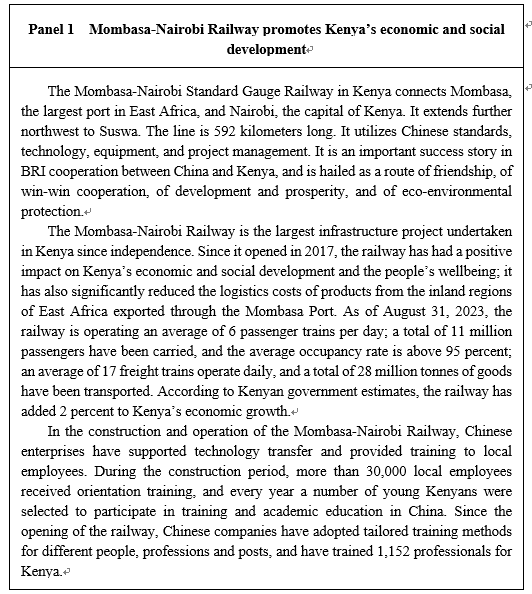
In Africa, railways such as the Mombasa-Nairobi Railway and the Addis Ababa-Djibouti Railway are now operational and have become important drivers of in-depth development not only in East Africa but across the entire continent.
Maritime connectivity is steadily improving. Cooperation is expanding in shipping among the ports of participating countries, and the efficiency of cargo transportation has seen notable increase.
The annual cargo throughput of the Port of Piraeus in Greece has increased to above 5 million twenty-foot equivalent units (TEUs), making it the fourth largest TEU port in Europe and a leading TEU port in the Mediterranean.
The Gwadar Port in Pakistan has seen major progress and is marching towards the goal of becoming a logistics center and industrial base.
Preliminary work is currently under way on the Kyaukphyu Deep-sea Port project in Myanmar, including geological exploration and environmental and social assessment.
The annual throughput of bulk cargo at Hambantota Port in Sri Lanka has increased to 1.21 million tonnes.
The Vado Gateway terminal has become the first semi-automatic terminal operating in Italy.
The Lekki Deep-sea Port in Nigeria has been completed and entered service, becoming a major modern deepwater port in Central and Western Africa.
The Silk Road Maritime network has continued to expand. By the end of June 2023, it had reached 117 ports in 43 countries, and more than 300 well-known Chinese and international shipping companies, port enterprises and think tanks, among other bodies, have joined the Silk Road Maritime association.
A marine environment forecast and support system that focuses on areas along the Maritime Silk Road offers services to more than 100 cities in participating countries.
The Air Silk Road has made notable progress. The aviation route network between participating countries is expanding rapidly, and the level of air connectivity is steadily improving.
China has signed bilateral air transport agreements with 104 BRI partner countries and opened direct flights with 57 partner countries to facilitate cross-border transport.
Chinese enterprises are active participants in civil aviation infrastructure cooperation with partner countries including Pakistan, Nepal and Togo, helping to develop the local civil aviation industry.
A BRI cooperation platform proposed by the Civil Aviation Administration of China was established in August 2020, improving mechanisms and platforms of civil aviation exchanges and cooperation among participating countries.
During the Covid-19 pandemic, a direct line of the Air Silk Road linking Zhengzhou in Henan Province and Luxemburg did not suspend its air or freighting services, and transported a large amount of supplies. It served as an air lifeline between China and Europe, and contributed to keeping international industrial and supply chains stable.
International inter-modality transport channels continue to enjoy stable development. These channels include the China-Europe Railway Express, the China-Europe Land-Sea Express Line, the New International Land-Sea Trade Corridor, and the Lianyungang-Khorgos New Eurasian Land-Sea Expressway.
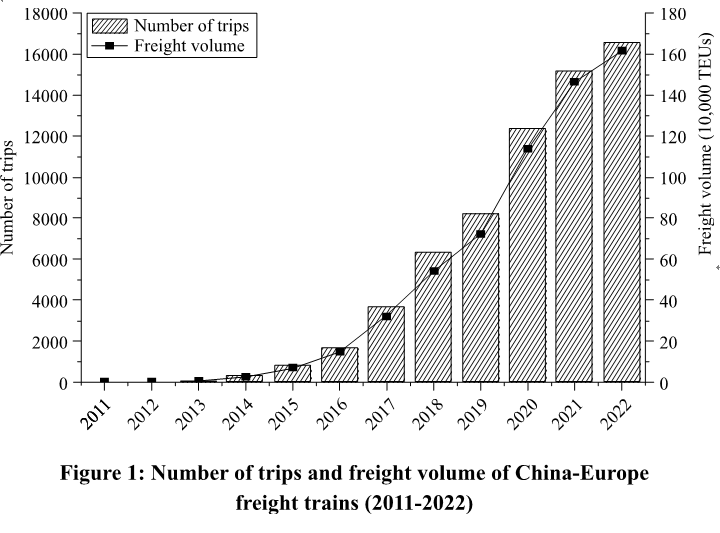
The China-Europe Railway Express has now reached more than 200 cities in 25 European countries, comprising 86 routes passing through the main regions of the Eurasian hinterland at a speed of 120 km per hour. Its logistics distribution network covers the entire Eurasian continent. By the end of June 2023, the cumulative volume of the China-Europe Railway Express had exceeded 74,000 trips, transporting nearly 7 million TEUs and over 50,000 types of goods in 53 categories such as automobiles, mechanical equipment, and electronic products, to a total value of more than US$300 billion.
The China-Europe Land-Sea Express Line has emerged from scratch to become the third trade channel between China and Europe, after traditional sea routes and the China-Europe Railway Express. In 2022, more than 180,000 TEUs were transported through this line, with rail trips exceeding 2,600.
The routes of rail-sea freight trains of the New International Land-sea Trade Corridor cover 18 provinces and equivalent administrative units, in central and western China, transporting goods to 300-plus ports in more than 100 countries.
3. Unimpeded, convenient and efficient trade
Facilitating trade and investment is a major task in building the Belt and Road. The participating countries have worked hard to promote trade and investment liberalization and facilitation, remove investment and trade barriers, and improve the business environment within the region and in all related countries. Efforts have been made to build free trade zones, broaden trading areas, improve trade structure, expand areas of mutual investment and industrial cooperation, establish a more balanced, equal and sustainable trading system, and develop mutually beneficial economic and trade relations, so as to make the “pie” of cooperation bigger.
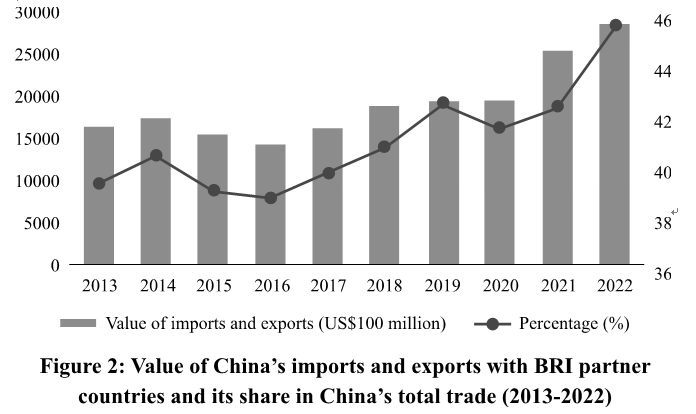
Trade and investment are expanding steadily. From 2013 to 2022, the cumulative value of imports and exports between China and BRI partner countries reached US$19.1 trillion, with an average annual growth rate of 6.4 percent. The cumulative two-way investment between China and partner countries reached US$380 billion, including US$240 billion from China. The value of newly signed construction contracts with partner countries reached US$2 trillion, and the actual turnover of Chinese contractors reached US$1.3 trillion. In 2022, the value of imports and exports between China and partner countries reached nearly US$2.9 trillion, accounting for 45.4 percent of China’s total foreign trade over the same period, representing an increase of 6.2 percentage points compared with 2013; the total value of imports and exports of Chinese private enterprises to partner countries exceeded US$1.5 trillion, accounting for 53.7 percent of the trade between China and these countries over the same period.
Trade and investment liberalization and facilitation is improving. BRI participating countries continue to uphold multilateralism and free trade, working hard to create a sound institutional environment for closer economic and trade relations. Positive progress has been made in the alignment of working systems, coordination of technical standards, mutual recognition of inspection results, and online verification of electronic certificates.
By the end of August 2023, more than 80 countries and international organizations had subscribed to the Initiative on Promoting Unimpeded Trade Cooperation Along the Belt and Road, proposed by China. China had signed 21 free trade agreements with 28 countries and regions. On January 1, 2022, the Regional Comprehensive Economic Partnership (RCEP) agreement entered into force, creating the world’s largest free trade zone in terms of population size and trade volume. The RCEP and the BRI overlap and complement each other in terms of participating countries and regions, as well as areas and contents of cooperation, forming a new dynamic of economic and trade cooperation in Asia.
China also works actively towards joining the Comprehensive and Progressive Agreement for Trans-Pacific Partnership and the Digital Economy Partnership Agreement.
China has signed bilateral investment agreements with 135 countries and regions, and conventions for the avoidance of double taxation (including arrangements and agreements) with 112 countries and regions. It has achieved Authorized Economic Operator mutual recognition with 35 partner countries, and has signed third-party market cooperation documents with 14 countries.
China has established a “single-window” cooperation mechanism with Singapore, Pakistan, Mongolia, Iran and other partner countries, and signed cooperation documents on customs inspection and quarantine, effectively improving the efficiency of customs clearance at border ports.
Trade and investment platforms are playing a growing role. China International Import Expo (CIIE) is the world’s first import-themed national-level expo and has been held for the past five years. It has resulted in a cumulative intended turnover of nearly US$350 billion, and about 2,000 launches of new products. With diverse participants from many countries and regions, the CIIE has become a global platform for international procurement, investment promotion, cultural exchanges, and open cooperation.
The influence of key exhibitions continues to expand; these include China Import and Export Fair (Canton Fair), China International Fair for Trade in Services, China International Fair for Investment and Trade, China International Consumer Products Expo, Global Digital Trade Expo, China-Africa Economic and Trade Expo, China-Arab States Expo, China-Russia Expo, China-CEEC Expo & International Consumer Goods Fair, China-ASEAN Expo, and China-Eurasia Expo. All of these have provided a strong boost to trade and investment cooperation among participating countries.
The Hong Kong SAR has held the Belt and Road Summit eight times, and the Macao SAR has held the International Infrastructure Investment and Construction Forum 14 times, which have played an important role in advancing economic, trade and investment cooperation along the Belt and Road.
Industrial cooperation is deepening. BRI participating countries have worked hard to foster a paradigm of cooperation based on coordinated development, mutual benefit, and win-win outcomes, which has given a strong boost to upgrading industrial structures and optimizing industrial chains in the countries involved.
The participating countries have jointly promoted cooperation on industrial capacity, expanded cooperation in traditional industries including steel, non-ferrous metals, building materials, automobiles, engineering machinery, resources and energy, and agriculture, explored cooperation in emerging industries such as the digital economy, new energy vehicles, nuclear energy and technology, and 5G, and carried out tri-party and multiparty market cooperation, thus advancing mutual complementarity and providing mutual benefits to all parties.
By the end of June 2023, China had signed agreements on industrial capacity cooperation with more than 40 countries. China Mining Conference & Exhibition and China-ASEAN Mining Cooperation Forum & Exhibition serve as important platforms for participating countries to conduct mining capacity cooperation.
The Shanghai Cooperation Organization (SCO) Demonstration Base for Agricultural Technology Exchange and Training has supported advances in agricultural science and technology under the BRI, and promoted economic and trade cooperation in agriculture among participating countries.
Jointly constructed by China and Pakistan, the K2 and K3 units of the Karachi Nuclear Power Plant have been completed and are in operation, utilizing China’s Hualong One nuclear technology.
The Ulba Fuel Assembly Plant, a successful joint venture between China and Kazakhstan, is now operational.
The China-ASEAN Forum on Peaceful Uses of Nuclear Technology has served as a bridge to establish connectivity, enabling BRI participating countries to cooperate on nuclear technology and promote growth and people’s wellbeing.
More than 70 overseas industrial parks have been built by Chinese enterprises together with governments and enterprises in partner countries. The China-Malaysia and China-Indonesia “Two Countries, Twin Parks” projects, the China-Belarus Great Stone Industrial Park, the China-UAE Industrial Capacity Cooperation Demonstration Zone, and the China-Egypt TEDA Suez Economic and Trade Cooperation Zone are making steady progress.
4. Diverse dynamics of financial integration
Financial integration is an important pillar of BRI cooperation. Participating countries and relevant institutions have carried out multiple forms of financial cooperation, created new models, expanded the channels, diversified the parties involved, and improved the mechanisms for investment and financing. They have promoted policy-based finance, development finance, commercial finance, and cooperative finance to support BRI cooperation, and worked to build a long-term, stable and sustainable investment and financing system that keeps risk under control.
The financial cooperation mechanisms are maturing. China Development Bank (CDB) has promoted the establishment of multilateral financial cooperation mechanisms such as China-Central and Eastern Europe Interbank Consortium, the China-Arab Countries Interbank Association, China-ASEAN Interbank Association, the ASEAN Plus Three Interbank Cooperation mechanism, China-Africa Interbank Association, and the Association of China-LAC Development Financial Institutions. The Industrial and Commercial Bank of China (ICBC) has promoted the Belt and Road Interbank Regular Cooperation (BRBR) mechanism.
As of the end of June 2023, a total of 13 Chinese-funded banks had established 145 first-tier offices and branches in 50 BRI partner countries; some 17.7 million businesses in 131 partner countries had opened UnionPay services, and 74 partner countries had opened UnionPay mobile payment services. The Belt and Road Innovation and Development Center, the Research Center for Belt and Road Financial and Economic Development, and the China-IMF Capacity Development Center have been established.
China has signed bilateral currency swap agreements with 20 partner countries and established renminbi (RMB) clearing arrangements in 17 partner countries. The number of participants, business volume, and influence of the RMB cross-border payment system have gradually increased, effectively facilitating trade and investment.
Financial regulation cooperation and exchanges have continued to move forward. China Banking and Insurance Regulatory Commission (now National Administration of Financial Regulation), China Securities Regulatory Commission (CSRC), and regulatory agencies from multiple other countries have signed memorandums of understanding (MoUs) for regulatory cooperation, facilitating the establishment of regional regulatory coordination mechanisms, promoting efficient allocation of funds, strengthening risk control, and creating sound investment conditions for various financial institutions and investment entities.
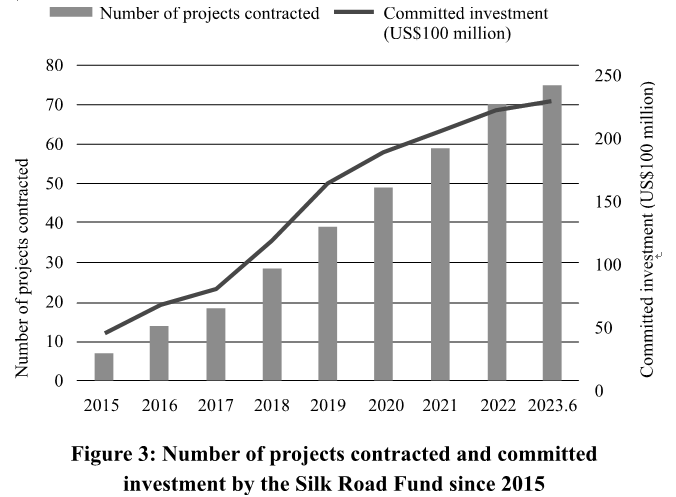
The channels and platforms for investment and financing are constantly expanding. China has funded the establishment of the Silk Road Fund (SRF) and established the Asian Infrastructure Investment Bank (AIIB) with other participating countries. The SRF specifically serves BRI cooperation. By the end of June 2023, the fund had signed agreements on 75 projects with committed investment of about US$22 billion; the number of AIIB members had reached 106, and the bank had approved 227 projects with a total investment of US$43.6 billion. The projects involve transport, energy, public health and other fields, providing investment and financing support for infrastructure connectivity and sustainable economic and social development.
China has actively participated in various existing financing arrangements. It has signed memorandums of cooperation with international financial institutions such as the World Bank and the Asian Development Bank, worked with international financial institutions to establish a multilateral development financing cooperation center, strengthened third-party market cooperation in investment and financing with the European Bank for Reconstruction and Development, and carried out joint financing with the International Finance Corporation, the African Development Bank and others. These moves have effectively mobilized market capital.
China has initiated the establishment of international economic cooperation funds such as the China-Eurasian Economic Cooperation Fund, the China-LAC Cooperation Fund, the China-Central and Eastern Europe Investment Cooperation Fund, the China-ASEAN Investment Cooperation Fund, the China-LAC Industrial Cooperation Investment Fund, and the China-Africa Fund for Industrial Cooperation. These have effectively expanded investment and financing channels for partner countries.
The CDB and the Export-Import Bank of China (China Eximbank) have each set up special loans for the BRI to pool resources to increase financing support for BRI cooperation. By the end of 2022, the CDB has provided direct high-quality financial services for more than 1,300 BRI projects, playing a leading role in guiding development finance, and pooling all kinds of domestic and foreign funds for BRI cooperation. The balance of loans of China Eximbank for BRI projects reached RMB2.2 trillion, covering 130-plus participating countries and driving more than US$400 billion of investment and more than US$2 trillion of trade. China Export & Credit Insurance Corporation has fully applied export credit insurance and actively provided comprehensive guarantees for building the Belt and Road.
Innovative investment and financing methods are steadily being explored. Various models such as funds and bonds have been developed, and BRI financial cooperation is improving.
China’s securities industry has set up a number of BRI-themed funds and indexes. In December 2015, the CSRC officially launched a pilot project for overseas institutions to issue RMB-denominated bonds (panda bonds) in China’s exchange-traded bond market. By the end of June 2023, overseas issuers in total had issued 99 panda bonds in China’s exchange-traded bond market, with a total value of RMB152.54 billion; 46 BRI-themed bonds had been issued, with a total value of RMB52.72 billion.
Green finance is steadily developing. In May 2019, the ICBC issued the first green BRBR bond that conformed to both international and domestic green bond standards. By the end of 2022, more than 40 large global institutions had signed the Green Investment Principles for the Belt and Road. In June 2023, China Eximbank issued financial bonds for promoting international cooperation in building the Belt and Road and supporting infrastructure construction of partner countries. China’s domestic stock and futures exchanges have steadily promoted practical cooperation in equity, products, technology and other fields with the exchanges in partner countries, and actively supported the development of exchanges participating in or holding shares in BRI projects, such as the Astana International Exchange in Kazakhstan, the Pakistan Stock Exchange, and the Dhaka Stock Exchange in Bangladesh.
Debt sustainability has continued to improve. Based on the principle of equal participation and benefit and risk sharing, China and 28 countries approved the Guiding Principles on Financing the Development of the Belt and Road, encouraging the governments, financial institutions and enterprises of participating countries to attach importance to debt sustainability and improve their debt management capability. Drawing on the debt sustainability framework of low-income countries endorsed by the International Monetary Fund and the World Bank, China has developed tools based on the actual conditions of participating countries, and issued the Debt Sustainability Framework for Participating Countries of the Belt and Road Initiative. All parties are encouraged to use it on a voluntary basis.
To avoid causing debt risk and financial burden to the countries where BRI projects are located, China has prioritized economic and social benefits and provided loans for project construction based on local needs and conditions. The key areas of investment are infrastructure projects designed to increase connectivity, and projects for public wellbeing urgently needed in participating countries. These have brought effective investment, increased high-quality assets, and boosted development momentum.
Many think tank experts and international institutions have pointed out that almost all the BRI projects are initiated by the host countries with the goals of growing their economies and improving their people’s lives. In the process, the logic of economics has taken precedence over geopolitics.
5. Solid foundations for people-to-people ties
People-to-people ties are the social foundations of BRI cooperation. The participating countries have passed on and carried forward the spirit of friendly cooperation of the ancient Silk Road, cooperated on exchanges in culture, tourism, education, think tank and the media, and promoted mutual learning among civilizations and cultural integration and innovation. A model of people-to-people exchanges characterized by dynamic interactions and diversity has underpinned public support for furthering the initiative.
Cooperation on culture and tourism is rich and colorful. By the end of June 2023, China had signed cultural and tourism cooperation documents with 144 BRI partner countries.
China has created cooperation platforms together with participating countries, including the Silk Road International League of Theaters, the Silk Road International Museum Alliance, the Network of Silk Road Arts Festivals, the Silk Road International Library Alliance, and the Silk Road International Alliance of Art Museums and Galleries. These platforms have a total of 562 members, including 326 cultural institutions from 72 partner countries.
China is steadily expanding international cultural exchanges. China has launched the Cultural Silk Road program, and organized signature events such as the Happy Chinese New Year celebrations, the Nihao China tourism promotions, and the Silk Road: Artists’ Rendezvous art exhibition. It has worked with Brunei, Cambodia, Greece, Italy, Malaysia, Russia and ASEAN to co-host cultural and tourism activities at designated years. China and BRI partner countries have hosted events in a reciprocal manner, ranging from cultural relics exhibitions, film festivals, arts festivals, book fairs and music festivals, and jointly translated and promoted each other’s publishing, radio, film and television programs. They have also implemented the BRI-themed theater arts creation and promotion project, the Belt and Road International Art Project, and the Belt and Road good-neighborliness cultural project, and worked to protect Asian cultural heritage. China has established 46 China cultural centers in 44 countries, of which 32 are partner countries. China has established 20 tourism offices in 18 countries, eight of which are in partner countries.
Educational exchanges and cooperation are extensive and profound. China has released the Education Action Plan for the Belt and Road Initiative to promote international education exchanges and cooperation. By the end of June 2023, China had signed agreements with 45 participating countries on the mutual recognition of higher education degrees.
China has set up the Silk Road Program under the Chinese Government Scholarship scheme. Some of China’s provinces and Hong Kong and Macao SARs, as well as universities and research institutions have also set up scholarships for students from BRI partner countries.
Chinese universities and colleges have opened 313 Confucius Institutes and 315 Confucius Classrooms in 132 partner countries. The “Chinese Bridge” Summer Camp has invited nearly 50,000 young people from more than 100 partner countries to come to China for academic visits, and supported 100,000 Chinese language enthusiasts from 143 partner countries to learn Chinese and experience Chinese culture online.
Chinese universities and colleges have worked with more than 20 counterparts in partner countries from Asia, Africa and Europe to build a number of Luban Workshops – a professional training program dedicated to the sharing of expertise by China’s vocational education institutions.
China and UNESCO have jointly held the International Youth Forum on Creativity and Heritage Along the Silk Roads and relevant activities in seven consecutive years, and established the Silk Roads Youth Research Grant which has funded 24 youth research projects. The Atomic Energy Scholarship of China has funded the education of nearly 200 Master’s and Doctoral students in the field of peaceful use of nuclear energy for 26 BRI partner countries.
Participating countries have capitalized on the demonstration and driving role of the University Alliance and the Alliance of International Science Organizations (ANSO) under the BRI framework, and expanded international exchanges and cooperation in talent training and scientific research.
Media and think tank cooperation has yielded fruitful results. BRI participating countries have held the Media Cooperation Forum on Belt and Road six times, and established the Belt and Road Media Community. The China-Arab States Forum on Radio and Television Cooperation, the Forum on China-Africa Media Cooperation, the China-Cambodia Radio and Television Annual Regular Cooperation Conference, the ASEAN-China Media Cooperation Forum, the Lancang-Mekong Audiovisual Week, and other bilateral and multilateral cooperation mechanisms have been set up. International organizations such as the Asia-Pacific Broadcasting Union and the Arab States Broadcasting Union have become active and important platforms for building consensus among participating countries.
Media outlets in China and partner countries have jointly established the Belt and Road News Network, which launched the Silk Road Global News Awards. By the end of June 2023, the network’s members had increased to 233 media outlets in 107 countries.
Think tank exchanges have become more frequent. The Advisory Council of the Belt and Road Forum for International Cooperation was established in 2018. The Silk Road Think Tank Association has recruited 122 partners in Asia, Africa, Europe, and Latin America. Sixteen Chinese and foreign think tanks have established the Belt and Road Studies Network.
People-to-people exchanges are constantly expanding. Non-governmental organizations (NGOs) continue to strengthen cooperation with the goals of benefiting the people, improving their lives, and connecting their hearts. At the people-to-people ties sub-forum of the Second Belt and Road Forum for International Cooperation, Chinese and foreign NGOs, including China NGO Network for International Exchanges, combined to launch the Silk Road Community Building Initiative, encouraging Chinese and foreign NGOs to establish nearly 600 cooperative partnership pairings and carry out more than 300 cooperation projects for improving people’s lives. Of these, some brand projects have achieved a wide impact, including the Shenzhen-Lancang-Mekong Cooperation to benefit the people in the Lancang-Mekong region with Shenzhen’s advanced products and technology, the Panda Pack Project to provide primary school students with learning supplies, and the Brightness Journey program to provide free cataract surgery to those in need.
Cities from 60-plus BRI partner countries have formed more than 1,000 pairs of friendly cities with their Chinese counterparts. A total of 352 NGOs from 72 countries and regions have formed a Silk Road NGO Cooperation Network, carrying out over 500 projects and various other activities, and becoming an important platform for exchanges and cooperation between NGOs in participating countries.
6. Steady progress in new areas
Leveraging their respective strengths, participating countries have continued to expand BRI cooperation into new fields and created innovative cooperation models, achieving great progress in building a healthy, green, innovative and digital Silk Road and further broadening the space for international cooperation.
Notable achievements have been made in health cooperation. To establish closer partnerships in health cooperation, participating countries are working hard to build a Health Silk Road and a global community of health for all. By the end of June 2023, China had signed an MoU with the WHO on health cooperation in BRI partner countries, inked health cooperation agreements with more than 160 countries and international organizations, and initiated or participated in nine international and regional health cooperation mechanisms, including China-Africa Health Cooperation, China-Arab States Health Cooperation, and China-ASEAN Health Cooperation.
Relying on mechanisms and platforms such as the Belt & Road Health Professionals Development Alliance, the Belt & Road Hospital Cooperation Alliance, the Belt & Road Health Policy Research Network, and the China-ASEAN Human Resources Training Program of Health Silk Road (2020-2022), China has helped BRI partner countries to train tens of thousands of professionals in health management, public health and medical research. It has also dispatched medical teams to 58 partner countries, and provided free treatment for nearly 10,000 cataract patients in more than 30 partner countries through the Brightness Journey program. In addition, China has sent several rounds of medical aid to island states of the South Pacific, and carried out international medical cooperation with neighboring countries, including countries of the Greater Mekong Subregion, Central Asian countries, and Mongolia.
After the outbreak of Covid-19, China provided assistance to more than 120 BRI partner countries to combat the pandemic, and sent 38 expert medical teams to 34 countries. It started the Initiative for Belt and Road Partnership on Covid-19 Vaccines Cooperation together with 31 countries, delivered more than 2 billion doses of vaccines to partner countries, and conducted joint vaccine production with more than 20 countries, improving vaccine affordability and accessibility in developing countries.
In addition, China has signed documents on traditional medicine cooperation with 14 BRI partner countries; eight partner countries have taken measures to support the development of traditional Chinese medicine (TCM) within the framework of their respective legal systems; 30 overseas TCM centers have been built; and 100-plus TCM drugs have been registered and marketed in partner countries.
Remarkable progress has been achieved in green and low-carbon development. China is working together with partner countries and international organizations to build a cooperation mechanism for green and low-carbon development under the BRI framework, promote green development, and address climate change.
China has issued documents such as the Guidance on Promoting Green Belt and Road and the Guidelines on Jointly Promoting Green Development of the Belt and Road, and set itself the ambitious goal of forming a basic framework of green development through BRI cooperation by 2030. China has also signed an MoU with the United Nations Environment Programme on building a green Belt and Road for 2017-2022, reached environmental cooperation agreements with more than 30 countries and international organizations, launched the Initiative for Belt and Road Partnership on Green Development together with 31 countries, formed the Belt and Road Initiative International Green Development Coalition with more than 150 partners from 40-plus countries, and established the Belt and Road Energy Partnership with 32 countries.
China has pledged to stop building new coal-fired power stations overseas, and to actively build green finance platforms and international cooperation mechanisms. It stands ready to cooperate with partner countries on research into biodiversity conservation, safeguarding the eco-environmental security of the Maritime Silk Road, building the Belt and Road Big Data Service Platform on Ecological and Environmental Protection and the Belt and Road Environmental Technology Exchange and Transfer Center, and implementing the Green Silk Road Envoys Program.
China is actively promoting the Belt and Road South-South Cooperation Initiative on Climate Change. It has signed 47 South-South MoUs on climate change with 39 partner countries, built low-carbon demonstration zones with Laos, Cambodia, and Seychelles, carried out more than 70 climate change mitigation and adaptation projects with 30-plus developing countries, and trained more than 3,000 environment management personnel and experts from more than 120 countries.
In May 2023, China Eximbank, together with a dozen financial institutions including China Development Bank, and China Export & Credit Insurance Corporation, released the Initiative for Supporting Belt and Road Energy Transition with Green Finance, calling on all parties involved to strengthen support for green and low-carbon energy transition in BRI participating countries.
Cooperation in scientific and technological innovation is gathering speed. BRI participating countries are strengthening cooperation on innovation, facilitating technology transfer and knowledge sharing, optimizing the innovation-enabling environment, and pooling innovation resources. They are also building up their capacity for scientific and technological innovation through cooperation in major projects and talent training.
In October 2016, China released the Special Plan on Advancing Belt and Road Cooperation in Scientific and Technological Innovation. In May 2017, the Action Plan on Belt and Road Cooperation in Scientific and Technological Innovation was implemented, to increase the capacity for innovation in BRI participating countries through pragmatic measures such as joint research, technology transfer, exchanges in science, technology and culture, and cooperation between high-tech industrial parks.
By the end of June 2023, China had signed intergovernmental agreements on scientific and technological cooperation with more than 80 BRI partner countries, and 58 members had joined the ANSO. Since 2013, China has hosted more than 10,000 young scientists from partner countries in carrying out short-term research and exchanges in China, and trained more than 16,000 technicians and management professionals for partner countries; China has established nine cross-border technology transfer platforms targeting ASEAN, South Asia, Arab states, Africa, Latin America, and other regions; China has assisted 22 African countries to build 23 agricultural technology demonstration centers, and set up 50-plus BRI joint laboratories in areas such as agriculture, new energy, and health.
China has signed an agreement with the World Intellectual Property Organization (WIPO) on strengthening BRI cooperation on intellectual property and additional agreements on subsequent revision and prolongation of the said agreement. China and the WIPO have jointly hosted twice the High-level Conference on Intellectual Property for Countries Along the Belt and Road, and released a joint initiative and a joint statement on strengthening cooperation on intellectual property. To date, China has established intellectual property cooperation relationships with more than 50 partner countries and international organizations, whose goal is to create an innovation and business environment in which the value of knowledge is duly respected.
Digital silk road cooperation presents numerous highlights. BRI participating countries have joined to create an open, fair, equitable and non-discriminatory environment for digital development by strengthening facilitation of and cooperation on rules and standards and promoting regional policy coordination.
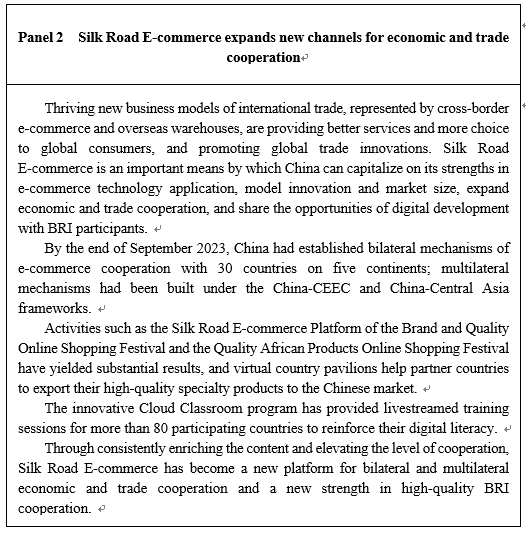
By the end of 2022, China had signed MoUs on building the Digital Silk Road with 17 countries, MoUs on e-commerce cooperation with 30 countries, and MoUs on closer investment cooperation in the digital economy with 18 countries and regions. It has proposed and worked to launch the Global Initiative on Data Security, the Belt and Road Digital Economy International Cooperation Initiative, the initiative for building the ASEAN-China Partnership on Digital Economy Cooperation, the China-League of Arab States Cooperation Initiative on Data Security, the China + Central Asia Data Security Cooperation Initiative, and the BRICS Digital Economy Partnership Framework, among others. It also took lead in formulating the Framework of Standards on Cross-border E-commerce.
China is active in strengthening digital infrastructure connectivity and is stepping up work on digital corridors. Several international submarine cables have made positive progress, and 130 cross-border terrestrial cable systems have been built.
China has built many 5G base stations, data centers, cloud computing centers and smart cities, and promoted digital upgrading and transformation of traditional infrastructure such as ports, railways, highways, energy networks and water conservancy facilities.
A number of key projects such as the China-ASEAN Information Harbor, and the digital platform of China-Europe Railway Express and the China-Arab Online Silk Road is making good progress, and the DBAR Big Earth Data Platform has realized multilingual data sharing.
The construction of the Belt and Road Initiative Space Information Corridor has been a resounding success. China has built teleports connecting South Asia, Africa, Europe, and the Americas. The data from remote sensing satellites under the China-Brazil Earth Resources Satellite (CBERS) program is widely used in multiple countries and fields. The BeiDou navigation satellite system (BDS-3) provides comprehensive services for China-Europe Railway Express, and in maritime transport and other fields.
China and a number of BRI partner countries and regions have combined to develop and launch communication or remote sensing satellites, and constructed satellite ground stations and other space infrastructure. Through the Regional Centre for Space Science and Technology Education in Asia and the Pacific (China) affiliated to the United Nations, China has trained a large number of space professionals for partner countries. Together with other countries and regions, China has built the China-GCC Joint Center for Lunar and Deep Space Exploration, the China-UAE Space Debris Joint Monitoring Center, the Lancang-Mekong Cooperation Center for Earth Observation Data, the China-ASEAN Satellite Remote Sensing Application Center, and the China-Africa Cooperation Center on Satellite Remote Sensing Application. The CNSA-GEO platform, the Belt and Road Analysis and Early Warning Platform for Typical Meteorological Disasters, and the Natural Resources Satellite Remote Sensing Cloud Service Platform now serve many partner countries.
IV. Injecting Positive Energy into World Peace and Development
Over the past decade, BRI cooperation has witnessed remarkable results. It has opened up new space for world economic growth, built a new platform for international trade and investment, reinforced the development capacity of relevant countries and improved people’s lives, sought ways to improve the global governance system, and brought greater certainty and stability to a world fraught with turbulence and change. The BRI has boosted China’s development and benefited the rest of the world.
1. Bringing tangible benefits to participating countries
Development is an eternal theme for humanity. The BRI has focused on the fundamental issue of development, addressing the weaker links and bottlenecks that hinder development, building new engines for economic development, and creating a new development environment and space for participating countries. This has strengthened their confidence and their capacity for development, and improved their people’s lives. The initiative has contributed to addressing global development imbalance and advancing modernization in all countries.
Boosting development in participating countries. Over the last 10 years, the BRI has addressed the major bottlenecks restricting connectivity and economic growth in most of the developing countries. A large number of infrastructure projects have been built, with significant progress for participating countries in the construction of railways, highways, pipelines, shipping, energy, communications and other basic public service facilities. This has improved local living and working conditions and the development environment, and boosted their capacity for independent economic development.
Some engineering projects with a long construction cycle are like seeds sown in a field, gradually generating comprehensive benefits for the long term. Connectivity in infrastructure has effectively reduced the cost for countries to participate in international trade, increased their access to the global economy, and stimulated the potential and impetus for their development. Research by the Asian Development Bank shows that lowering a land-locked country’s trade costs by 10 percent through improvement in infrastructure could increase its exports by 20 percent.
Industrial capacity cooperation has promoted industrialization, digitization, informatization, and the structural upgrading of industries in participating countries. It has helped them to form competitive industrial systems and expand the breadth and depth of their participation in the international division of labor and cooperation, creating more opportunities and greater space for development.
China has actively conducted international cooperation in emergency management. It has sent rescue teams to Nepal, Mozambique, Türkiye and other countries to carry out humanitarian operations following earthquakes and floods, and provided emergency supplies and technical support to Tonga and Madagascar, among other countries.
Building poverty reduction capacity in participating countries. Developing countries still face the challenge of problems related to food. China has taken an active part in global food and agriculture governance. It has released the Vision and Action on Jointly Promoting Agricultural Cooperation Along the Belt and Road with partner countries, and signed more than 100 agricultural and fishery cooperation documents with almost 90 partner countries and international organizations. Its trade in agricultural products with BRI partners has reached US$139.4 billion. China has sent more than 2,000 agricultural experts and technicians to over 70 countries and regions, and introduced more than 1,500 agricultural technologies such as Juncao and hybrid rice to many of these countries. It has helped with rural poverty reduction in Asia, Africa, the South Pacific, Latin America, and the Caribbean, developing modern agriculture and helping to increase farmers’ incomes.
Boosting employment is an important element of poverty reduction. In the process of BRI cooperation, China has helped to construct industrial parks with participating countries and provided guidance for Chinese enterprises to create jobs for local residents through high-level industrial cooperation. The jobs provided to locals have helped to lift their families out of poverty. A McKinsey survey revealed that Chinese firms in Africa recruited 89 percent of their employees locally, contributing to local employment in an effective way.
The World Bank has estimated that by 2030, BRI-related investments could lift 7.6 million out of extreme poverty and 32 million out of moderate poverty.
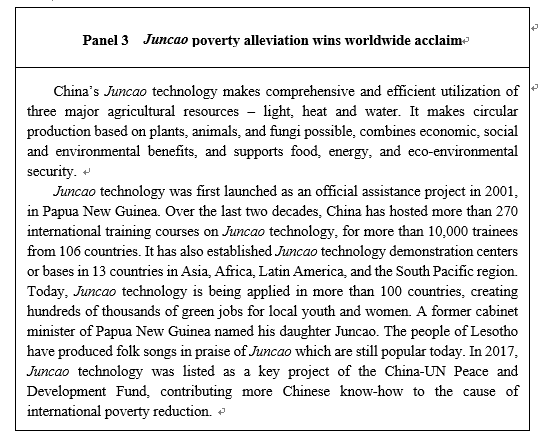
Delivering notable results in projects that improve people’s lives. Chinese firms have repaired and maintained bridges to make it easier for local residents to travel. They have drilled wells to meet local villagers’ needs for drinking water. They have installed street lamps for pedestrians to see clearly on their way home at night. Many such seemingly small projects have solved urgent problems for local people and improved their daily lives. They have brought tangible benefits to the people of participating countries, and increased their sense of gain, fulfillment and security.
Over the last 10 years, Chinese firms have launched more than 300 poverty alleviation, health care and rehabilitation, and Happy Home projects in participating countries. They have helped with the construction of the headquarters of Africa Centres for Disease Control and Prevention and the China-Pakistan Fraternity Emergency Care Center in Gwadar, Pakistan. They have also helped Cameroon, Ethiopia, Djibouti and other countries to provide clean drinking water for the local people.
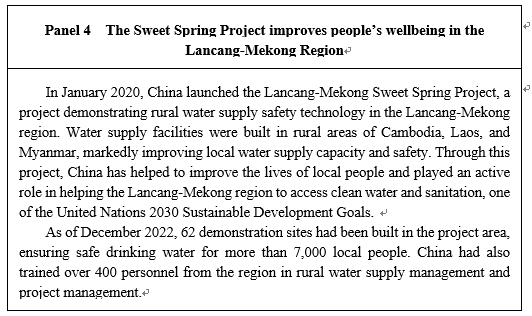
The Silk Road Community Building Initiative has promoted projects in more than 20 areas, including poverty alleviation and disaster relief, humanitarian assistance, environmental protection, and women’s exchanges and cooperation. Related activities have had an extensive impact.
2. Adding vitality to economic globalization
Against a rising tide of de-globalization, the BRI is committed to global connectivity and interconnected development. It has further opened up the main arteries of economic globalization, facilitated the flow of information, capital, technology, product, industry and people, and promoted closer and broader international cooperation. By expanding economic globalization and distributing its benefits fairly, the BRI aims to promote global development that is balanced, coordinated, inclusive and shared by all, and that brings win-win cooperation and common prosperity.
Boosting the momentum for global development. The BRI has connected the vibrant East Asia economic circle at one end, the developed European economic circle at the other, and the countries in between with huge potential for economic development, and fostered closer economic cooperation with African and Latin American countries. It has formed a new global development dynamic in which the Eurasian continent is fully connected with the Pacific, Indian and Atlantic oceans, and the land is integrated with the sea. It has expanded the scope and coverage of the international division of labor in a broader economic and geographical space, and enlarged the global market, which ultimately promoted new global economic growth.
At the same time, through infrastructure connectivity, the BRI has proved a catalyst to international investment and boosted global interest in and enthusiasm for investment in infrastructure, which provides economic growth and rapid development in participating countries. These efforts have effectively addressed the shortage of international public goods and provided sustained impetus for world economic growth.
Encouraging deeper regional economic cooperation. In strengthening infrastructure connectivity, the BRI promotes connectivity between countries in many directions and various fields. The BRI turns dots into lines and lines into fields, gradually amplifying the radiation effect of development. It encourages countries to coordinate economic policies, systems and mechanisms, and innovate cooperation models, conduct broader, deeper and closer regional cooperation, and jointly create an open, inclusive and balanced regional economic cooperation architecture that benefits all. It has facilitated a freer and more orderly flow of economic factors, more efficient allocation of resources, and deeper integration of markets, and upgraded economic and trade connectivity and vitality between countries and regions, and the overall position of participating countries in global industry chains, supply chains, and value chains.
Participating countries have made full use of their own factor endowments to integrate, coordinate, and upgrade their industry chains, promote industrial complementarity, and improve the efficiency of division of labor. They have broken down trade barriers and market monopolies, unleashed internal and cross-border consumption potential, and expanded the scale of regional markets. Through technology transfer and cooperation in industrial cooperation, they have established technology interaction and interdependence, strengthened capacity for innovation, and promoted leapfrog development.
Promoting global trade. The BRI supports the liberalization and facilitation of trade and investment by building transport and information infrastructure in a planned and progressive manner. It has eliminated internal, transnational, and inter-regional transport bottlenecks and barriers to trade and investment cooperation, made cross-border logistics and foreign trade easier and more convenient, and increased the efficiency of domestic and international cooperation. It has built up an all-round, multi-level and complex network of unimpeded trade, creating a new dynamic and greatly facilitating global trade.
At the same time, the BRI has made participating countries more attractive to quality global capital, and contributed to rising direct cross-border investment in these countries. In 2022, cross-border direct investment inflows in Southeast Asia accounted for 17.2 percent of the global total, 9 percentage points higher than in 2013. The inflow of FDI into Kazakhstan grew by a historical high of 83 percent year on year.
World Bank study – “Belt and Road Economics: Opportunities and Risks of Transport Corridors” – estimates that prior to the BRI, the six corridor economies undertrade with each other and the rest of the world by 30 percent on average and they fall short of their absorptive potential of FDI by 70 percent. Transport infrastructure projects under the BRI would reduce trade costs for the world by 1.8 percent, and reduce trade costs along the China-Central Asia-West Asia economic corridor by 10 percent. This has greatly facilitated global trade and boosted economic growth. The study projects that trade growth would range between 2.8 and 9.7 percent for corridor economies and between 1.7 and 6.2 percent worldwide, and global real income is expected to increase by 0.7 to 2.9 percent.
Maintaining the stability of global supply chains. An efficient and interconnected international transport corridor established under the BRI framework plays an important role in maintaining the stability and smooth flow of global supply chains.
During the Covid-19 outbreak, ports and logistics companies canceled or reduced services for shipping and freight transport, which had dealt a hard blow to those global supply chains which were highly dependent on shipping.
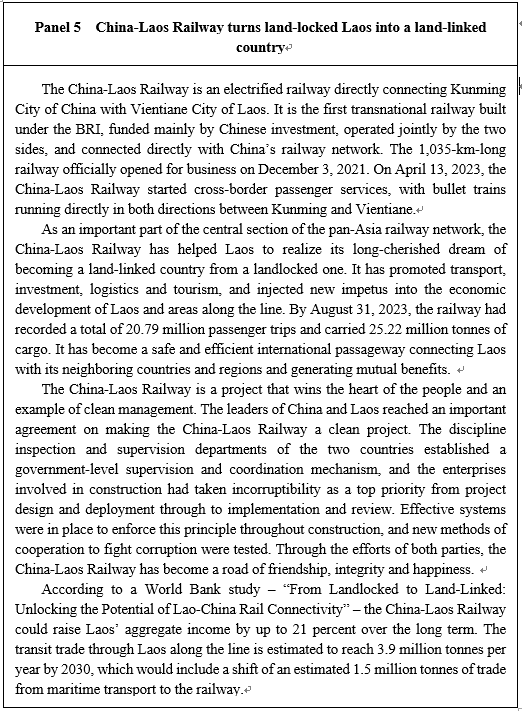
As a key output of BRI cooperation, the China-Europe Railway Express effectively sustained rail connectivity on the Eurasian continent, boosted sea-rail, road-rail, air-rail, and other forms of multi-modal transport, and opened up a new transport corridor for the Eurasian continental supply chain. Together with the innovations in customs clearance such as the Customs-Train Operators Partnership for Secure and Expedited Clearance of CR Express Carried Goods (C-TOP), Rapid Customs Clearance for rail service, China made an important contribution to stabilizing the global economy.
Several well-known international logistics associations have stated publicly that the China-Europe Railway Express has provided the world with a reliable logistics solution that can effectively alleviate tensions in the global supply chain and strengthen international logistics.
3. Providing new solutions for improving global governance
The deficit in global governance presents a severe challenge to the whole world. The BRI supports genuine multilateralism, and cherishes shared growth through consultation and collaboration in global governance. It advocates dialogue rather than confrontation, removing walls rather than erecting walls, integration rather than decoupling, and inclusiveness rather than exclusion. This is a new paradigm for state-to-state relations that shapes the international order towards greater justice and equality.
Gaining more recognition for the concept of global governance. The BRI’s core principles of “extensive consultation, joint contribution, and shared benefits” have appeared in important documents from international organizations and mechanisms, including the UN and the Forum on China-Africa Cooperation.
The vision of a global community of shared future has developed deep roots. A number of bilateral communities have been built between China and other countries, including Laos and Pakistan. Steady progress has been made in building multilateral communities, including those between China and Africa, the Arab States, Latin America, ASEAN, Central Asia and Pacific Island countries. Practical results have been achieved in building communities in functional areas, including cyber space, maritime cooperation, and health for all.
According to the China’s National Image Global Survey released by the Academy of Contemporary China and World Studies in 2020, the BRI is the Chinese proposal with the highest level of acceptance overseas, with more than 70 percent of respondents recognizing the positive impact of the BRI on individuals, states and global governance. European think tank Bruegel released a paper titled “Global Trends in Countries’ Perceptions of the Belt and Road Initiative” in April 2023, which noted that the BRI is generally positively received in the world, and Central Asia and sub-Saharan Africa, in particular, exhibit strongly positive sentiment towards the BRI.
Improving multilateral governance mechanisms. The BRI upholds the principles of mutual respect and equality, openness, inclusiveness, and win-win results. It enshrines multilateralism by securing international fairness and justice, and protecting the rights and interests of developing countries.
The BRI helps improve the existing multilateral governance mechanisms by firmly upholding the authority and status of the UN, and striving to consolidate and strengthen the stature and effectiveness of global multilateral governance platforms such as the WTO. It actively promotes new multilateral governance mechanisms such as the Asian Infrastructure Investment Bank, and works with participating parties to promote governance mechanisms in emerging areas such as the deep sea, polar regions, outer space, internet and artificial intelligence.
The BRI has strengthened the position and role of developing countries and emerging economies in the world market system, and increased their discourse power in regional and global economic governance. As a result, the aspirations and concerns of developing countries are increasingly included in the global agenda – a significant improvement in global governance.
Innovating and optimizing global governance rules. Taking into account the differences in the level of economic development, factor endowments, and cultural and religious traditions of relevant parties, the BRI has not preset any rules and standards, nor does it draw ideological lines. Instead, it formulates new rules to solve new problems through full consultation and in-depth exchanges, based on the wishes and needs of the parties involved.
BRI participating countries seek synergy in their strategies, plans, mechanisms, projects, and rules and standards, which helps to optimize the rules for BRI cooperation, and supports the transition from opening up based on the flow of goods and factors of production to opening up based on rules and related institutions. Some rules and standards with strong potential for universal application have been formulated in this process, which has effectively filled in gaps in the global governance system in these areas.
4. Garnering strength for the progress of human civilization
Exchanges and mutual learning among civilizations drive human progress and global peace and development. In contrast to those who persist with black and white thinking, concoct such concepts as the “clash of civilizations” and “superiority of Western civilization”, and provoke large-scale ideological confrontation, the BRI advocates equality, mutual learning, dialogue, and inclusiveness among civilizations, and promotes the shared values of humanity. It has charted a path of exchanges and mutual learning among civilizations for all to prosper individually and?collectively, in order to achieve closer ties among peoples and link up the cultures and hearts of all countries.
Improving the mechanisms for people-to-people exchanges. People-to-people exchanges cover a wide range of areas, including politics, culture, the arts, sports, and education. The global influence of various multilateral and bilateral political party exchange mechanisms has increased with the creation of mechanisms such as the CPC and World Political Parties Summit, and the CPC in Dialogue with World Political Parties High-level Meeting. The leading role of high-level inter-party exchanges garners consensus and strengths for stronger people-to-people ties.
Various BRI cooperation mechanisms have emerged, including the Silk Road Think Tank Association, the Belt and Road Initiative Tax Administration Cooperation Mechanism, the ANSO, the Belt and Road Health Professionals Development Alliance, the Silk Road International League of Theaters, and the Silk Road International Museum Alliance. The emergence of such mechanisms has facilitated people-to-people exchanges in diverse forms, promoting mutual understanding, mutual respect, and mutual appreciation among the peoples of all countries.
China, Kyrgyzstan, Iran and other Central and West Asian countries jointly launched the Alliance for Cultural Heritage in Asia – the first international cooperation mechanism regarding Asian cultural heritage – to protect cultural heritage, the tangible carriers of civilization. The projects under the framework of the alliance, for example the protection and restoration of Uzbekistan’s ancient city of Khiva, have been highly commended by UNESCO.
Creating quality brand projects and activities. Several projects and activities have become popular and attracted widespread public participation. Examples include the Silk Road (Dunhuang) International Cultural Expo, the Belt and Road/Great Wall International Folk Culture and Arts Festival, the Silk Road International Arts Festival, the Maritime Silk Road International Arts Festival, the Belt and Road Youth Story, and the Tea Road Cultural Tourism Expo.
Cultural and people-to-people exchange programs have won wide acclaim, including the Silk Road Community Building Initiative, the Kit of Love of medical supplies, Luban Workshops of technical vocational training, the Happy Spring well-drilling project, the Brightness Journey program of free cataract surgeries, the Panda Pack Project of school supplies, the Amity Torch Program of educational assistance, the Belt and Road Tour of Acupuncture-Moxibustion promoting traditional Chinese medicine therapies, and the Confucius Classroom of cultural exchanges.
As these goodwill activities, quality brands, and signature projects continue to emerge, they have become an important means through which all parties can join to strengthen people-to-people ties. This reinforces the sense of identity and belonging of the peoples of all BRI participating countries.
Galvanizing the power of youth. The future of the BRI belongs to the youth. Over the last 10 years, young people in participating countries have engaged proactively in people-to-people exchanges and programs that create a better life. The younger generation has galvanized the tremendous power of youth for strengthening people-to-people bonds and realizing common development.
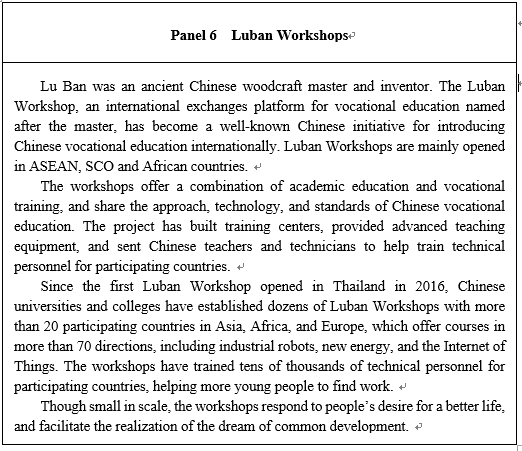
The Chinese Youth Global Partnership has received a positive response from all over the world. More than 100 national youth organizations and international organizations have established ties and cooperative relations with China.
Sixteen events of the Belt and Road Youth Story have attracted more than 1,500 young people from participating countries. Focusing on poverty alleviation and reduction, climate change, and pandemic response cooperation, participants shared with the audience their stories and experience in promoting social development and their own development, which vividly demonstrated the right way to view the world from the perspective of appreciation, mutual learning, and sharing.
Other successful activities have also taken place, including the Silk Road Incubator Youth Entrepreneurship Program and the China-Central and Eastern Europe International Forum for Young Innovators, which have become important platforms for the youth of participating countries to strengthen friendly exchanges and cooperation.
V. Pursuing Steady and Sustained Progress in High-Quality BRI Cooperation
Experience over the past 10 years has proved that BRI cooperation responds to the call of the times and benefits the peoples in participating countries. It thus enjoys popular support. It is a path for all participating countries to achieve modernization and a path of hope leading to a bright future. It is resilient and vigorous, and offers broad prospects.
Currently, the world is in a period of turbulence and transformation. Rivalry and competition between major countries is escalating; the geopolitical situation remains tense; global economic recovery is yet to appear over the horizon; cold-war and zero-sum mentalities are resurgent; unilateralism, protectionism and hegemonism are proliferating; populism is making a noticeable resurgence. A new round of technological revolution and industrial transformation has given rise to ever fiercer competition; the deficit in peace, development, security and governance is growing; foreseeable and unforeseeable risks are rising rapidly around the globe. All of this presents unprecedented challenges to humanity.
Certain countries overstretch the concept of national security and seek “decoupling” in the name of “derisking”; they trample international economic and trade order and market rules, and endanger the security and stability of international industrial supply chains; they also impede international humanistic and technological exchanges and cooperation. Their actions raise obstacles to the long-term development of humanity. In a world full of uncertainties and instabilities, all countries should urgently bridge differences through dialogue, oppose rifts with unity, and promote development through cooperation. Against this backdrop, the BRI becomes more meaningful and is an initiative to be welcomed.
In the long term, the trends towards multipolarity and economic globalization, the trend of our times towards peace, development, cooperation and win-win outcomes, and the desire of the people of all countries for a better life will remain unchanged. So will the momentum behind the rise of developing countries as a whole and the status and responsibilities of China as the largest developing country in the world. The BRI faces some difficulties and challenges; however, its future is promising, as long as all countries can manage threats, address challenges, and advance cooperation by considering both their own long-term interests and the overall interests of humanity.
As a large and developing country that meets its responsibilities, China will continue to promote the BRI as its overarching plan and its top-level design for opening up and win-win international cooperation. It will open up on a larger scale, across more areas, and in greater depth. It will steadily expand institutional opening up with regard to rules, regulations, management and standards, and establish new mechanisms for a more open economy. It will achieve high-quality new development through opening up, and provide new opportunities for the world with that development.
China is ready to increase its resource input in global cooperation and do its best to support and help other developing countries to progress faster. It will work to achieve a greater say for emerging economies and developing countries in global governance, and contribute to the common development of all countries. China sincerely welcomes more countries and international organizations to join in cooperation under the BRI, and will support any initiative that can genuinely help developing countries build infrastructure and achieve shared progress, thereby promoting global connectivity and sustainable development.
All countries involved in high-quality BRI cooperation are equal participants, contributors and beneficiaries. China is willing to work with all other parties to strengthen confidence, maintain resolve, and advance BRI cooperation in the spirit of extensive consultation, joint contribution and shared benefits. China hopes that all parties can consolidate the foundations, expand the reach, and optimize the projects of cooperation. Working together, all can create new opportunities, seek new drivers, create new space, and share new fruits of development. All can form closer partnerships in health, connectivity, green development, opening up, inclusiveness, innovation and clean government, and all can thereby participate in fruitful BRI cooperation and provide new and powerful impetus for building a global community of shared future.
Conclusion
The Belt and Road Initiative has given new life to a history of cultural exchanges that dates back more than two millennia, and has inspired more than 150 countries with the zeal to realize new dreams.
In the 10 years that have passed since its launch, cooperation under the BRI framework has brought remarkable and profound change to the world and become a major milestone in the history of humanity.
The BRI is a long-term, transnational and systematic global project of the 21st century. It has succeeded in taking its first step on a long journey. Continuing from this new starting point, the BRI will demonstrate greater creativity and vitality, become more open and inclusive, and generate new opportunities for both China and the rest of the world.
In the future, the BRI will find itself confronted by new difficulties. But as long as all parties involved combine their forces, work together and persevere, we will be able to overcome these problems and raise our extensive consultation, joint contribution, and shared benefits to new heights. Cooperation will thrive, and the BRI can look forward to an even brighter future.
China stands ready to work with other countries to pursue closer and more fruitful cooperation under the BRI framework, implement the Global Development Initiative, the Global Security Initiative and the Global Civilization Initiative, and build an open, inclusive, clean and beautiful world that enjoys lasting peace, universal security and common prosperity. Our goals are to pass on the torch of peace from generation to generation, sustain development, ensure that civilizations flourish, and build a global community of shared future.
 国内精品在线播放第一页|
中文字幕日韩人妻在线三区|
东京干手机福利视频|
亚洲成人情色电影在线观看|
久久艹在线观看视频|
天堂av中文在线最新版|
啪啪啪啪啪啪啪免费视频|
在线视频精品你懂的|
亚洲人成精品久久久久久久|
91人妻精品久久久久久久网站|
操日韩美女视频在线免费看|
中文字幕 人妻精品|
av大全在线播放免费|
日本脱亚入欧是指什么|
日本少妇的秘密免费视频|
青青草人人妻人人妻|
五月天久久激情视频|
亚洲欧美激情国产综合久久久|
性色蜜臀av一区二区三区|
亚洲精品无码色午夜福利理论片|
久久久久久9999久久久久|
91精品激情五月婷婷在线|
国产激情av网站在线观看|
成人综合亚洲欧美一区
|
亚洲精品久久视频婷婷|
美女张开两腿让男人桶av|
夜色福利视频在线观看|
18禁美女黄网站色大片下载|
亚洲欧洲一区二区在线观看|
97香蕉碰碰人妻国产樱花|
社区自拍揄拍尻屁你懂的|
天天操天天弄天天射|
国产精品自偷自拍啪啪啪|
韩国亚洲欧美超一级在线播放视频|
熟妇一区二区三区高清版|
最新91九色国产在线观看|
亚洲成人国产av在线|
精品av久久久久久久|
91精品国产综合久久久蜜|
亚洲偷自拍高清视频|
女警官打开双腿沦为性奴|
色婷婷综合激情五月免费观看|
视频啪啪啪免费观看|
99re国产在线精品|
狠狠的往里顶撞h百合|
一级黄色片夫妻性生活|
成年人免费看在线视频|
久草福利电影在线观看|
2022中文字幕在线|
97少妇精品在线观看|
男人天堂色男人av|
www,久久久,com|
2021天天色天天干|
亚洲欧美色一区二区|
自拍 日韩 欧美激情|
青青青青爽手机在线|
午夜免费体验区在线观看|
国产一区二区久久久裸臀|
啊慢点鸡巴太大了啊舒服视频|
成人精品视频99第一页|
免费男阳茎伸入女阳道视频|
欧美一级片免费在线成人观看|
sspd152中文字幕在线|
后入美女人妻高清在线|
啪啪啪啪啪啪啪啪啪啪黄色|
超pen在线观看视频公开97|
日韩精品中文字幕在线|
精品国产午夜视频一区二区|
最近中文2019年在线看|
女生被男生插的视频网站|
国产女人叫床高潮大片视频|
免费观看理论片完整版|
91久久综合男人天堂|
91九色国产熟女一区二区|
91she九色精品国产|
国产精品亚洲在线观看|
热99re69精品8在线播放|
无码中文字幕波多野不卡|
水蜜桃国产一区二区三区|
欧美亚洲一二三区蜜臀|
亚洲精品国产久久久久久|
欧美综合婷婷欧美综合|
亚洲综合在线视频可播放|
亚洲午夜伦理视频在线|
天天夜天天日天天日|
蜜桃精品久久久一区二区|
日本黄色特一级视频|
中文字幕AV在线免费看 |
91久久人澡人人添人人爽乱|
小穴多水久久精品免费看|
丝袜长腿第一页在线|
98精产国品一二三产区区别|
麻豆精品成人免费视频|
av在线观看网址av|
看一级特黄a大片日本片黑人|
亚洲无码一区在线影院|
chinese国产盗摄一区二区|
班长撕开乳罩揉我胸好爽|
黄网十四区丁香社区激情五月天|
国产av一区2区3区|
中文字幕—97超碰网|
大陆av手机在线观看|
女生自摸在线观看一区二区三区
|
特级欧美插插插插插bbbbb|
天天色天天舔天天射天天爽|
韩国亚洲欧美超一级在线播放视频|
青青草精品在线视频观看|
日韩在线视频观看有码在线|
2018在线福利视频|
国产麻豆乱子伦午夜视频观看|
亚洲午夜福利中文乱码字幕|
丁香花免费在线观看中文字幕|
最新中文字幕免费视频|
可以免费看的www视频你懂的
|
精品久久久久久高潮|
亚洲精品乱码久久久本|
中文字幕av熟女人妻|
国产成人综合一区2区|
亚洲综合乱码一区二区|
人妻最新视频在线免费观看|
青青草在观免费国产精品|
2021最新热播中文字幕|
国产精品国产精品一区二区|
亚洲综合一区成人在线|
天天艹天天干天天操|
午夜91一区二区三区|
久久久久久久久久久免费女人|
91色九色porny|
中文字幕人妻一区二区视频|
国产成人自拍视频在线免费观看|
性感美女福利视频网站|
粉嫩欧美美人妻小视频|
国产亚洲精品视频合集|
国产妇女自拍区在线观看|
成人av免费不卡在线观看|
四川乱子伦视频国产vip|
免费在线观看污污视频网站|
成人sm视频在线观看|
男人插女人视频网站|
日本欧美视频在线观看三区|
成年午夜免费无码区|
一区二区三区久久久91|
91av精品视频在线|
国产性生活中老年人视频网站|
欧美视频不卡一区四区|
成人精品在线观看视频|
专门看国产熟妇的网站|
亚洲午夜在线视频福利|
日本高清成人一区二区三区|
美日韩在线视频免费看|
欧美精品久久久久久影院|
风流唐伯虎电视剧在线观看
|
亚洲欧美国产麻豆综合|
换爱交换乱高清大片|
精品久久久久久久久久久a√国产|
1000部国产精品成人观看视频|
久草福利电影在线观看|
38av一区二区三区|
玖玖一区二区在线观看|
亚洲欧美在线视频第一页|
一区二区三区麻豆福利视频|
韩国爱爱视频中文字幕|
久久人人做人人妻人人玩精品vr|
亚洲国际青青操综合网站|
亚洲1069综合男同|
大鸡巴插入美女黑黑的阴毛|
亚洲日本一区二区三区|
中文字幕无码一区二区免费|
99精品视频在线观看免费播放|
天天日天天操天天摸天天舔|
亚洲蜜臀av一区二区三区九色|
婷婷色中文亚洲网68|
国产视频网站一区二区三区
|
亚洲中文精品字幕在线观看|
一区二区三区久久久91|
黄色中文字幕在线播放|
93人妻人人揉人人澡人人|
日韩国产乱码中文字幕|
av高潮迭起在线观看|
国产又色又刺激在线视频|
婷婷久久一区二区字幕网址你懂得|
日本又色又爽又黄又粗|
无忧传媒在线观看视频|
日比视频老公慢点好舒服啊|
欧美一级片免费在线成人观看|
免费一级特黄特色大片在线观看|
91免费福利网91麻豆国产精品|
精品久久久久久高潮|
青青青青青免费视频|
国产精品三级三级三级|
日本在线一区二区不卡视频|
精品一区二区亚洲欧美|
中文字幕视频一区二区在线观看|
欧美一区二区三区啪啪同性|
少妇人妻100系列|
性欧美激情久久久久久久|
欧美色呦呦最新网址|
中文字幕日韩精品日本|
综合色区亚洲熟妇shxstz|
在线成人日韩av电影|
亚洲成人免费看电影|
精品国产午夜视频一区二区|
婷婷久久一区二区字幕网址你懂得|
欧美亚洲国产成人免费在线|
在线观看视频污一区|
久久久久久久久久性潮|
欧美成人综合视频一区二区
|
亚洲熟妇x久久av久久|
99久久成人日韩欧美精品|
色秀欧美视频第一页|
www天堂在线久久|
99热久久极品热亚洲|
国产一区av澳门在线观看|
国产在线91观看免费观看|
欧美视频一区免费在线|
久久麻豆亚洲精品av|
国产麻豆国语对白露脸剧情|
欧美地区一二三专区|
伊人精品福利综合导航|
国产一区自拍黄视频免费观看|
久久久久五月天丁香社区
|
很黄很污很色的午夜网站在线观看|
中国视频一区二区三区|
亚洲av日韩av第一区二区三区|
最新91精品视频在线|
久久久久91精品推荐99|
女同久久精品秋霞网|
成人性黑人一级av|
一区二区三区av高清免费|
沈阳熟妇28厘米大战黑人|
国产精品久久久久久久精品视频|
沙月文乃人妻侵犯中文字幕在线|
日韩一个色综合导航|
18禁网站一区二区三区四区|
在线免费观看日本片|
国产丰满熟女成人视频|
欧美精产国品一二三区|
97青青青手机在线视频|
亚洲天堂第一页中文字幕|
色婷婷久久久久swag精品|
国产清纯美女al在线|
在线观看视频一区麻豆|
美女小视频网站在线|
xxx日本hd高清|
精品美女久久久久久|
视频一区 视频二区 视频|
精品亚洲中文字幕av|
ka0ri在线视频|
超碰在线中文字幕一区二区|
久久精品国产亚洲精品166m|
2020国产在线不卡视频|
中国产一级黄片免费视频播放|
精品区一区二区三区四区人妻
|
伊人情人综合成人久久网小说
|
国产妇女自拍区在线观看|
人妻素人精油按摩中出|
偷拍美女一区二区三区|
日本av高清免费网站|
免费大片在线观看视频网站|
北条麻妃高跟丝袜啪啪|
最近中文2019年在线看|
亚洲免费av在线视频|
日本黄在免费看视频|
亚洲欧美一区二区三区电影|
久久午夜夜伦痒痒想咳嗽P|
jiujiure精品视频在线|
成年人啪啪视频在线观看|
精品一区二区三区午夜|
日韩av熟妇在线观看|
高潮视频在线快速观看国家快速|
黄色成人在线中文字幕|
av在线观看网址av|
国产精品久久久久网|
婷婷久久久综合中文字幕|
久久久人妻一区二区|
一区二区视频在线观看视频在线|
91精品一区二区三区站长推荐|
在线观看视频一区麻豆|
丝袜亚洲另类欧美变态|
大香蕉福利在线观看|
中文字幕一区二区亚洲一区|
中文字幕乱码av资源|
国产视频精品资源网站|
揄拍成人国产精品免费看视频
|
日韩欧美一级黄片亚洲|
亚洲欧美色一区二区|
91人妻精品久久久久久久网站|
国产三级影院在线观看|
欧洲黄页网免费观看|
在线播放 日韩 av|
亚洲精品午夜久久久久|
gogo国模私拍视频|
国产高清在线在线视频|
99的爱精品免费视频|
lutube在线成人免费看|
97精品综合久久在线|
哥哥姐姐综合激情小说
|
中文字幕成人日韩欧美|
久久丁香花五月天色婷婷|
精品国产亚洲av一淫|
2025年人妻中文字幕乱码在线|
视频一区 二区 三区 综合|
avjpm亚洲伊人久久|
日韩北条麻妃一区在线|
japanese五十路熟女熟妇|
av乱码一区二区三区|
春色激情网欧美成人|
91精品啪在线免费|
caoporn蜜桃视频|
视频一区二区综合精品|
aⅴ五十路av熟女中出|
欧美成人精品在线观看|
欧美一级片免费在线成人观看|
好吊视频—区二区三区|
一区二区三区日韩久久|
亚洲成人黄色一区二区三区|
视频一区二区综合精品|
热久久只有这里有精品|
天堂av在线最新版在线|
高清一区二区欧美系列|
视频啪啪啪免费观看|
97人妻色免费视频|
亚洲av天堂在线播放|
人妻久久无码中文成人|
91精品国产黑色丝袜|
天天射夜夜操综合网|
亚洲一区二区三区精品乱码|
婷婷久久久综合中文字幕|
午夜成午夜成年片在线观看|
国产激情av网站在线观看|
最新97国产在线视频|
人妻少妇av在线观看|
精品乱子伦一区二区三区免费播|
精品区一区二区三区四区人妻|
99re6热在线精品|
在线观看一区二区三级|
国产在线自在拍91国语自产精品
|
日本特级片中文字幕|
免费在线观看污污视频网站|
日本熟妇喷水xxx|
青青青青青青草国产|
和邻居少妇愉情中文字幕|
五色婷婷综合狠狠爱|
亚洲高清国产拍青青草原|
免费岛国喷水视频在线观看|
91久久精品色伊人6882|
日韩美女搞黄视频免费|
亚洲国产欧美一区二区丝袜黑人|
91精品激情五月婷婷在线|
亚洲欧美日韩视频免费观看|
成人av久久精品一区二区|
动漫av网站18禁|
人人妻人人澡欧美91精品|
超碰在线观看免费在线观看|
中文字幕在线永久免费播放|
日本一二三中文字幕|
日本高清成人一区二区三区|
亚洲国产欧美一区二区丝袜黑人
|
青青草人人妻人人妻|
中文字幕日韩人妻在线三区|
日韩欧美中文国产在线|
美女福利写真在线观看视频|
日韩亚国产欧美三级涩爱|
亚洲国产欧美国产综合在线
|
欧美日本在线视频一区|
老司机在线精品福利视频|
这里只有精品双飞在线播放|
女同久久精品秋霞网|
中文字幕国产专区欧美激情|
欧美视频中文一区二区三区|
日韩美女精品视频在线观看网站
|
jiujiure精品视频在线|
天天日天天日天天射天天干
|
yy96视频在线观看|
欧美亚洲免费视频观看|
青青青青青手机视频|
最近的中文字幕在线mv视频|
青青草人人妻人人妻|
视频久久久久久久人妻|
精品黑人巨大在线一区|
91色九色porny|
清纯美女在线观看国产|
果冻传媒av一区二区三区|
一区二区三区国产精选在线播放|
久草视频福利在线首页|
99精品视频在线观看婷婷|
亚洲av极品精品在线观看|
水蜜桃一区二区三区在线观看视频
|
一区二区三区国产精选在线播放|
亚洲一区二区三区av网站|
一区二区三区另类在线|
久久久精品999精品日本|
午夜国产免费福利av|
国产精品污污污久久|
2021最新热播中文字幕|
精品91高清在线观看|
大屁股肉感人妻中文字幕在线|
久久丁香婷婷六月天|
亚洲乱码中文字幕在线|
国产欧美日韩第三页|
欧美一区二区三区四区性视频|
国产女人被做到高潮免费视频
|
日韩视频一区二区免费观看|
国产精品探花熟女在线观看|
在线观看一区二区三级|
日本一区精品视频在线观看|
激情伦理欧美日韩中文字幕|
青青青国产免费视频|
男人在床上插女人视频|
亚欧在线视频你懂的|
亚洲在线一区二区欧美|
国产精品久久久久网|
女同久久精品秋霞网|
日本精品视频不卡一二三|
成熟熟女国产精品一区|
19一区二区三区在线播放|
成人国产小视频在线观看|
少妇高潮一区二区三区|
天天插天天色天天日|
都市激情校园春色狠狠|
非洲黑人一级特黄片|
在线视频免费观看网|
国产自拍黄片在线观看|
日韩影片一区二区三区不卡免费|
亚洲特黄aaaa片|
亚洲欧美综合另类13p|
黑人3p华裔熟女普通话|
中文字幕免费福利视频6|
av在线资源中文字幕|
中文字幕一区二区三区人妻大片|
白白操白白色在线免费视频|
韩国AV无码不卡在线播放|
亚洲公开视频在线观看|
在线播放一区二区三区Av无码|
538精品在线观看视频|
搡老熟女一区二区在线观看|
久久精品国产亚洲精品166m|
加勒比视频在线免费观看|
中文字幕在线永久免费播放|
中国老熟女偷拍第一页|
久久久麻豆精亚洲av麻花|
国产性生活中老年人视频网站|
日本少妇高清视频xxxxx|
护士特殊服务久久久久久久|
国产成人精品久久二区91|
欧美日韩亚洲国产无线码|
东京热男人的av天堂|
天天躁日日躁狠狠躁躁欧美av|
国产女人被做到高潮免费视频|
大鸡巴后入爆操大屁股美女|
日本在线一区二区不卡视频|
91国内精品自线在拍白富美|
亚洲精品在线资源站|
欧亚日韩一区二区三区观看视频|
精品视频一区二区三区四区五区|
免费在线黄色观看网站|
久草福利电影在线观看|
久久久精品国产亚洲AV一
|
日韩少妇人妻精品无码专区|
18禁免费av网站|
久草视频在线免播放|
日本人妻精品久久久久久|
国产麻豆乱子伦午夜视频观看
|
久草极品美女视频在线观看|
午夜dv内射一区区|
av一本二本在线观看|
国产精品久久久久久美女校花|
女警官打开双腿沦为性奴|
日本美女成人在线视频|
久久久久久性虐视频|
40道精品招牌菜特色|
又色又爽又黄的美女裸体|
午夜福利人人妻人人澡人人爽|
欧美另类z0z变态|
夜色撩人久久7777|
91成人精品亚洲国产|
久久一区二区三区人妻欧美
|
free性日本少妇|
日本性感美女视频网站|
日本又色又爽又黄又粗|
色秀欧美视频第一页|
天天干狠狠干天天操|
亚洲精品高清自拍av|
mm131美女午夜爽爽爽|
人妻熟女中文字幕aⅴ在线|
91久久国产成人免费网站|
亚洲图库另类图片区|
最新欧美一二三视频|
91超碰青青中文字幕|
午夜dv内射一区区|
亚洲av自拍偷拍综合|
一级黄色av在线观看|
亚洲 欧美 精品 激情 偷拍|
少妇高潮无套内谢麻豆|
日韩精品电影亚洲一区|
午夜精品久久久久麻豆影视|
夏目彩春在线中文字幕|
亚洲中文精品人人免费|
自拍偷拍亚洲欧美在线视频|
亚洲伊人av天堂有码在线|
欧美亚洲牲夜夜综合久久|
男生用鸡操女生视频动漫|
亚洲一区制服丝袜美腿|
成人综合亚洲欧美一区
|
天天日天天添天天爽|
国产综合高清在线观看|
2021天天色天天干|
夏目彩春在线中文字幕|
国产成人精品午夜福利训2021|
日本午夜久久女同精女女|
国产女人被做到高潮免费视频|
日本丰满熟妇大屁股久久|
老司机99精品视频在线观看|
午夜毛片不卡在线看|
综合激情网激情五月五月婷婷|
青青热久免费精品视频在线观看|
在线免费观看亚洲精品电影|
9l人妻人人爽人人爽|
麻豆精品成人免费视频|
天天操天天操天天碰|
精品国产高潮中文字幕|
黄色片黄色片wyaa|
亚洲图库另类图片区|
开心 色 六月 婷婷|
天天夜天天日天天日|
国产刺激激情美女网站|
亚洲伊人av天堂有码在线|
av破解版在线观看|
伊人开心婷婷国产av|
一级黄片久久久久久久久|
日韩美女综合中文字幕pp|
蜜桃精品久久久一区二区|
精产国品久久一二三产区区别|
人人妻人人爽人人添夜|
人妻激情图片视频小说|
欧美亚洲偷拍自拍色图|
欧美久久久久久三级网|
精品91自产拍在线观看一区|
岛国毛片视频免费在线观看|
天天日天天干天天要|
极品丝袜一区二区三区|
中文字幕在线第一页成人|
亚洲偷自拍高清视频|
国产亚洲精品品视频在线|
免费看国产av网站|
国产va精品免费观看|
2020av天堂网在线观看|
亚洲 中文字幕在线 日韩|
国产欧美精品免费观看视频|
99热99re在线播放|
二区中出在线观看老师|
国产精品福利小视频a|
91av精品视频在线|
很黄很污很色的午夜网站在线观看|
男人操女人逼逼视频网站|
888欧美视频在线|
中文字幕乱码人妻电影|
日本韩国免费一区二区三区视频|
欧美中文字幕一区最新网址|
国产亚洲精品欧洲在线观看|
caoporn蜜桃视频|
精品成人啪啪18免费蜜臀|
天天日天天操天天摸天天舔|
国产视频一区在线观看|
任你操视频免费在线观看|
亚洲va欧美va人人爽3p|
在线观看的a站 最新|
国产一区成人在线观看视频
|
夜色17s精品人妻熟女|
亚洲青青操骚货在线视频|
亚洲天堂av最新网址|
毛片av在线免费看|
欧美日韩国产一区二区三区三州|
唐人色亚洲av嫩草|
亚洲男人在线天堂网|
国产女孩喷水在线观看|
成人综合亚洲欧美一区|
超碰公开大香蕉97|
无套猛戳丰满少妇人妻|
91快播视频在线观看|
天堂v男人视频在线观看|
狠狠地躁夜夜躁日日躁|
亚洲精品久久综合久|
人人在线视频一区二区|
中文字幕在线第一页成人|
亚洲中文字字幕乱码|
国产一区二区视频观看|
人妻少妇亚洲一区二区|
久久久久久97三级|
美日韩在线视频免费看|
av中文在线天堂精品|
福利在线视频网址导航
|
国产亚洲欧美45p|
天天色天天操天天透|
日韩一区二区电国产精品|
97色视频在线观看|
午夜美女少妇福利视频|
国产日韩精品免费在线|
亚洲欧美另类手机在线|
中文字幕第1页av一天堂网|
人妻少妇av在线观看|
婷婷色国产黑丝少妇勾搭AV|
欧美亚洲免费视频观看|
国产高清在线在线视频|
女同互舔一区二区三区|
超碰中文字幕免费观看|
男人的天堂av日韩亚洲|
动色av一区二区三区|
91欧美在线免费观看|
色噜噜噜噜18禁止观看|
中文字幕一区二区三区蜜月|
天天插天天色天天日|
国产亚洲精品视频合集|
男人和女人激情视频|
日本三极片视频网站观看|
欧美精品激情在线最新观看视频|
天天干天天操天天扣|
日本18禁久久久久久|
欧洲亚洲欧美日韩综合|
人妻少妇精品久久久久久|
国产欧美精品不卡在线|
2018在线福利视频|
成年午夜免费无码区|
午夜精品福利91av|
福利视频广场一区二区|
国产欧美精品免费观看视频|
午夜久久香蕉电影网|
中文字幕欧美日韩射射一|
青青青青操在线观看免费|
男女啪啪视频免费在线观看|
大香蕉玖玖一区2区|
国内精品在线播放第一页|
久久精品国产999|
国产chinesehd精品麻豆|
最新的中文字幕 亚洲|
国产又大又黄免费观看|
色呦呦视频在线观看视频|
视频啪啪啪免费观看|
av网址在线播放大全|
成人性爱在线看四区|
最近中文字幕国产在线|
中文字幕在线观看极品视频|
精品美女福利在线观看|
999热精品视频在线|
亚洲欧美成人综合视频|
青青在线视频性感少妇和隔壁黑丝
|
精品成人午夜免费看|
98精产国品一二三产区区别|
久草免费人妻视频在线|
av视网站在线观看|
欧美成一区二区三区四区|
97少妇精品在线观看|
男生用鸡操女生视频动漫|
91精品一区二区三区站长推荐|
日本女人一级免费片|
啪啪啪啪啪啪啪啪啪啪黄色|
天天日天天日天天射天天干|
欧美va亚洲va天堂va|
福利国产视频在线观看|
蜜臀av久久久久久久|
人妻久久久精品69系列|
亚洲在线一区二区欧美|
黄色黄色黄片78在线|
亚洲自拍偷拍综合色|
天天插天天色天天日|
男生用鸡操女生视频动漫|
干逼又爽又黄又免费的视频|
无码中文字幕波多野不卡|
97瑟瑟超碰在线香蕉|
亚洲成人激情视频免费观看了|
av中文字幕国产在线观看|
黄色中文字幕在线播放|
人妻在线精品录音叫床|
久久精品在线观看一区二区|
红杏久久av人妻一区|
亚洲成a人片777777|
成人国产激情自拍三区|
高潮视频在线快速观看国家快速|
人妻丝袜精品中文字幕|
日比视频老公慢点好舒服啊|
狠狠操操操操操操操操操|
夜夜骑夜夜操夜夜奸|
亚洲成人av一区久久|
大陆胖女人与丈夫操b国语高清|
91精品资源免费观看|
天天干夜夜操天天舔|
国产精品黄色的av|
精品美女在线观看视频在线观看|
国产又色又刺激在线视频|
免费男阳茎伸入女阳道视频
|
日本人妻精品久久久久久|
亚洲 中文 自拍 另类 欧美|
亚洲码av无色中文|
国产欧美日韩在线观看不卡|
一区二区三区国产精选在线播放|
激情国产小视频在线|
日韩a级黄色小视频|
日本女人一级免费片|
一区二区三区四区中文|
精品人妻每日一部精品|
福利视频网久久91|
播放日本一区二区三区电影|
丰满的子国产在线观看|
内射久久久久综合网|
亚洲福利天堂久久久久久|
日本少妇高清视频xxxxx|
日日夜夜大香蕉伊人|
激情综合治理六月婷婷|
精品国产午夜视频一区二区|
欧美中国日韩久久精品|
东游记中文字幕版哪里可以看到|
亚洲欧洲一区二区在线观看|
亚洲欧美激情中文字幕|
动漫精品视频在线观看|
97国产精品97久久|
老鸭窝在线观看一区|
人妻久久久精品69系列|
青青伊人一精品视频|
91she九色精品国产|
乱亲女秽乱长久久久|
国产高清精品一区二区三区|
天天摸天天日天天操|
亚洲 欧美 精品 激情 偷拍|
欧美精产国品一二三区|
天天操天天干天天插|
东游记中文字幕版哪里可以看到|
国产精品视频资源在线播放|
久久国产精品精品美女|
只有精品亚洲视频在线观看|
色97视频在线播放|
sspd152中文字幕在线|
yy6080国产在线视频|
97少妇精品在线观看|
av老司机精品在线观看|
97国产福利小视频合集|
最新91精品视频在线|
38av一区二区三区|
啊啊好慢点插舔我逼啊啊啊视频|
91九色国产porny蝌蚪|
五月婷婷在线观看视频免费|
桃色视频在线观看一区二区|
操人妻嗷嗷叫视频一区二区|
免费av岛国天堂网站|
日日爽天天干夜夜操|
大香蕉福利在线观看|
男女啪啪视频免费在线观看
|
国产欧美精品一区二区高清
|
老师啊太大了啊啊啊尻视频|
精品国产成人亚洲午夜|
男人和女人激情视频|
天天操天天弄天天射|
美女视频福利免费看|
国产精品久久久久久久久福交|
无码中文字幕波多野不卡|
中文字幕高清免费在线人妻
|
自拍偷拍vs一区二区三区|
天天日天天操天天摸天天舔|
日噜噜噜夜夜噜噜噜天天噜噜噜|
日本午夜爽爽爽爽爽视频在线观看|
区一区二区三国产中文字幕|
999九九久久久精品|
中文字幕在线永久免费播放|
男人插女人视频网站|
性感美女高潮视频久久久|
久久香蕉国产免费天天|
五月天中文字幕内射|
一级黄色片夫妻性生活|
亚洲偷自拍高清视频|
美女大bxxxx内射|
亚洲中文字幕国产日韩|
国产不卡av在线免费|
国产九色91在线视频|
91国偷自产一区二区三区精品|
姐姐的朋友2在线观看中文字幕|
人妻少妇一区二区三区蜜桃|
无码中文字幕波多野不卡|
欧美精品激情在线最新观看视频
|
欧美香蕉人妻精品一区二区|
中文字幕人妻三级在线观看|
韩国AV无码不卡在线播放|
制服丝袜在线人妻中文字幕|
久久久人妻一区二区|
最新激情中文字幕视频|
少妇人妻100系列|
天天躁日日躁狠狠躁躁欧美av|
日本一道二三区视频久久
|
人人妻人人澡人人爽人人dvl|
国产高清在线观看1区2区|
久久久久久久一区二区三
|
国产视频精品资源网站|
国产中文字幕四区在线观看|
青青青青青操视频在线观看|
亚洲国产美女一区二区三区软件|
在线免费观看日本伦理|
日本中文字幕一二区视频|
亚洲 欧美 自拍 偷拍 在线|
国产aⅴ一线在线观看|
亚洲1卡2卡三卡4卡在线观看|
狠狠嗨日韩综合久久|
一级黄片大鸡巴插入美女|
99精品视频在线观看婷婷|
日韩一区二区电国产精品|
中文亚洲欧美日韩无线码|
午夜婷婷在线观看视频|
亚洲第17页国产精品|
国产高清在线在线视频|
男生舔女生逼逼视频|
偷偷玩弄新婚人妻h视频|
都市激情校园春色狠狠|
91高清成人在线视频|
成年女人免费播放视频|
2018最新中文字幕在线观看
|
av无限看熟女人妻另类av|
色呦呦视频在线观看视频|
国产精彩福利精品视频|
日本性感美女视频网站|
老司机免费视频网站在线看|
免费高清自慰一区二区三区网站|
天天摸天天日天天操|
扒开让我视频在线观看|
亚洲国产香蕉视频在线播放|
91九色porny国产在线|
一级黄色片夫妻性生活|
成人免费毛片aaaa|
超碰中文字幕免费观看|
亚洲国产欧美国产综合在线|
特大黑人巨大xxxx|
夜色撩人久久7777|
黑人乱偷人妻中文字幕|
成人30分钟免费视频|
久久久久久久久久性潮|
久草视频在线一区二区三区资源站
|
91老熟女连续高潮对白|
欧美专区日韩专区国产专区|
狠狠躁狠狠爱网站视频|
青青青青青青青在线播放视频|
欧美在线一二三视频|
国产伦精品一区二区三区竹菊|
av手机在线免费观看日韩av|
一二三区在线观看视频|
日韩不卡中文在线视频网站|
欧美成人一二三在线网|
不卡一区一区三区在线|
99re国产在线精品|
日韩成人综艺在线播放|
和邻居少妇愉情中文字幕|
亚洲国产精品美女在线观看|
AV天堂一区二区免费试看|
超碰在线中文字幕一区二区|
天天日天天干天天爱|
人妻素人精油按摩中出|
最新中文字幕免费视频|
91亚洲精品干熟女蜜桃频道
|
国产大学生援交正在播放|
欧美一区二区三区四区性视频|
91极品新人『兔兔』精品新作|
中文字幕 人妻精品|
国产成人精品久久二区91|
日韩剧情片电影在线收看|
久久久久久久久久性潮|
aⅴ精产国品一二三产品|
国产变态另类在线观看|
亚洲av男人的天堂你懂的|
少妇人妻真实精品视频|
一区二区视频视频视频|
晚上一个人看操B片|
黄页网视频在线免费观看|
日韩视频一区二区免费观看|
热思思国产99re|
在线视频自拍第三页|
国产欧美日韩第三页|
97超碰人人搞人人|
天天插天天狠天天操|
免费黄色成人午夜在线网站|
日韩一个色综合导航|
日韩美女福利视频网|
亚洲偷自拍高清视频|
人妻无码色噜噜狠狠狠狠色|
超碰在线观看免费在线观看|
不卡精品视频在线观看|
最新激情中文字幕视频|
久久久久久国产精品|
黑人大几巴狂插日本少妇|
久久这里只有精彩视频免费|
色综合久久五月色婷婷综合|
日韩三级黄色片网站|
又粗又长 明星操逼小视频|
亚洲精品乱码久久久久久密桃明|
青青草亚洲国产精品视频|
亚洲综合自拍视频一区|
五月精品丁香久久久久福利社|
孕妇奶水仑乱A级毛片免费看|
视频一区二区在线免费播放|
亚洲欧美福利在线观看|
日韩美女精品视频在线观看网站|
日本少妇精品免费视频|
免费在线观看污污视频网站|
少妇人妻二三区视频|
91免费放福利在线观看|
免费在线播放a级片|
亚洲欧美色一区二区|
五十路丰满人妻熟妇|
香港三日本三韩国三欧美三级|
国产日本精品久久久久久久|
夜夜嗨av蜜臀av|
97超碰免费在线视频|
91精品国产高清自在线看香蕉网|
夜色撩人久久7777|
中文字幕1卡1区2区3区|
天天干天天操天天插天天日|
亚洲免费视频欧洲免费视频|
黄色在线观看免费观看在线|
韩国AV无码不卡在线播放|
农村胖女人操逼视频|
国产一级麻豆精品免费|
日韩欧美高清免费在线|
经典国语激情内射视频|
熟女视频一区,二区,三区|
黄色录像鸡巴插进去|
成人av天堂丝袜在线观看|
成人精品在线观看视频|
中文字幕一区二区亚洲一区|
五十路熟女av天堂|
中国把吊插入阴蒂的视频|
97瑟瑟超碰在线香蕉|
午夜激情高清在线观看|
国产av一区2区3区|
成人综合亚洲欧美一区|
欧美成一区二区三区四区|
大白屁股精品视频国产|
国产av自拍偷拍盛宴|
18禁精品网站久久|
韩国AV无码不卡在线播放|
大屁股肉感人妻中文字幕在线|
无码日韩人妻精品久久|
jiuse91九色视频|
欧美成一区二区三区四区|
免费在线观看污污视频网站|
婷婷色国产黑丝少妇勾搭AV
|
国产高潮无码喷水AV片在线观看|
中文字幕中文字幕 亚洲国产|
国产亚洲成人免费在线观看|
aⅴ五十路av熟女中出|
视频啪啪啪免费观看|
精品黑人巨大在线一区|
欧美精品中文字幕久久二区|
在线免费观看视频一二区|
无套猛戳丰满少妇人妻|
xxx日本hd高清|
九色porny九色9l自拍视频|
蜜桃久久久久久久人妻|
青青青青在线视频免费观看|
青青青视频自偷自拍38碰|
春色激情网欧美成人|
不卡一区一区三区在线|
欧美伊人久久大香线蕉综合|
久草福利电影在线观看|
精品一区二区三区欧美|
国产日本欧美亚洲精品视|
粉嫩av蜜乳av蜜臀|
亚洲成高清a人片在线观看|
日比视频老公慢点好舒服啊|
亚洲av无乱一区二区三区性色|
非洲黑人一级特黄片|
丝袜肉丝一区二区三区四区在线|
少妇人妻100系列|
国产成人午夜精品福利|
国产欧美精品不卡在线|
天天日天天干天天干天天日|
狠狠的往里顶撞h百合|
丰满的继坶3中文在线观看|
青青青青草手机在线视频免费看
|
91色老99久久九九爱精品|
欧美精产国品一二三区|
欧美中国日韩久久精品|
国产性生活中老年人视频网站|
精品人人人妻人人玩日产欧|
国产一区二区久久久裸臀|
美女福利视频导航网站|
国产精品入口麻豆啊啊啊
|
国产精品亚洲在线观看|
老司机午夜精品视频资源|
一区二区三区另类在线|
国产亚洲欧美45p|
久久久久久久精品老熟妇|
日本少妇高清视频xxxxx
|
日本裸体熟妇区二区欧美|
精品国产乱码一区二区三区乱|
天天日天天做天天日天天做|
国产福利小视频二区|
国产精品一区二区久久久av|
欧美精产国品一二三产品价格
|
在线视频精品你懂的|
最近中文2019年在线看|
午夜在线精品偷拍一区二
|
亚洲欧美成人综合视频|
2022中文字幕在线|
红杏久久av人妻一区|
绝顶痉挛大潮喷高潮无码|
日本少妇人妻xxxxxhd|
天天综合天天综合天天网|
午夜久久香蕉电影网|
国产亚洲欧美视频网站|
少妇人妻二三区视频|
日韩精品一区二区三区在线播放|
三上悠亚和黑人665番号|
国产福利小视频二区|
国产视频在线视频播放|
久久久91蜜桃精品ad|
国产 在线 免费 精品|
欧美日韩v中文在线|
在线观看国产免费麻豆|
亚洲精品午夜久久久久|
激情图片日韩欧美人妻|
欧美精品中文字幕久久二区|
成人av在线资源网站|
日韩中文字幕福利av|
国产美女一区在线观看|
在线视频自拍第三页|
少妇露脸深喉口爆吞精|
日本人妻精品久久久久久|
久久美欧人妻少妇一区二区三区|
亚洲av极品精品在线观看|
国产男女视频在线播放|
大鸡巴操娇小玲珑的女孩逼|
欧美viboss性丰满|
黄色男人的天堂视频|
中文字幕高清在线免费播放|
久久尻中国美女视频|
一二三中文乱码亚洲乱码one|
果冻传媒av一区二区三区|
初美沙希中文字幕在线|
91av中文视频在线|
亚洲午夜电影在线观看|
亚洲少妇高潮免费观看|
91chinese在线视频|
国产伊人免费在线播放|
日本熟女精品一区二区三区|
免费成人av中文字幕|
mm131美女午夜爽爽爽|
人妻激情图片视频小说|
极品粉嫩小泬白浆20p主播|
五十路av熟女松本翔子|
日本少妇人妻xxxxx18|
成人动漫大肉棒插进去视频|
久久久精品精品视频视频|
99人妻视频免费在线|
成人av天堂丝袜在线观看|
高潮视频在线快速观看国家快速|
欧美在线一二三视频|
午夜影院在线观看视频羞羞羞|
中文字幕国产专区欧美激情|
国产精品探花熟女在线观看|
2022天天干天天操|
日本午夜久久女同精女女|
3D动漫精品啪啪一区二区下载
|
神马午夜在线观看视频|
狠狠鲁狠狠操天天晚上干干|
五月精品丁香久久久久福利社|
91国内视频在线观看|
超黄超污网站在线观看|
九九热99视频在线观看97|
天天爽夜夜爽人人爽QC|
岛国av高清在线成人在线|
热思思国产99re|
真实国模和老外性视频|
eeuss鲁片一区二区三区|
日韩欧美制服诱惑一区在线|
狍和女人的王色毛片|
亚洲男人让女人爽的视频|
2019av在线视频|
午夜在线观看岛国av,com|
人妻丝袜精品中文字幕|
美女 午夜 在线视频|
又黄又刺激的午夜小视频|
欧美一区二区三区久久久aaa|
抽查舔水白紧大视频|
制服丝袜在线人妻中文字幕|
av成人在线观看一区|
青青青aaaa免费|
人人在线视频一区二区|
成人sm视频在线观看|
国产熟妇一区二区三区av
|
久精品人妻一区二区三区|
亚洲一区二区三区久久受|
欧美成人黄片一区二区三区|
欧美黄片精彩在线免费观看|
偷拍自拍福利视频在线观看|
夜夜嗨av蜜臀av|
100%美女蜜桃视频|
一级黄色av在线观看|
大肉大捧一进一出好爽在线视频|
人妻久久久精品69系列|
91国内精品久久久久精品一
|
在线网站你懂得老司机|
国产chinesehd精品麻豆|
精品一区二区三区三区色爱|
日韩成人综艺在线播放|
久久午夜夜伦痒痒想咳嗽P|
亚洲一区二区三区偷拍女厕91|
亚洲国产精品黑丝美女|
日韩a级精品一区二区|
国产亚洲精品视频合集|
视频在线免费观看你懂得|
国产综合精品久久久久蜜臀|
人妻丝袜av在线播放网址|
欧美国产亚洲中英文字幕|
黑人性生活视频免费看|
我想看操逼黄色大片|
精品一区二区三区在线观看|
欧美日韩人妻久久精品高清国产|
中文 成人 在线 视频|
亚洲精品午夜aaa久久|
色吉吉影音天天干天天操|
区一区二区三国产中文字幕|
日本又色又爽又黄又粗|
国产精品国产三级麻豆|
黄色片黄色片wyaa|
国产在线观看免费人成短视频|
欧美国品一二三产区区别|
亚洲激情唯美亚洲激情图片|
亚洲综合自拍视频一区|
丁香花免费在线观看中文字幕|
精品成人啪啪18免费蜜臀|
又色又爽又黄的美女裸体|
啪啪啪啪啪啪啪啪av|
一区二区三区av高清免费|
激情伦理欧美日韩中文字幕|
免费看美女脱光衣服的视频|
亚洲蜜臀av一区二区三区九色
|
丝袜国产专区在线观看|
超污视频在线观看污污污
|
免费福利av在线一区二区三区|
亚洲自拍偷拍综合色|
亚洲av色图18p|
18禁网站一区二区三区四区|
中文字幕一区二区三区蜜月|
国产精品黄大片在线播放|
91社福利《在线观看|
国产精品人妻一区二区三区网站|
欧美精品免费aaaaaa|
国产精品免费不卡av|
天天日天天天天天天天天天天|
嫩草aⅴ一区二区三区|
在线制服丝袜中文字幕|
青青社区2国产视频|
亚洲精品一线二线在线观看|
日日操综合成人av|
亚洲av琪琪男人的天堂|
欧美交性又色又爽又黄麻豆|
4个黑人操素人视频网站精品91
|
中文字幕国产专区欧美激情|
日韩精品中文字幕福利|
亚洲免费福利一区二区三区|
自拍偷拍一区二区三区图片|
55夜色66夜色国产精品站|
国产变态另类在线观看|
少妇人妻100系列|
亚洲伊人色一综合网|
韩国一级特黄大片做受|
大鸡巴操b视频在线|
18禁精品网站久久|
国产精选一区在线播放|
免费成人av中文字幕|
亚洲国产最大av综合|
欧美精品免费aaaaaa|
日本少妇人妻xxxxx18|
蜜臀av久久久久久久|
欧美爆乳肉感大码在线观看|
国产中文精品在线观看|
日韩人妻xxxxx|
国产自拍在线观看成人|
婷婷午夜国产精品久久久|
欧美日韩激情啪啪啪|
美女操逼免费短视频下载链接|
中文字幕一区二区三区人妻大片|
av中文字幕在线导航|
韩国一级特黄大片做受|
粉嫩av懂色av蜜臀av|
51国产成人精品视频|
亚洲熟妇x久久av久久|
久久精品美女免费视频|
国产午夜福利av导航|
国产美女精品福利在线|
免费看美女脱光衣服的视频|
在线新三级黄伊人网|
免费一级黄色av网站|
国产精品手机在线看片|
女同久久精品秋霞网|
成熟熟女国产精品一区|
国产日韩一区二区在线看|
天天摸天天亲天天舔天天操天天爽|
午夜激情精品福利视频|
精品少妇一二三视频在线|
自拍 日韩 欧美激情|
中国视频一区二区三区|
深夜男人福利在线观看|
一区二区三区久久中文字幕|
特级欧美插插插插插bbbbb|
国产三级精品三级在线不卡|
久草视频在线一区二区三区资源站|
亚洲精品亚洲人成在线导航|
免费观看污视频网站|
最新中文字幕免费视频|
成年人啪啪视频在线观看|
91老师蜜桃臀大屁股|
色婷婷久久久久swag精品|
亚洲无码一区在线影院|
亚洲成人激情视频免费观看了
|
粉嫩av蜜乳av蜜臀|
午夜美女少妇福利视频|
人妻丝袜诱惑我操她视频|
老司机福利精品视频在线|
亚洲精品三级av在线免费观看|
午夜美女福利小视频|
亚洲1069综合男同|
青青青激情在线观看视频|
91 亚洲视频在线观看|
91精品国产麻豆国产|
中文字幕一区的人妻欧美日韩|
亚洲一区二区三区精品乱码|
国产精品午夜国产小视频|
日日夜夜狠狠干视频|
国产精品自偷自拍啪啪啪|
欧美亚洲自偷自拍 在线|
天天操天天干天天日狠狠插|
男大肉棒猛烈插女免费视频|
久久久久久久精品老熟妇|
国产精品视频资源在线播放|
九九视频在线精品播放|
1024久久国产精品|
国产视频网站一区二区三区|
成人网18免费视频版国产|
大香蕉玖玖一区2区|
亚洲一级av大片免费观看|
班长撕开乳罩揉我胸好爽|
阴茎插到阴道里面的视频|
日本人妻少妇18—xx|
伊人综合免费在线视频|
日韩欧美国产一区ab|
黑人进入丰满少妇视频|
插小穴高清无码中文字幕|
岛国一区二区三区视频在线|
中文字幕国产专区欧美激情|
在线观看视频一区麻豆|
亚洲一区二区三区在线高清
|
制丝袜业一区二区三区|
久久久麻豆精亚洲av麻花|
黄色视频在线观看高清无码|
精品美女福利在线观看|
91片黄在线观看喷潮|
久久久麻豆精亚洲av麻花|
精品91高清在线观看|
天天干天天操天天插天天日|
天天摸天天日天天操|
韩国女主播精品视频网站|
人妻自拍视频中国大陆|
40道精品招牌菜特色|
wwwxxx一级黄色片|
任你操任你干精品在线视频|
亚洲美女自偷自拍11页|
asmr福利视频在线观看|
任你操任你干精品在线视频|
国产av一区2区3区|
免费大片在线观看视频网站|
天天干天天插天天谢|
亚洲熟女久久久36d|
日韩欧美制服诱惑一区在线|
欧洲欧美日韩国产在线|
AV无码一区二区三区不卡|
国产高清97在线观看视频|
中文 成人 在线 视频|
91免费黄片可看视频|
人妻少妇性色欲欧美日韩|
天天插天天色天天日|
天天射夜夜操综合网|
青青青青青操视频在线观看|
男人操女人逼逼视频网站|
丝袜美腿欧美另类 中文字幕|
亚洲高清视频在线不卡|
色97视频在线播放|
亚洲中文字幕校园春色|
黄页网视频在线免费观看
|
国产超码片内射在线|
97人妻色免费视频|
亚洲欧美一区二区三区爱爱动图|
在线免费观看亚洲精品电影|
chinese国产盗摄一区二区|
在线观看成人国产电影|
久久精品在线观看一区二区|
日韩不卡中文在线视频网站|
91色老99久久九九爱精品|
久久久久久国产精品|
天天日天天玩天天摸|
一区二区三区四区五区性感视频
|
久久精品视频一区二区三区四区|
五十路熟女人妻一区二|
亚洲成人激情av在线|
国产一区二区三免费视频|
中文字幕人妻一区二区视频|
日韩三级黄色片网站|
99一区二区在线观看|
亚洲国产欧美一区二区三区…|
欧美亚洲偷拍自拍色图|
一区二区熟女人妻视频|
日韩中文字幕福利av|
欧美日韩在线精品一区二区三|
mm131美女午夜爽爽爽|
丰满少妇翘臀后进式|
亚洲欧美自拍另类图片|
国产日韩av一区二区在线|
日韩国产乱码中文字幕|
91中文字幕免费在线观看|
国产视频网站一区二区三区
|
很黄很污很色的午夜网站在线观看|
欧美日韩情色在线观看|
久久丁香婷婷六月天|
av视网站在线观看|
欧美精品资源在线观看|
亚洲午夜伦理视频在线|
青青青青青青青青青国产精品视频|
亚洲成人熟妇一区二区三区|
日韩二区视频一线天婷婷五|
自拍偷拍日韩欧美一区二区|
日韩精品二区一区久久|
亚洲第一伊人天堂网|
欧美日韩在线精品一区二区三|
free性日本少妇|
天天干天天操天天爽天天摸|
亚洲欧美另类自拍偷拍色图|
国产精品成人xxxx|
亚洲精品乱码久久久久久密桃明
|
91大神福利视频网|
亚洲国产欧美一区二区三区…|
少妇露脸深喉口爆吞精|
天天操天天插天天色|
中文字幕免费福利视频6|
午夜精品一区二区三区4|
日本少妇高清视频xxxxx|
成人伊人精品色xxxx视频|
日韩av中文在线免费观看|
亚洲va欧美va人人爽3p|
av乱码一区二区三区|
日美女屁股黄邑视频|
免费观看国产综合视频|
黄色录像鸡巴插进去|
自拍偷拍亚洲另类色图|
四虎永久在线精品免费区二区|
在线播放一区二区三区Av无码
|
国产丰满熟女成人视频|
中文字幕日韩无敌亚洲精品|
一级黄色片夫妻性生活|
最新中文字幕免费视频|
18禁美女黄网站色大片下载|
91www一区二区三区|
蜜桃视频入口久久久|
中文字幕免费在线免费|
中文乱理伦片在线观看|
国产chinesehd精品麻豆|
97人妻夜夜爽二区欧美极品|
亚洲综合在线视频可播放|
中文字幕亚洲久久久|
久久午夜夜伦痒痒想咳嗽P|
视频一区 视频二区 视频|
91高清成人在线视频|
日本高清成人一区二区三区|
国产麻豆剧果冻传媒app|
色哟哟在线网站入口|
大香蕉伊人国产在线|
在线观看黄色成年人网站|
久久久超爽一二三av|
mm131美女午夜爽爽爽|
99精品视频之69精品视频|
国产精品视频一区在线播放|
99久久久无码国产精品性出奶水
|
新婚人妻聚会被中出|
最新91精品视频在线|
亚洲一区av中文字幕在线观看|
日韩精品电影亚洲一区|
人妻丝袜榨强中文字幕|
亚洲av日韩av第一区二区三区|
扒开腿挺进肉嫩小18禁视频|
操日韩美女视频在线免费看|
人妻丝袜榨强中文字幕|
中文字幕AV在线免费看 |
美女大bxxxx内射|
中文字幕av一区在线观看|
成年人免费看在线视频|
国产精品自偷自拍啪啪啪|
一区二区麻豆传媒黄片|
日日日日日日日日夜夜夜夜夜夜|
91免费观看国产免费|
亚洲精品午夜aaa久久|
18禁美女黄网站色大片下载|
丰满的继坶3中文在线观看|
欧美第一页在线免费观看视频|
亚洲高清视频在线不卡|
高潮喷水在线视频观看|
97年大学生大白天操逼|
亚洲欧美激情国产综合久久久|
蜜桃专区一区二区在线观看|
成年美女黄网站18禁久久|
国产视频网站国产视频|
99精品免费观看视频|
国产精品大陆在线2019不卡|
亚洲视频在线观看高清|
18禁无翼鸟成人在线|
国产美女精品福利在线|
亚洲成人免费看电影|
在线免费观看国产精品黄色|
亚洲成人激情av在线|
性欧美激情久久久久久久|
成人亚洲精品国产精品|
天天插天天狠天天操|
亚洲国产欧美一区二区三区…|
伊人精品福利综合导航|
老师啊太大了啊啊啊尻视频|
日本精品美女在线观看|
黄片色呦呦视频免费看|
精品成人午夜免费看|
自拍偷区二区三区麻豆|
日本av高清免费网站|
日韩a级黄色小视频|
三上悠亚和黑人665番号|
99精品国产免费久久|
日本丰满熟妇BBXBBXHD|
亚洲中文字幕国产日韩|
99精品免费久久久久久久久a|
亚洲成人熟妇一区二区三区|
亚洲av男人的天堂你懂的|
国产 在线 免费 精品|
亚洲 自拍 色综合图|
五十路熟女人妻一区二区9933|
av乱码一区二区三区|
亚洲av无硬久久精品蜜桃|
国产精品午夜国产小视频|
日韩精品电影亚洲一区|
女同互舔一区二区三区|
欧美一级片免费在线成人观看|
人人妻人人澡欧美91精品|
国产品国产三级国产普通话三级|
熟女视频一区,二区,三区|
在线视频自拍第三页|
欧亚乱色一区二区三区|
亚洲视频在线视频看视频在线|
一区二区在线视频中文字幕|
亚洲欧洲一区二区在线观看|
色婷婷精品大在线观看|
少妇人妻100系列|
欧美aa一级一区三区四区|
久久永久免费精品人妻专区|
亚洲 欧美 精品 激情 偷拍
|
在线观看亚洲人成免费网址|
好男人视频在线免费观看网站|
美女骚逼日出水来了|
91国偷自产一区二区三区精品|
可以免费看的www视频你懂的
|
成年人午夜黄片视频资源|
中文字幕日韩人妻在线三区|
亚洲午夜福利中文乱码字幕|
成人综合亚洲欧美一区|
亚欧在线视频你懂的|
老司机你懂得福利视频|
在线观看亚洲人成免费网址|
国产一区自拍黄视频免费观看|
亚洲精品三级av在线免费观看|
一区二区三区四区中文|
青娱乐在线免费视频盛宴
|
久久久噜噜噜久久熟女av|
国产一区二区神马久久|
亚洲综合一区成人在线|
青青青青青青青青青国产精品视频|
久久精品国产23696|
日韩欧美一级aa大片|
免费看美女脱光衣服的视频|
成人综合亚洲欧美一区|
亚洲人人妻一区二区三区|
91九色国产porny蝌蚪|
成年午夜影片国产片|
色在线观看视频免费的|
综合一区二区三区蜜臀|
精品高潮呻吟久久av|
精品一区二区三区在线观看|
少妇露脸深喉口爆吞精|
91麻豆精品久久久久|
亚洲综合在线视频可播放|
日韩欧美一级aa大片|
2022国产精品视频|
57pao国产一区二区|
精内国产乱码久久久久久|
97精品综合久久在线|
噜噜色噜噜噜久色超碰|
成人性黑人一级av|
在线播放 日韩 av|
人妻少妇中文有码精品|
在线播放 日韩 av|
成人av免费不卡在线观看|
特大黑人巨大xxxx|
老司机深夜免费福利视频在线观看|
国产亚洲视频在线观看|
亚洲熟妇久久无码精品|
国产精品国产三级国产午|
91社福利《在线观看|
国产 在线 免费 精品|
国产亚州色婷婷久久99精品|
大香蕉福利在线观看|
天天夜天天日天天日|
国产91精品拍在线观看|
成人av亚洲一区二区|
亚洲国产精品免费在线观看|
啊啊好大好爽啊啊操我啊啊视频
|
亚洲一区二区激情在线|
91综合久久亚洲综合|
国产日韩欧美视频在线导航|
夜色福利视频在线观看|
性欧美激情久久久久久久|
偷拍自拍视频图片免费|
人妻自拍视频中国大陆|
天天做天天干天天操天天射|
在线视频国产欧美日韩|
97国产在线av精品|
亚洲成人情色电影在线观看|
欧美国品一二三产区区别|
中文字幕日韩人妻在线三区|
视频在线免费观看你懂得|
欧亚乱色一区二区三区|
57pao国产一区二区|
久久综合老鸭窝色综合久久|
蜜桃视频17c在线一区二区|
香蕉aⅴ一区二区三区|
亚洲欧美综合在线探花|
成人24小时免费视频|
人人妻人人爽人人添夜|
很黄很污很色的午夜网站在线观看|
又大又湿又爽又紧A视频|
熟女91pooyn熟女|
成人性爱在线看四区|
秋霞午夜av福利经典影视|
绝色少妇高潮3在线观看|
搞黄色在线免费观看|
做爰视频毛片下载蜜桃视频1|
heyzo蜜桃熟女人妻|
一区二区麻豆传媒黄片|
精品高潮呻吟久久av|
午夜蜜桃一区二区三区|
色天天天天射天天舔|
自拍偷拍一区二区三区图片|
国产91久久精品一区二区字幕|
日韩中文字幕福利av|
欧美日韩一级黄片免费观看|
欧美日韩激情啪啪啪|
清纯美女在线观看国产|
天天日天天操天天摸天天舔|
青青热久免费精品视频在线观看|
美日韩在线视频免费看|
成人av天堂丝袜在线观看|
日本午夜久久女同精女女|
青青草原色片网站在线观看|
青青青青青青草国产|
国产精品手机在线看片|
免费福利av在线一区二区三区|
成人国产小视频在线观看|
一区二区三区在线视频福利|
av在线资源中文字幕|
青草久久视频在线观看|
天天艹天天干天天操|
在线视频免费观看网|
91免费放福利在线观看|
亚洲国产成人av在线一区|
98视频精品在线观看|
国产一区二区欧美三区|
久久精品视频一区二区三区四区|
99精品国产aⅴ在线观看|
精品亚洲在线免费观看|
熟妇一区二区三区高清版|
日韩av免费观看一区|
日本脱亚入欧是指什么|
特黄老太婆aa毛毛片|
淫秽激情视频免费观看|
欧美日韩v中文在线|
国产品国产三级国产普通话三级|
熟女少妇激情五十路|
9久在线视频只有精品|
99久久成人日韩欧美精品|
欧美va亚洲va天堂va|
黄色资源视频网站日韩|
欧亚乱色一区二区三区|
自拍 日韩 欧美激情|
在线免费观看靠比视频的网站
|
最新激情中文字幕视频|
在线观看免费岛国av|
日韩美女综合中文字幕pp|
啪啪啪18禁一区二区三区|
天天艹天天干天天操|
亚洲区欧美区另类最新章节|
免费在线福利小视频|
丝袜亚洲另类欧美变态|
天天干天天操天天爽天天摸|
姐姐的朋友2在线观看中文字幕|
午夜美女少妇福利视频|
亚洲va国产va欧美va在线|
韩国一级特黄大片做受|
美女小视频网站在线|
三上悠亚和黑人665番号|
中文字幕高清免费在线人妻
|
丰满的继坶3中文在线观看|
男人的天堂在线黄色|
黄页网视频在线免费观看|
欧美一区二区中文字幕电影|
国产午夜福利av导航|
国产亚洲天堂天天一区|
精品乱子伦一区二区三区免费播|
91传媒一区二区三区|
yy96视频在线观看|
粉嫩av蜜乳av蜜臀|
日韩三级电影华丽的外出|
最新国产精品拍在线观看|
91国内精品自线在拍白富美|
在线国产中文字幕视频|
av视屏免费在线播放|
欧美精品国产综合久久|
成人亚洲精品国产精品|
乱亲女秽乱长久久久|
色婷婷综合激情五月免费观看|
91天堂天天日天天操|
欧美精品一区二区三区xxxx|
宅男噜噜噜666免费观看|
成人蜜桃美臀九一一区二区三区|
大香蕉福利在线观看|
中文字幕国产专区欧美激情|
国产97视频在线精品|
亚洲午夜高清在线观看|
91国产资源在线视频|
都市激情校园春色狠狠|
亚洲午夜精品小视频|
国产97在线视频观看|
夜夜骑夜夜操夜夜奸|
91精品免费久久久久久|
2019av在线视频|
538精品在线观看视频|
中文字幕在线乱码一区二区|
99热这里只有精品中文|
午夜场射精嗯嗯啊啊视频|
亚洲欧美激情人妻偷拍|
成人24小时免费视频|
97黄网站在线观看|
av欧美网站在线观看|
美女吃鸡巴操逼高潮视频|
女同互舔一区二区三区|
不卡日韩av在线观看|
国产麻豆国语对白露脸剧情|
国产乱子伦精品视频潮优女|
韩国亚洲欧美超一级在线播放视频|
欧美3p在线观看一区二区三区|
非洲黑人一级特黄片|
婷婷综合蜜桃av在线|
大肉大捧一进一出好爽在线视频
|
嫩草aⅴ一区二区三区|
亚洲综合在线视频可播放|
午夜在线一区二区免费|
国产一级精品综合av|
男大肉棒猛烈插女免费视频
|
亚洲福利精品福利精品福利|
久久久久久久久久久免费女人|
亚洲的电影一区二区三区|
热思思国产99re|
亚洲av日韩av第一区二区三区|
国产又粗又猛又爽又黄的视频美国|
亚洲老熟妇日本老妇|
亚洲2021av天堂|
在线播放国产黄色av|
97人妻夜夜爽二区欧美极品|
午夜av一区二区三区
|
亚洲欧美日韩视频免费观看|
ka0ri在线视频|
农村胖女人操逼视频|
做爰视频毛片下载蜜桃视频1|
99精品视频在线观看婷婷|
五月婷婷在线观看视频免费|
九色porny九色9l自拍视频|
91精品国产观看免费|
18禁精品网站久久|
亚洲精品国产久久久久久|
久久这里有免费精品|
日韩伦理短片在线观看|
美女av色播在线播放|
日本一区二区三区免费小视频|
日本在线不卡免费视频|
狠狠躁夜夜躁人人爽天天天天97|
真实国模和老外性视频|
亚洲成人线上免费视频观看|
初美沙希中文字幕在线|
和邻居少妇愉情中文字幕|
青青青青在线视频免费观看|
一级黄片大鸡巴插入美女|
国产精品一区二区三区蜜臀av|
五月激情婷婷久久综合网|
午夜福利资源综合激情午夜福利资|
天天色天天爱天天爽|
美女福利视频导航网站|
国产性感美女福利视频|
xxx日本hd高清|
高潮视频在线快速观看国家快速|
亚洲免费成人a v|
欧美成人黄片一区二区三区|
一区二区视频视频视频|
黄色片黄色片wyaa|
亚洲一级av大片免费观看|
日韩人妻在线视频免费|
久草免费人妻视频在线|
66久久久久久久久久久|
欧美乱妇无乱码一区二区|
北条麻妃高跟丝袜啪啪|
av中文字幕网址在线|
AV无码一区二区三区不卡|
在线免费观看靠比视频的网站
|
亚洲伊人av天堂有码在线|
2018在线福利视频|
老熟妇凹凸淫老妇女av在线观看|
在线观看的黄色免费网站|
亚洲国产精品黑丝美女|
精品suv一区二区69|
欧美偷拍亚洲一区二区|
韩国爱爱视频中文字幕|
www,久久久,com|
中文字幕一区的人妻欧美日韩|
天天爽夜夜爽人人爽QC|
久久精品国产999|
激情色图一区二区三区|
福利片区一区二体验区|
中文字幕网站你懂的|
av乱码一区二区三区|
含骚鸡巴玩逼逼视频|
青青青青青操视频在线观看|
日本高清成人一区二区三区|
91中文字幕免费在线观看|
另类av十亚洲av|
欧洲日韩亚洲一区二区三区|
国产在线一区二区三区麻酥酥|
亚洲av无硬久久精品蜜桃|
激情五月婷婷综合色啪|
久久久久久cao我的性感人妻|
久草免费人妻视频在线|
男人天堂av天天操|
国产乱子伦一二三区|
男生舔女生逼逼视频|
日韩人妻丝袜中文字幕|
大陆av手机在线观看|
97人妻总资源视频|
免费在线观看视频啪啪
|
亚洲av一妻不如妾|
亚洲综合一区成人在线|
91精品视频在线观看免费|
国产亚洲精品视频合集|
大屁股熟女一区二区三区|
91人妻精品一区二区在线看|
视频在线亚洲一区二区|
制丝袜业一区二区三区|
国产熟妇人妻ⅹxxxx麻豆|
亚洲伊人色一综合网|
中文字幕国产专区欧美激情|
噜噜色噜噜噜久色超碰|
天天干天天操天天扣|
18禁网站一区二区三区四区|
一区二区三区四区五区性感视频|
999九九久久久精品|
五月天色婷婷在线观看视频免费|
欧美日韩不卡一区不区二区|
欧美日韩一区二区电影在线观看|
人妻3p真实偷拍一二区|
91九色porny国产在线|
日韩精品中文字幕在线|
国产免费高清视频视频|
亚洲一区制服丝袜美腿|
在线不卡成人黄色精品|
综合激情网激情五月五月婷婷|
黄色无码鸡吧操逼视频|
亚洲欧美精品综合图片小说|
国产黄色a级三级三级三级
|
weyvv5国产成人精品的视频|
青青青青青青草国产|
av天堂中文免费在线|
亚洲av无女神免非久久|
97精品视频在线观看|
日噜噜噜夜夜噜噜噜天天噜噜噜|
亚洲无码一区在线影院|
中文字幕一区二区自拍|
欧美日韩一级黄片免费观看|
亚洲免费视频欧洲免费视频|
亚洲免费福利一区二区三区|
亚洲国产在线精品国偷产拍
|
人妻另类专区欧美制服|
日日操综合成人av|
女人精品内射国产99|
五月婷婷在线观看视频免费|
国产精品入口麻豆啊啊啊|
av高潮迭起在线观看|
国产亚洲视频在线二区|
亚洲免费国产在线日韩|
精品人妻每日一部精品|
班长撕开乳罩揉我胸好爽|
午夜精彩视频免费一区|
亚洲人人妻一区二区三区|
日韩近亲视频在线观看|
亚洲码av无色中文|
亚洲成人情色电影在线观看|
精品美女福利在线观看|
亚洲男人的天堂a在线|
国产黄色片在线收看|
美女 午夜 在线视频|
中文字幕高清在线免费播放
|
国产一区二区欧美三区|
国产美女一区在线观看|
日韩av熟妇在线观看|
日韩av大胆在线观看|
青青社区2国产视频|
婷婷久久一区二区字幕网址你懂得
|
激情啪啪啪啪一区二区三区|
午夜dv内射一区区|
欧美成人猛片aaaaaaa|
后入美女人妻高清在线|
国产又粗又猛又爽又黄的视频在线|
AV无码一区二区三区不卡|
青青青视频自偷自拍38碰|
国产精品女邻居小骚货|
av新中文天堂在线网址|
亚洲精品av在线观看|
91精品一区二区三区站长推荐|
成人蜜桃美臀九一一区二区三区
|
岛国黄色大片在线观看|
中文字幕一区二区自拍|
欧美一区二区三区四区性视频|
午夜福利人人妻人人澡人人爽|
免费黄高清无码国产|
亚洲国产成人av在线一区|
天天干天天操天天插天天日|
天堂av中文在线最新版|
天天日天天添天天爽|
中文字幕av熟女人妻|
亚洲一级av无码一级久久精品|
一个色综合男人天堂|
欧美黑人性猛交xxxxⅹooo|
日本丰满熟妇大屁股久久|
国语对白xxxx乱大交|
成年人黄色片免费网站|
亚洲精品三级av在线免费观看|
中文字幕人妻熟女在线电影|
久久久久久九九99精品|
91国内精品自线在拍白富美|
国产九色91在线观看精品|
国产视频网站国产视频|
caoporm超碰国产|
欧美伊人久久大香线蕉综合|
久久精品久久精品亚洲人|
中文字幕一区二区自拍|
又粗又硬又猛又爽又黄的|
国产三级影院在线观看|
国产麻豆91在线视频|
欧美成人综合色在线噜噜|
无码日韩人妻精品久久|
色噜噜噜噜18禁止观看|
夜夜操,天天操,狠狠操|
一区二区三区视频,福利一区二区|
午夜久久香蕉电影网|
一色桃子人妻一区二区三区|
视频在线亚洲一区二区|
日日操综合成人av|
天天日天天日天天射天天干|
欧美一级片免费在线成人观看|
欧美激情电影免费在线|
一区二区三区在线视频福利|
97国产在线观看高清|
无码精品一区二区三区人|
亚洲天堂有码中文字幕视频|
黑人巨大精品欧美视频|
黑人巨大精品欧美视频|
92福利视频午夜1000看|
一区二区三区另类在线|
51精品视频免费在线观看|
激情图片日韩欧美人妻|
日韩黄色片在线观看网站|
天天日天天干天天爱|
久久精品久久精品亚洲人|
九色精品视频在线播放|
日韩人妻丝袜中文字幕|
国产精品久久久久久久女人18|
91免费放福利在线观看|
日本在线不卡免费视频|
成年人啪啪视频在线观看|
国产自拍黄片在线观看|
国产熟妇一区二区三区av|
亚洲视频在线视频看视频在线|
高潮喷水在线视频观看|
亚洲综合自拍视频一区|
国产亚洲精品品视频在线|
亚洲免费va在线播放|
熟女国产一区亚洲中文字幕|
538精品在线观看视频|
久久久久久久久久一区二区三区
|
国产精品欧美日韩区二区|
色综合天天综合网国产成人|
亚洲高清国产拍青青草原|
老司机你懂得福利视频|
亚洲日产av一区二区在线|
沙月文乃人妻侵犯中文字幕在线|
曰本无码人妻丰满熟妇啪啪|
色狠狠av线不卡香蕉一区二区
|
九九视频在线精品播放|
黄色无码鸡吧操逼视频|
成人H精品动漫在线无码播放|
人妻熟女中文字幕aⅴ在线|
99久久超碰人妻国产|
经典国语激情内射视频|
欧美日韩情色在线观看|
国际av大片在线免费观看|
一区国内二区日韩三区欧美|
这里有精品成人国产99|
中出中文字幕在线观看|
亚洲第17页国产精品|
色97视频在线播放|
欧美另类重口味极品在线观看|
中文字幕日韩精品就在这里|
国产精品自拍视频大全|
aⅴ五十路av熟女中出|
rct470中文字幕在线|
免费无毒热热热热热热久|
亚洲推理片免费看网站|
521精品视频在线观看|
天天日天天干天天爱|
av网址在线播放大全|
欧美日韩一区二区电影在线观看|
亚洲av自拍天堂网|
一区二区三区另类在线|
在线观看av亚洲情色|
av大全在线播放免费|
91综合久久亚洲综合|
亚洲 人妻 激情 中文|
99国产精品窥熟女精品|
97青青青手机在线视频|
欧美日韩在线精品一区二区三|
国产成人小视频在线观看无遮挡|
天天通天天透天天插|
最新激情中文字幕视频|
九九热99视频在线观看97|
一区二区三区久久久91|
亚洲av一妻不如妾|
国产欧美精品一区二区高清|
成人sm视频在线观看|
久久久精品欧洲亚洲av|
日本av高清免费网站|
曰本无码人妻丰满熟妇啪啪|
国产无遮挡裸体免费直播视频|
亚洲第一黄色在线观看|
国产a级毛久久久久精品|
大鸡吧插入女阴道黄色片|
日韩美av高清在线|
亚洲免费在线视频网站|
欧美精品激情在线最新观看视频|
日韩av大胆在线观看|
男人的网址你懂的亚洲欧洲av|
中文字幕人妻被公上司喝醉在线|
嫩草aⅴ一区二区三区|
午夜免费体验区在线观看|
啪啪啪啪啪啪啪免费视频|
偷青青国产精品青青在线观看
|
一区二区视频在线观看免费观看|
国产普通话插插视频|
啪啪啪操人视频在线播放|
高清一区二区欧美系列|
国产一区二区神马久久|
av高潮迭起在线观看|
九色精品视频在线播放|
日本熟妇一区二区x x|
午夜成午夜成年片在线观看|
一区二区三区日韩久久|
欧美日韩一级黄片免费观看|
夜色17s精品人妻熟女|
国产又色又刺激在线视频
|
揄拍成人国产精品免费看视频|
好太好爽好想要免费|
日本啪啪啪啪啪啪啪|
久草视频首页在线观看|
日本一二三中文字幕|
中文字幕人妻一区二区视频|
日韩精品激情在线观看|
狠狠嗨日韩综合久久|
亚洲va天堂va国产va久|
91精品视频在线观看免费|
91国产资源在线视频|
在线播放一区二区三区Av无码|
人妻丝袜诱惑我操她视频|
青青尤物在线观看视频网站|
91av精品视频在线|
mm131美女午夜爽爽爽|
国产精品亚洲а∨天堂免|
在线观看黄色成年人网站|
成人av久久精品一区二区|
av线天堂在线观看|
亚洲av男人的天堂你懂的|
久久免看30视频口爆视频|
国产av国片精品一区二区|
精品一区二区三区三区色爱|
夜鲁夜鲁狠鲁天天在线|
国产视频网站一区二区三区|
色吉吉影音天天干天天操
|
日本美女性生活一级片|
亚洲午夜伦理视频在线|
亚洲视频在线视频看视频在线|
最后99天全集在线观看|
日本男女操逼视频免费看|
夫妻在线观看视频91|
欧美精产国品一二三产品价格|
欧美一区二区三区四区性视频|
黄色av网站免费在线|
91精品国产91久久自产久强|
五月色婷婷综合开心网4438|
成人综合亚洲欧美一区|
av中文字幕电影在线看|
天天操天天干天天艹|
亚洲av成人网在线观看|
欧美精产国品一二三产品价格|
91香蕉成人app下载|
日本裸体熟妇区二区欧美|
中国把吊插入阴蒂的视频|
91色网站免费在线观看|
亚洲 清纯 国产com|
在线免费观看亚洲精品电影|
日韩国产乱码中文字幕|
国产激情av网站在线观看|
888欧美视频在线|
亚国产成人精品久久久|
国产无遮挡裸体免费直播视频|
久久免看30视频口爆视频|
久碰精品少妇中文字幕av|
亚洲欧美成人综合视频|
在线免费观看日本伦理|
女蜜桃臀紧身瑜伽裤|
黄色片一级美女黄色片|
沙月文乃人妻侵犯中文字幕在线|
国产精品系列在线观看一区二区|
岳太深了紧紧的中文字幕|
2021天天色天天干|
亚洲人人妻一区二区三区|
欧美老妇精品另类不卡片|
亚洲av无硬久久精品蜜桃|
黄色大片免费观看网站|
岛国免费大片在线观看
|
韩国三级aaaaa高清视频|
国产精品久久久久国产三级试频|
白嫩白嫩美女极品国产在线观看|
精品国产成人亚洲午夜|
天天操天天插天天色|
色噜噜噜噜18禁止观看|
日日夜夜大香蕉伊人|
亚洲国产欧美国产综合在线|
18禁无翼鸟成人在线|
天堂av在线播放免费|
黄色男人的天堂视频|
加勒比视频在线免费观看|
日本裸体熟妇区二区欧美|
黑人3p华裔熟女普通话|
精品高跟鞋丝袜一区二区|
污污小视频91在线观看|
动漫av网站18禁|
欧美一区二区三区激情啪啪啪
|
www天堂在线久久|
老司机福利精品视频在线|
日视频免费在线观看|
国产女人被做到高潮免费视频
|
国产成人精品亚洲男人的天堂|
国产女人被做到高潮免费视频|
天天日天天鲁天天操|
人妻爱爱 中文字幕|
国产亚洲视频在线二区|
97人妻色免费视频|
后入美女人妻高清在线|
日本丰满熟妇BBXBBXHD|
午夜极品美女福利视频|
99国内精品永久免费视频|
春色激情网欧美成人|
一区二区三区四区五区性感视频|
日本三极片视频网站观看|
中文字幕奴隷色的舞台50|
天天摸天天亲天天舔天天操天天爽
|
视频 一区二区在线观看|
在线观看免费岛国av|
男人操女人的逼免费视频|
国产黄色大片在线免费播放
|
亚洲欧美人精品高清|
人妻少妇亚洲精品中文字幕|
亚洲av第国产精品|
精品suv一区二区69|
五十路av熟女松本翔子|
亚洲成人熟妇一区二区三区|
亚洲美女美妇久久字幕组|
日本丰满熟妇大屁股久久|
国产日韩欧美美利坚蜜臀懂色|
国产精品成人xxxx|
岛国黄色大片在线观看|
鸡巴操逼一级黄色气|
人妻激情图片视频小说|
欧美成人黄片一区二区三区
|
中文字幕国产专区欧美激情|
中文字幕 亚洲av|
亚洲中文精品人人免费|
黑人大几巴狂插日本少妇|
午夜蜜桃一区二区三区|
精品亚洲中文字幕av|
久久久精品精品视频视频|
亚洲 中文 自拍 无码|
在线国产中文字幕视频|
一区二区在线观看少妇|
特级无码毛片免费视频播放|
黄色三级网站免费下载|
亚洲福利精品视频在线免费观看|
天天日天天爽天天爽|
国产麻豆乱子伦午夜视频观看|
色花堂在线av中文字幕九九
|
不戴胸罩引我诱的隔壁的人妻|
唐人色亚洲av嫩草|
美女日逼视频免费观看|
日本一本午夜在线播放|
欧美成人猛片aaaaaaa|
大香蕉大香蕉在线有码 av|
青娱乐极品视频青青草|
亚洲av日韩高清hd|
91欧美在线免费观看|
大香蕉福利在线观看|
国产女人被做到高潮免费视频
|
久久久人妻一区二区|
国内自拍第一页在线观看|
色综合天天综合网国产成人|
免费大片在线观看视频网站|
亚洲国产免费av一区二区三区|
大肉大捧一进一出好爽在线视频|
国产久久久精品毛片|
久草福利电影在线观看|
亚洲国产欧美一区二区三区…|
在线观看视频污一区|
xxx日本hd高清|
熟女视频一区,二区,三区|
亚洲高清免费在线观看视频|
亚洲精品 日韩电影|
熟女俱乐部一二三区|
中英文字幕av一区|
国产日韩精品电影7777|
亚洲国产最大av综合|
啊啊好大好爽啊啊操我啊啊视频
|
成人av免费不卡在线观看|
成人国产激情自拍三区|
中字幕人妻熟女人妻a62v网
|
亚洲特黄aaaa片|
国产av福利网址大全|
亚洲 欧美 精品 激情 偷拍|
家庭女教师中文字幕在线播放|
五十路熟女人妻一区二区9933|
91国内视频在线观看|
又粗又硬又猛又黄免费30|
又色又爽又黄的美女裸体|
国产午夜男女爽爽爽爽爽视频|
一区二区三区av高清免费|
日本福利午夜电影在线观看|
日本精品美女在线观看|
成人国产激情自拍三区|
日韩美女搞黄视频免费|
精产国品久久一二三产区区别|
亚洲欧美久久久久久久久|
亚洲成人激情视频免费观看了|
国产亚洲成人免费在线观看|
岛国av高清在线成人在线|
国产使劲操在线播放|
国产精品福利小视频a|
亚洲卡1卡2卡三卡四老狼|
久久久精品999精品日本|
精品视频国产在线观看|
2022中文字幕在线|
一级黄片久久久久久久久|
sw137 中文字幕 在线|
国产在线一区二区三区麻酥酥|
亚洲国产第一页在线观看|
欧美亚洲自偷自拍 在线|
天天干天天日天天干天天操|
免费黄页网站4188|
男人操女人逼逼视频网站|
福利视频网久久91|
久草视频在线一区二区三区资源站
|
亚洲天堂成人在线观看视频网站|
日本丰满熟妇大屁股久久|
日本后入视频在线观看
|
丝袜美腿欧美另类 中文字幕|
1024久久国产精品|
日本免费视频午夜福利视频|
不卡一区一区三区在线|
国产中文字幕四区在线观看|
青青社区2国产视频|
人人妻人人爽人人添夜|
97香蕉碰碰人妻国产樱花|
国产亚洲精品品视频在线|
男大肉棒猛烈插女免费视频|
日本av熟女在线视频|
亚洲激情av一区二区|
色av色婷婷人妻久久久精品高清
|
亚洲国产40页第21页|
白嫩白嫩美女极品国产在线观看|
超碰在线中文字幕一区二区|
国产又粗又黄又硬又爽|
大香蕉大香蕉在线看|
亚洲精品一线二线在线观看|
www天堂在线久久|
五十路av熟女松本翔子|
aⅴ精产国品一二三产品|
国产久久久精品毛片|
国产又大又黄免费观看|
水蜜桃一区二区三区在线观看视频|
五十路息与子猛烈交尾视频|
热99re69精品8在线播放|
人妻另类专区欧美制服|
中文字幕亚洲久久久|
中文字幕 亚洲av|
天天躁日日躁狠狠躁av麻豆|
91亚洲国产成人精品性色|
福利午夜视频在线观看|
国产日韩欧美美利坚蜜臀懂色|
国产日韩精品电影7777|
在线播放一区二区三区Av无码|
一区二区三区四区中文|
国产乱子伦精品视频潮优女|
成人蜜桃美臀九一一区二区三区
|
91片黄在线观看喷潮|
日韩一区二区电国产精品|
成人激情文学网人妻|
人妻凌辱欧美丰满熟妇|
亚洲国际青青操综合网站|
成人免费毛片aaaa|
成人国产小视频在线观看|
天天干天天操天天扣|
lutube在线成人免费看
|
欧美女同性恋免费a|
999九九久久久精品|
久草视频在线看免费|
毛茸茸的大外阴中国视频|
少妇人妻100系列|
亚洲国际青青操综合网站|
91九色porny国产蝌蚪视频|
青青热久免费精品视频在线观看
|
午夜精品福利一区二区三区p
|
日本午夜久久女同精女女|
人妻久久久精品69系列|
国产一区二区久久久裸臀|
国产精品中文av在线播放|
动色av一区二区三区|
成人av天堂丝袜在线观看|
天天操天天插天天色|
av在线免费中文字幕|
国产午夜无码福利在线看|
国产黄色片蝌蚪九色91|
中文人妻AV久久人妻水|
精品视频中文字幕在线播放|
国产精品视频资源在线播放|
精品suv一区二区69|
一区二区三区四区中文|
成年人该看的视频黄免费|
亚洲va欧美va人人爽3p|
人妻素人精油按摩中出|
av大全在线播放免费|
亚洲熟妇无码一区二区三区|
福利一二三在线视频观看|
天天爽夜夜爽人人爽QC|
亚洲欧美成人综合视频|
91免费观看在线网站|
中文字幕日韩91人妻在线|
岛国黄色大片在线观看|
久久www免费人成一看片|
大鸡吧插逼逼视频免费看|
唐人色亚洲av嫩草|
国产精品黄页网站视频|
亚欧在线视频你懂的|
国产精品黄片免费在线观看|
视频在线免费观看你懂得|
国产亚洲精品欧洲在线观看|
亚洲欧美成人综合在线观看|
日视频免费在线观看|
日本啪啪啪啪啪啪啪|
午夜国产福利在线观看|
人人妻人人爽人人添夜|
91精品国产黑色丝袜|
av亚洲中文天堂字幕网|
99av国产精品欲麻豆|
一级a看免费观看网站|
亚洲一区久久免费视频|
91精品一区二区三区站长推荐|
国产熟妇一区二区三区av|
欧美熟妇一区二区三区仙踪林|
午夜国产免费福利av|
青青青青青免费视频|
国产91精品拍在线观看|
毛片一级完整版免费|
婷婷五月亚洲综合在线|
黄色在线观看免费观看在线|
久草视频在线看免费|
天码人妻一区二区三区在线看|
青娱乐最新视频在线|
国产女孩喷水在线观看|
亚洲精品福利网站图片|
亚洲福利精品福利精品福利
|
亚洲一区二区三区精品乱码|
国产中文字幕四区在线观看|
午夜久久久久久久99|
av中文字幕福利网|
欧美亚洲免费视频观看|
久久丁香婷婷六月天|
久久久麻豆精亚洲av麻花|
青青操免费日综合视频观看|
日本在线不卡免费视频|
久久麻豆亚洲精品av|
黄色成人在线中文字幕|
在线观看av2025|
人人超碰国字幕观看97|
成人免费做爰高潮视频|
久久久噜噜噜久久熟女av|
大鸡巴操b视频在线|
超碰97人人做人人爱|
沈阳熟妇28厘米大战黑人|
国产白袜脚足J棉袜在线观看|
国产黄色片在线收看|
人人妻人人人操人人人爽|
国产妇女自拍区在线观看|
91小伙伴中女熟女高潮|
视频 国产 精品 熟女 |
色狠狠av线不卡香蕉一区二区|
一区二区三区国产精选在线播放|
岛国一区二区三区视频在线|
黄色片年轻人在线观看|
男生舔女生逼逼视频|
大鸡巴操b视频在线|
日韩欧美亚洲熟女人妻|
欧美交性又色又爽又黄麻豆|
tube69日本少妇|
在线免费观看av日韩|
国产成人精品久久二区91|
男大肉棒猛烈插女免费视频|
热思思国产99re|
99婷婷在线观看视频|
在线观看操大逼视频|
2021天天色天天干|
黄色成年网站午夜在线观看|
在线观看av2025|
视频一区二区三区高清在线|
日韩写真福利视频在线观看|
在线免费观看视频一二区|
秋霞午夜av福利经典影视|
okirakuhuhu在线观看|
大陆av手机在线观看|
91精品国产高清自在线看香蕉网
|
夏目彩春在线中文字幕|
亚洲av男人天堂久久|
九九视频在线精品播放|
丰满的子国产在线观看|
91人妻精品一区二区在线看|
色天天天天射天天舔|
在线观看日韩激情视频|
中文字幕 码 在线视频|
摧残蹂躏av一二三区|
中文字幕av一区在线观看
|
久久这里只有精品热视频
|
97精品视频在线观看|
人妻熟女中文字幕aⅴ在线|
国产熟妇乱妇熟色T区|
狠狠躁夜夜躁人人爽天天天天97|
亚洲高清视频在线不卡|
久久久久国产成人精品亚洲午夜|
久久99久久99精品影院|
小穴多水久久精品免费看|
狠狠嗨日韩综合久久|
少妇人妻久久久久视频黄片|
午夜精品福利一区二区三区p|
av中文字幕在线观看第三页|
caoporm超碰国产|
51国产成人精品视频|
国产亚洲视频在线二区|
啪啪啪操人视频在线播放|
国产精品成久久久久三级蜜臀av|
色哟哟国产精品入口|
日日夜夜大香蕉伊人|
97精品综合久久在线|
老司机免费视频网站在线看|
蜜桃专区一区二区在线观看|
超污视频在线观看污污污
|
天天日天天鲁天天操|
免费在线黄色观看网站|
日本免费午夜视频网站|
亚洲综合一区二区精品久久|
欧美在线偷拍视频免费看|
久久久久久97三级|
青青青激情在线观看视频|
国产三级精品三级在线不卡|
午夜美女少妇福利视频|
日本免费视频午夜福利视频|
欧美日韩亚洲国产无线码|
亚洲欧美综合另类13p|
日韩三级电影华丽的外出|
2012中文字幕在线高清|
亚洲欧美国产综合777|
免费在线看的黄网站|
av中文字幕福利网|
国产真实乱子伦a视频|
亚洲精品成人网久久久久久小说|
99热这里只有国产精品6|
mm131美女午夜爽爽爽|
久久精品视频一区二区三区四区|
亚洲高清国产自产av|
天天综合天天综合天天网|
100%美女蜜桃视频|
美女少妇亚洲精选av|
不卡精品视频在线观看|
老鸭窝日韩精品视频观看|
国产综合高清在线观看|
caoporm超碰国产|
9色在线视频免费观看|
亚洲av无乱一区二区三区性色|
色婷婷综合激情五月免费观看
|
丰满的子国产在线观看|
久久精品36亚洲精品束缚|
天天干天天日天天干天天操|
亚洲日产av一区二区在线|
性欧美激情久久久久久久|
18禁免费av网站|
日美女屁股黄邑视频|
欧美麻豆av在线播放|
国内精品在线播放第一页|
中文字幕日韩人妻在线三区|
东京干手机福利视频|
亚洲成人情色电影在线观看|
久久艹在线观看视频|
天堂av中文在线最新版|
啪啪啪啪啪啪啪免费视频|
在线视频精品你懂的|
亚洲人成精品久久久久久久|
91人妻精品久久久久久久网站|
操日韩美女视频在线免费看|
中文字幕 人妻精品|
av大全在线播放免费|
日本脱亚入欧是指什么|
日本少妇的秘密免费视频|
青青草人人妻人人妻|
五月天久久激情视频|
亚洲欧美激情国产综合久久久|
性色蜜臀av一区二区三区|
亚洲精品无码色午夜福利理论片|
久久久久久9999久久久久|
91精品激情五月婷婷在线|
国产激情av网站在线观看|
成人综合亚洲欧美一区
|
亚洲精品久久视频婷婷|
美女张开两腿让男人桶av|
夜色福利视频在线观看|
18禁美女黄网站色大片下载|
亚洲欧洲一区二区在线观看|
97香蕉碰碰人妻国产樱花|
社区自拍揄拍尻屁你懂的|
天天操天天弄天天射|
国产精品自偷自拍啪啪啪|
韩国亚洲欧美超一级在线播放视频|
熟妇一区二区三区高清版|
最新91九色国产在线观看|
亚洲成人国产av在线|
精品av久久久久久久|
91精品国产综合久久久蜜|
亚洲偷自拍高清视频|
女警官打开双腿沦为性奴|
色婷婷综合激情五月免费观看|
视频啪啪啪免费观看|
99re国产在线精品|
狠狠的往里顶撞h百合|
一级黄色片夫妻性生活|
成年人免费看在线视频|
久草福利电影在线观看|
2022中文字幕在线|
97少妇精品在线观看|
男人天堂色男人av|
www,久久久,com|
2021天天色天天干|
亚洲欧美色一区二区|
自拍 日韩 欧美激情|
青青青青爽手机在线|
午夜免费体验区在线观看|
国产一区二区久久久裸臀|
啊慢点鸡巴太大了啊舒服视频|
成人精品视频99第一页|
免费男阳茎伸入女阳道视频|
欧美一级片免费在线成人观看|
sspd152中文字幕在线|
后入美女人妻高清在线|
啪啪啪啪啪啪啪啪啪啪黄色|
超pen在线观看视频公开97|
日韩精品中文字幕在线|
精品国产午夜视频一区二区|
最近中文2019年在线看|
女生被男生插的视频网站|
国产女人叫床高潮大片视频|
免费观看理论片完整版|
91久久综合男人天堂|
91九色国产熟女一区二区|
91she九色精品国产|
国产精品亚洲在线观看|
热99re69精品8在线播放|
无码中文字幕波多野不卡|
水蜜桃国产一区二区三区|
欧美亚洲一二三区蜜臀|
亚洲精品国产久久久久久|
欧美综合婷婷欧美综合|
亚洲综合在线视频可播放|
亚洲午夜伦理视频在线|
天天夜天天日天天日|
蜜桃精品久久久一区二区|
日本黄色特一级视频|
中文字幕AV在线免费看 |
91久久人澡人人添人人爽乱|
小穴多水久久精品免费看|
丝袜长腿第一页在线|
98精产国品一二三产区区别|
麻豆精品成人免费视频|
av在线观看网址av|
看一级特黄a大片日本片黑人|
亚洲无码一区在线影院|
chinese国产盗摄一区二区|
班长撕开乳罩揉我胸好爽|
黄网十四区丁香社区激情五月天|
国产av一区2区3区|
中文字幕—97超碰网|
大陆av手机在线观看|
女生自摸在线观看一区二区三区
|
特级欧美插插插插插bbbbb|
天天色天天舔天天射天天爽|
韩国亚洲欧美超一级在线播放视频|
青青草精品在线视频观看|
日韩在线视频观看有码在线|
2018在线福利视频|
国产麻豆乱子伦午夜视频观看|
亚洲午夜福利中文乱码字幕|
丁香花免费在线观看中文字幕|
最新中文字幕免费视频|
可以免费看的www视频你懂的
|
精品久久久久久高潮|
亚洲精品乱码久久久本|
中文字幕av熟女人妻|
国产成人综合一区2区|
亚洲综合乱码一区二区|
人妻最新视频在线免费观看|
青青草在观免费国产精品|
2021最新热播中文字幕|
国产精品国产精品一区二区|
亚洲综合一区成人在线|
天天艹天天干天天操|
午夜91一区二区三区|
久久久久久久久久久免费女人|
91色九色porny|
中文字幕人妻一区二区视频|
国产成人自拍视频在线免费观看|
性感美女福利视频网站|
粉嫩欧美美人妻小视频|
国产亚洲精品视频合集|
国产妇女自拍区在线观看|
成人av免费不卡在线观看|
四川乱子伦视频国产vip|
免费在线观看污污视频网站|
成人sm视频在线观看|
男人插女人视频网站|
日本欧美视频在线观看三区|
成年午夜免费无码区|
一区二区三区久久久91|
91av精品视频在线|
国产性生活中老年人视频网站|
欧美视频不卡一区四区|
成人精品在线观看视频|
专门看国产熟妇的网站|
亚洲午夜在线视频福利|
日本高清成人一区二区三区|
美日韩在线视频免费看|
欧美精品久久久久久影院|
风流唐伯虎电视剧在线观看
|
亚洲欧美国产麻豆综合|
换爱交换乱高清大片|
精品久久久久久久久久久a√国产|
1000部国产精品成人观看视频|
久草福利电影在线观看|
38av一区二区三区|
玖玖一区二区在线观看|
亚洲欧美在线视频第一页|
一区二区三区麻豆福利视频|
韩国爱爱视频中文字幕|
久久人人做人人妻人人玩精品vr|
亚洲国际青青操综合网站|
亚洲1069综合男同|
大鸡巴插入美女黑黑的阴毛|
亚洲日本一区二区三区|
中文字幕无码一区二区免费|
99精品视频在线观看免费播放|
天天日天天操天天摸天天舔|
亚洲蜜臀av一区二区三区九色|
婷婷色中文亚洲网68|
国产视频网站一区二区三区
|
亚洲中文精品字幕在线观看|
一区二区三区久久久91|
黄色中文字幕在线播放|
93人妻人人揉人人澡人人|
日韩国产乱码中文字幕|
av高潮迭起在线观看|
国产又色又刺激在线视频|
婷婷久久一区二区字幕网址你懂得|
日本又色又爽又黄又粗|
无忧传媒在线观看视频|
日比视频老公慢点好舒服啊|
欧美一级片免费在线成人观看|
免费一级特黄特色大片在线观看|
91免费福利网91麻豆国产精品|
精品久久久久久高潮|
青青青青青免费视频|
国产精品三级三级三级|
日本在线一区二区不卡视频|
精品一区二区亚洲欧美|
中文字幕视频一区二区在线观看|
欧美一区二区三区啪啪同性|
少妇人妻100系列|
性欧美激情久久久久久久|
欧美色呦呦最新网址|
中文字幕日韩精品日本|
综合色区亚洲熟妇shxstz|
在线成人日韩av电影|
亚洲成人免费看电影|
精品国产午夜视频一区二区|
婷婷久久一区二区字幕网址你懂得|
欧美亚洲国产成人免费在线|
在线观看视频污一区|
久久久久久久久久性潮|
欧美成人综合视频一区二区
|
亚洲熟妇x久久av久久|
99久久成人日韩欧美精品|
色秀欧美视频第一页|
www天堂在线久久|
99热久久极品热亚洲|
国产一区av澳门在线观看|
国产在线91观看免费观看|
欧美视频一区免费在线|
久久麻豆亚洲精品av|
国产麻豆国语对白露脸剧情|
欧美地区一二三专区|
伊人精品福利综合导航|
国产一区自拍黄视频免费观看|
久久久久五月天丁香社区
|
很黄很污很色的午夜网站在线观看|
中国视频一区二区三区|
亚洲av日韩av第一区二区三区|
最新91精品视频在线|
久久久久91精品推荐99|
女同久久精品秋霞网|
成人性黑人一级av|
一区二区三区av高清免费|
沈阳熟妇28厘米大战黑人|
国产精品久久久久久久精品视频|
沙月文乃人妻侵犯中文字幕在线|
日韩一个色综合导航|
18禁网站一区二区三区四区|
在线免费观看日本片|
国产丰满熟女成人视频|
欧美精产国品一二三区|
97青青青手机在线视频|
亚洲天堂第一页中文字幕|
色婷婷久久久久swag精品|
国产清纯美女al在线|
在线观看视频一区麻豆|
美女小视频网站在线|
xxx日本hd高清|
精品美女久久久久久|
视频一区 视频二区 视频|
精品亚洲中文字幕av|
ka0ri在线视频|
超碰在线中文字幕一区二区|
久久精品国产亚洲精品166m|
2020国产在线不卡视频|
中国产一级黄片免费视频播放|
精品区一区二区三区四区人妻
|
伊人情人综合成人久久网小说
|
国产妇女自拍区在线观看|
人妻素人精油按摩中出|
偷拍美女一区二区三区|
日本av高清免费网站|
免费大片在线观看视频网站|
北条麻妃高跟丝袜啪啪|
最近中文2019年在线看|
亚洲免费av在线视频|
日本黄在免费看视频|
亚洲欧美一区二区三区电影|
久久午夜夜伦痒痒想咳嗽P|
jiujiure精品视频在线|
成年人啪啪视频在线观看|
精品一区二区三区午夜|
日韩av熟妇在线观看|
高潮视频在线快速观看国家快速|
黄色成人在线中文字幕|
av在线观看网址av|
国产精品久久久久网|
婷婷久久久综合中文字幕|
久久久人妻一区二区|
一区二区视频在线观看视频在线|
91精品一区二区三区站长推荐|
在线观看视频一区麻豆|
丝袜亚洲另类欧美变态|
大香蕉福利在线观看|
中文字幕一区二区亚洲一区|
中文字幕乱码av资源|
国产视频精品资源网站|
揄拍成人国产精品免费看视频
|
日韩欧美一级黄片亚洲|
亚洲欧美色一区二区|
91人妻精品久久久久久久网站|
国产三级影院在线观看|
欧洲黄页网免费观看|
在线播放 日韩 av|
亚洲精品午夜久久久久|
gogo国模私拍视频|
国产高清在线在线视频|
99的爱精品免费视频|
lutube在线成人免费看|
97精品综合久久在线|
哥哥姐姐综合激情小说
|
中文字幕成人日韩欧美|
久久丁香花五月天色婷婷|
精品国产亚洲av一淫|
2025年人妻中文字幕乱码在线|
视频一区 二区 三区 综合|
avjpm亚洲伊人久久|
日韩北条麻妃一区在线|
japanese五十路熟女熟妇|
av乱码一区二区三区|
春色激情网欧美成人|
91精品啪在线免费|
caoporn蜜桃视频|
视频一区二区综合精品|
aⅴ五十路av熟女中出|
欧美成人精品在线观看|
欧美一级片免费在线成人观看|
好吊视频—区二区三区|
一区二区三区日韩久久|
亚洲成人黄色一区二区三区|
视频一区二区综合精品|
热久久只有这里有精品|
天堂av在线最新版在线|
高清一区二区欧美系列|
视频啪啪啪免费观看|
97人妻色免费视频|
亚洲av天堂在线播放|
人妻久久无码中文成人|
91精品国产黑色丝袜|
天天射夜夜操综合网|
亚洲一区二区三区精品乱码|
婷婷久久久综合中文字幕|
午夜成午夜成年片在线观看|
国产激情av网站在线观看|
最新97国产在线视频|
人妻少妇av在线观看|
精品乱子伦一区二区三区免费播|
精品区一区二区三区四区人妻|
99re6热在线精品|
在线观看一区二区三级|
国产在线自在拍91国语自产精品
|
日本特级片中文字幕|
免费在线观看污污视频网站|
日本熟妇喷水xxx|
青青青青青青草国产|
和邻居少妇愉情中文字幕|
五色婷婷综合狠狠爱|
亚洲高清国产拍青青草原|
免费岛国喷水视频在线观看|
91久久精品色伊人6882|
日韩美女搞黄视频免费|
亚洲国产欧美一区二区丝袜黑人|
91精品激情五月婷婷在线|
亚洲欧美日韩视频免费观看|
成人av久久精品一区二区|
动漫av网站18禁|
人人妻人人澡欧美91精品|
超碰在线观看免费在线观看|
中文字幕在线永久免费播放|
日本一二三中文字幕|
日本高清成人一区二区三区|
亚洲国产欧美一区二区丝袜黑人
|
青青草人人妻人人妻|
中文字幕日韩人妻在线三区|
日韩欧美中文国产在线|
美女福利写真在线观看视频|
日韩亚国产欧美三级涩爱|
亚洲国产欧美国产综合在线
|
欧美日本在线视频一区|
老司机在线精品福利视频|
这里只有精品双飞在线播放|
女同久久精品秋霞网|
中文字幕国产专区欧美激情|
欧美视频中文一区二区三区|
日韩美女精品视频在线观看网站
|
jiujiure精品视频在线|
天天日天天日天天射天天干
|
yy96视频在线观看|
欧美亚洲免费视频观看|
青青青青青手机视频|
最近的中文字幕在线mv视频|
青青草人人妻人人妻|
视频久久久久久久人妻|
精品黑人巨大在线一区|
91色九色porny|
清纯美女在线观看国产|
果冻传媒av一区二区三区|
一区二区三区国产精选在线播放|
久草视频福利在线首页|
99精品视频在线观看婷婷|
亚洲av极品精品在线观看|
水蜜桃一区二区三区在线观看视频
|
一区二区三区国产精选在线播放|
亚洲一区二区三区av网站|
一区二区三区另类在线|
久久久精品999精品日本|
午夜国产免费福利av|
国产精品污污污久久|
2021最新热播中文字幕|
精品91高清在线观看|
大屁股肉感人妻中文字幕在线|
久久丁香婷婷六月天|
亚洲乱码中文字幕在线|
国产欧美日韩第三页|
欧美一区二区三区四区性视频|
国产女人被做到高潮免费视频
|
日韩视频一区二区免费观看|
国产精品探花熟女在线观看|
在线观看一区二区三级|
日本一区精品视频在线观看|
激情伦理欧美日韩中文字幕|
青青青国产免费视频|
男人在床上插女人视频|
亚欧在线视频你懂的|
亚洲在线一区二区欧美|
国产精品久久久久网|
女同久久精品秋霞网|
日本精品视频不卡一二三|
成熟熟女国产精品一区|
19一区二区三区在线播放|
成人国产小视频在线观看|
少妇高潮一区二区三区|
天天插天天色天天日|
都市激情校园春色狠狠|
非洲黑人一级特黄片|
在线视频免费观看网|
国产自拍黄片在线观看|
日韩影片一区二区三区不卡免费|
亚洲特黄aaaa片|
亚洲欧美综合另类13p|
黑人3p华裔熟女普通话|
中文字幕免费福利视频6|
av在线资源中文字幕|
中文字幕一区二区三区人妻大片|
白白操白白色在线免费视频|
韩国AV无码不卡在线播放|
亚洲公开视频在线观看|
在线播放一区二区三区Av无码|
538精品在线观看视频|
搡老熟女一区二区在线观看|
久久精品国产亚洲精品166m|
加勒比视频在线免费观看|
中文字幕在线永久免费播放|
中国老熟女偷拍第一页|
久久久麻豆精亚洲av麻花|
国产性生活中老年人视频网站|
日本少妇高清视频xxxxx|
护士特殊服务久久久久久久|
国产成人精品久久二区91|
欧美日韩亚洲国产无线码|
东京热男人的av天堂|
天天躁日日躁狠狠躁躁欧美av|
国产女人被做到高潮免费视频|
大鸡巴后入爆操大屁股美女|
日本在线一区二区不卡视频|
91国内精品自线在拍白富美|
亚洲精品在线资源站|
欧亚日韩一区二区三区观看视频|
精品视频一区二区三区四区五区|
免费在线黄色观看网站|
久草福利电影在线观看|
久久久精品国产亚洲AV一
|
日韩少妇人妻精品无码专区|
18禁免费av网站|
久草视频在线免播放|
日本人妻精品久久久久久|
国产麻豆乱子伦午夜视频观看
|
久草极品美女视频在线观看|
午夜dv内射一区区|
av一本二本在线观看|
国产精品久久久久久美女校花|
女警官打开双腿沦为性奴|
日本美女成人在线视频|
久久久久久性虐视频|
40道精品招牌菜特色|
又色又爽又黄的美女裸体|
午夜福利人人妻人人澡人人爽|
欧美另类z0z变态|
夜色撩人久久7777|
91成人精品亚洲国产|
久久一区二区三区人妻欧美
|
free性日本少妇|
日本性感美女视频网站|
日本又色又爽又黄又粗|
色秀欧美视频第一页|
天天干狠狠干天天操|
亚洲精品高清自拍av|
mm131美女午夜爽爽爽|
人妻熟女中文字幕aⅴ在线|
91久久国产成人免费网站|
亚洲图库另类图片区|
最新欧美一二三视频|
91超碰青青中文字幕|
午夜dv内射一区区|
亚洲av自拍偷拍综合|
一级黄色av在线观看|
亚洲 欧美 精品 激情 偷拍|
少妇高潮无套内谢麻豆|
日韩精品电影亚洲一区|
午夜精品久久久久麻豆影视|
夏目彩春在线中文字幕|
亚洲中文精品人人免费|
自拍偷拍亚洲欧美在线视频|
亚洲伊人av天堂有码在线|
欧美亚洲牲夜夜综合久久|
男生用鸡操女生视频动漫|
亚洲一区制服丝袜美腿|
成人综合亚洲欧美一区
|
天天日天天添天天爽|
国产综合高清在线观看|
2021天天色天天干|
夏目彩春在线中文字幕|
国产成人精品午夜福利训2021|
日本午夜久久女同精女女|
国产女人被做到高潮免费视频|
日本丰满熟妇大屁股久久|
老司机99精品视频在线观看|
午夜毛片不卡在线看|
综合激情网激情五月五月婷婷|
青青热久免费精品视频在线观看|
在线免费观看亚洲精品电影|
9l人妻人人爽人人爽|
麻豆精品成人免费视频|
天天操天天操天天碰|
精品国产高潮中文字幕|
黄色片黄色片wyaa|
亚洲图库另类图片区|
开心 色 六月 婷婷|
天天夜天天日天天日|
国产刺激激情美女网站|
亚洲伊人av天堂有码在线|
av破解版在线观看|
伊人开心婷婷国产av|
一级黄片久久久久久久久|
日韩美女综合中文字幕pp|
蜜桃精品久久久一区二区|
精产国品久久一二三产区区别|
人人妻人人爽人人添夜|
人妻激情图片视频小说|
欧美亚洲偷拍自拍色图|
欧美久久久久久三级网|
精品91自产拍在线观看一区|
岛国毛片视频免费在线观看|
天天日天天干天天要|
极品丝袜一区二区三区|
中文字幕在线第一页成人|
亚洲偷自拍高清视频|
国产亚洲精品品视频在线|
免费看国产av网站|
国产va精品免费观看|
2020av天堂网在线观看|
亚洲 中文字幕在线 日韩|
国产欧美精品免费观看视频|
99热99re在线播放|
二区中出在线观看老师|
国产精品福利小视频a|
91av精品视频在线|
很黄很污很色的午夜网站在线观看|
男人操女人逼逼视频网站|
888欧美视频在线|
中文字幕乱码人妻电影|
日本韩国免费一区二区三区视频|
欧美中文字幕一区最新网址|
国产亚洲精品欧洲在线观看|
caoporn蜜桃视频|
精品成人啪啪18免费蜜臀|
天天日天天操天天摸天天舔|
国产视频一区在线观看|
任你操视频免费在线观看|
亚洲va欧美va人人爽3p|
在线观看的a站 最新|
国产一区成人在线观看视频
|
夜色17s精品人妻熟女|
亚洲青青操骚货在线视频|
亚洲天堂av最新网址|
毛片av在线免费看|
欧美日韩国产一区二区三区三州|
唐人色亚洲av嫩草|
亚洲男人在线天堂网|
国产女孩喷水在线观看|
成人综合亚洲欧美一区|
超碰公开大香蕉97|
无套猛戳丰满少妇人妻|
91快播视频在线观看|
天堂v男人视频在线观看|
狠狠地躁夜夜躁日日躁|
亚洲精品久久综合久|
人人在线视频一区二区|
中文字幕在线第一页成人|
亚洲中文字字幕乱码|
国产一区二区视频观看|
人妻少妇亚洲一区二区|
久久久久久97三级|
美日韩在线视频免费看|
av中文在线天堂精品|
福利在线视频网址导航
|
国产亚洲欧美45p|
天天色天天操天天透|
日韩一区二区电国产精品|
97色视频在线观看|
午夜美女少妇福利视频|
国产日韩精品免费在线|
亚洲欧美另类手机在线|
中文字幕第1页av一天堂网|
人妻少妇av在线观看|
婷婷色国产黑丝少妇勾搭AV|
欧美亚洲免费视频观看|
国产高清在线在线视频|
女同互舔一区二区三区|
超碰中文字幕免费观看|
男人的天堂av日韩亚洲|
动色av一区二区三区|
91欧美在线免费观看|
色噜噜噜噜18禁止观看|
中文字幕一区二区三区蜜月|
天天插天天色天天日|
国产亚洲精品视频合集|
男人和女人激情视频|
日本三极片视频网站观看|
欧美精品激情在线最新观看视频|
天天干天天操天天扣|
日本18禁久久久久久|
欧洲亚洲欧美日韩综合|
人妻少妇精品久久久久久|
国产欧美精品不卡在线|
2018在线福利视频|
成年午夜免费无码区|
午夜精品福利91av|
福利视频广场一区二区|
国产欧美精品免费观看视频|
午夜久久香蕉电影网|
中文字幕欧美日韩射射一|
青青青青操在线观看免费|
男女啪啪视频免费在线观看|
大香蕉玖玖一区2区|
国内精品在线播放第一页|
久久精品国产999|
国产chinesehd精品麻豆|
最新的中文字幕 亚洲|
国产又大又黄免费观看|
色呦呦视频在线观看视频|
视频啪啪啪免费观看|
av网址在线播放大全|
成人性爱在线看四区|
最近中文字幕国产在线|
中文字幕在线观看极品视频|
精品美女福利在线观看|
999热精品视频在线|
亚洲欧美成人综合视频|
青青在线视频性感少妇和隔壁黑丝
|
精品成人午夜免费看|
98精产国品一二三产区区别|
久草免费人妻视频在线|
av视网站在线观看|
欧美成一区二区三区四区|
97少妇精品在线观看|
男生用鸡操女生视频动漫|
91精品一区二区三区站长推荐|
日本女人一级免费片|
啪啪啪啪啪啪啪啪啪啪黄色|
天天日天天日天天射天天干|
欧美va亚洲va天堂va|
福利国产视频在线观看|
蜜臀av久久久久久久|
人妻久久久精品69系列|
亚洲在线一区二区欧美|
黄色黄色黄片78在线|
亚洲自拍偷拍综合色|
天天插天天色天天日|
男生用鸡操女生视频动漫|
干逼又爽又黄又免费的视频|
无码中文字幕波多野不卡|
97瑟瑟超碰在线香蕉|
亚洲成人激情视频免费观看了|
av中文字幕国产在线观看|
黄色中文字幕在线播放|
人妻在线精品录音叫床|
久久精品在线观看一区二区|
红杏久久av人妻一区|
亚洲成a人片777777|
成人国产激情自拍三区|
高潮视频在线快速观看国家快速|
人妻丝袜精品中文字幕|
日比视频老公慢点好舒服啊|
狠狠操操操操操操操操操|
夜夜骑夜夜操夜夜奸|
亚洲成人av一区久久|
大陆胖女人与丈夫操b国语高清|
91精品资源免费观看|
天天干夜夜操天天舔|
国产精品黄色的av|
精品美女在线观看视频在线观看|
国产又色又刺激在线视频|
免费男阳茎伸入女阳道视频
|
日本人妻精品久久久久久|
亚洲 中文 自拍 另类 欧美|
亚洲码av无色中文|
国产欧美日韩在线观看不卡|
一区二区三区国产精选在线播放|
激情国产小视频在线|
日韩a级黄色小视频|
日本女人一级免费片|
一区二区三区四区中文|
精品人妻每日一部精品|
福利视频网久久91|
播放日本一区二区三区电影|
丰满的子国产在线观看|
内射久久久久综合网|
亚洲福利天堂久久久久久|
日本少妇高清视频xxxxx|
日日夜夜大香蕉伊人|
激情综合治理六月婷婷|
精品国产午夜视频一区二区|
欧美中国日韩久久精品|
东游记中文字幕版哪里可以看到|
亚洲欧洲一区二区在线观看|
亚洲欧美激情中文字幕|
动漫精品视频在线观看|
97国产精品97久久|
老鸭窝在线观看一区|
人妻久久久精品69系列|
青青伊人一精品视频|
91she九色精品国产|
乱亲女秽乱长久久久|
国产高清精品一区二区三区|
天天摸天天日天天操|
亚洲 欧美 精品 激情 偷拍|
欧美精产国品一二三区|
天天操天天干天天插|
东游记中文字幕版哪里可以看到|
国产精品视频资源在线播放|
久久国产精品精品美女|
只有精品亚洲视频在线观看|
色97视频在线播放|
sspd152中文字幕在线|
yy6080国产在线视频|
97少妇精品在线观看|
av老司机精品在线观看|
97国产福利小视频合集|
最新91精品视频在线|
38av一区二区三区|
啊啊好慢点插舔我逼啊啊啊视频|
91九色国产porny蝌蚪|
五月婷婷在线观看视频免费|
桃色视频在线观看一区二区|
操人妻嗷嗷叫视频一区二区|
免费av岛国天堂网站|
日日爽天天干夜夜操|
大香蕉福利在线观看|
男女啪啪视频免费在线观看
|
国产欧美精品一区二区高清
|
老师啊太大了啊啊啊尻视频|
精品国产成人亚洲午夜|
男人和女人激情视频|
天天操天天弄天天射|
美女视频福利免费看|
国产精品久久久久久久久福交|
无码中文字幕波多野不卡|
中文字幕高清免费在线人妻
|
自拍偷拍vs一区二区三区|
天天日天天操天天摸天天舔|
日噜噜噜夜夜噜噜噜天天噜噜噜|
日本午夜爽爽爽爽爽视频在线观看|
区一区二区三国产中文字幕|
999九九久久久精品|
中文字幕在线永久免费播放|
男人插女人视频网站|
性感美女高潮视频久久久|
久久香蕉国产免费天天|
五月天中文字幕内射|
一级黄色片夫妻性生活|
亚洲偷自拍高清视频|
美女大bxxxx内射|
亚洲中文字幕国产日韩|
国产不卡av在线免费|
国产九色91在线视频|
91国偷自产一区二区三区精品|
姐姐的朋友2在线观看中文字幕|
人妻少妇一区二区三区蜜桃|
无码中文字幕波多野不卡|
欧美精品激情在线最新观看视频
|
欧美香蕉人妻精品一区二区|
中文字幕人妻三级在线观看|
韩国AV无码不卡在线播放|
制服丝袜在线人妻中文字幕|
久久久人妻一区二区|
最新激情中文字幕视频|
少妇人妻100系列|
天天躁日日躁狠狠躁躁欧美av|
日本一道二三区视频久久
|
人人妻人人澡人人爽人人dvl|
国产高清在线观看1区2区|
久久久久久久一区二区三
|
国产视频精品资源网站|
国产中文字幕四区在线观看|
青青青青青操视频在线观看|
亚洲国产美女一区二区三区软件|
在线免费观看日本伦理|
日本中文字幕一二区视频|
亚洲 欧美 自拍 偷拍 在线|
国产aⅴ一线在线观看|
亚洲1卡2卡三卡4卡在线观看|
狠狠嗨日韩综合久久|
一级黄片大鸡巴插入美女|
99精品视频在线观看婷婷|
日韩一区二区电国产精品|
中文亚洲欧美日韩无线码|
午夜婷婷在线观看视频|
亚洲第17页国产精品|
国产高清在线在线视频|
男生舔女生逼逼视频|
偷偷玩弄新婚人妻h视频|
都市激情校园春色狠狠|
91高清成人在线视频|
成年女人免费播放视频|
2018最新中文字幕在线观看
|
av无限看熟女人妻另类av|
色呦呦视频在线观看视频|
国产精彩福利精品视频|
日本性感美女视频网站|
老司机免费视频网站在线看|
免费高清自慰一区二区三区网站|
天天摸天天日天天操|
扒开让我视频在线观看|
亚洲国产香蕉视频在线播放|
91九色porny国产在线|
一级黄色片夫妻性生活|
成人免费毛片aaaa|
超碰中文字幕免费观看|
亚洲国产欧美国产综合在线|
特大黑人巨大xxxx|
夜色撩人久久7777|
黑人乱偷人妻中文字幕|
成人30分钟免费视频|
久久久久久久久久性潮|
久草视频在线一区二区三区资源站
|
91老熟女连续高潮对白|
欧美专区日韩专区国产专区|
狠狠躁狠狠爱网站视频|
青青青青青青青在线播放视频|
欧美在线一二三视频|
国产伦精品一区二区三区竹菊|
av手机在线免费观看日韩av|
一二三区在线观看视频|
日韩不卡中文在线视频网站|
欧美成人一二三在线网|
不卡一区一区三区在线|
99re国产在线精品|
日韩成人综艺在线播放|
和邻居少妇愉情中文字幕|
亚洲国产精品美女在线观看|
AV天堂一区二区免费试看|
超碰在线中文字幕一区二区|
天天日天天干天天爱|
人妻素人精油按摩中出|
最新中文字幕免费视频|
91亚洲精品干熟女蜜桃频道
|
国产大学生援交正在播放|
欧美一区二区三区四区性视频|
91极品新人『兔兔』精品新作|
中文字幕 人妻精品|
国产成人精品久久二区91|
日韩剧情片电影在线收看|
久久久久久久久久性潮|
aⅴ精产国品一二三产品|
国产变态另类在线观看|
亚洲av男人的天堂你懂的|
少妇人妻真实精品视频|
一区二区视频视频视频|
晚上一个人看操B片|
黄页网视频在线免费观看|
日韩视频一区二区免费观看|
热思思国产99re|
在线视频自拍第三页|
国产欧美日韩第三页|
97超碰人人搞人人|
天天插天天狠天天操|
免费黄色成人午夜在线网站|
日韩一个色综合导航|
日韩美女福利视频网|
亚洲偷自拍高清视频|
人妻无码色噜噜狠狠狠狠色|
超碰在线观看免费在线观看|
不卡精品视频在线观看|
最新激情中文字幕视频|
久久久久久国产精品|
黑人大几巴狂插日本少妇|
久久这里只有精彩视频免费|
色综合久久五月色婷婷综合|
日韩三级黄色片网站|
又粗又长 明星操逼小视频|
亚洲精品乱码久久久久久密桃明|
青青草亚洲国产精品视频|
亚洲综合自拍视频一区|
五月精品丁香久久久久福利社|
孕妇奶水仑乱A级毛片免费看|
视频一区二区在线免费播放|
亚洲欧美福利在线观看|
日韩美女精品视频在线观看网站|
日本少妇精品免费视频|
免费在线观看污污视频网站|
少妇人妻二三区视频|
91免费放福利在线观看|
免费在线播放a级片|
亚洲欧美色一区二区|
五十路丰满人妻熟妇|
香港三日本三韩国三欧美三级|
国产日本精品久久久久久久|
夜夜嗨av蜜臀av|
97超碰免费在线视频|
91精品国产高清自在线看香蕉网|
夜色撩人久久7777|
中文字幕1卡1区2区3区|
天天干天天操天天插天天日|
亚洲免费视频欧洲免费视频|
黄色在线观看免费观看在线|
韩国AV无码不卡在线播放|
农村胖女人操逼视频|
国产一级麻豆精品免费|
日韩欧美高清免费在线|
经典国语激情内射视频|
熟女视频一区,二区,三区|
黄色录像鸡巴插进去|
成人av天堂丝袜在线观看|
成人精品在线观看视频|
中文字幕一区二区亚洲一区|
五十路熟女av天堂|
中国把吊插入阴蒂的视频|
97瑟瑟超碰在线香蕉|
午夜激情高清在线观看|
国产av一区2区3区|
成人综合亚洲欧美一区|
欧美成一区二区三区四区|
大白屁股精品视频国产|
国产av自拍偷拍盛宴|
18禁精品网站久久|
韩国AV无码不卡在线播放|
大屁股肉感人妻中文字幕在线|
无码日韩人妻精品久久|
jiuse91九色视频|
欧美成一区二区三区四区|
免费在线观看污污视频网站|
婷婷色国产黑丝少妇勾搭AV
|
国产高潮无码喷水AV片在线观看|
中文字幕中文字幕 亚洲国产|
国产亚洲成人免费在线观看|
aⅴ五十路av熟女中出|
视频啪啪啪免费观看|
精品黑人巨大在线一区|
欧美精品中文字幕久久二区|
在线免费观看视频一二区|
无套猛戳丰满少妇人妻|
xxx日本hd高清|
九色porny九色9l自拍视频|
蜜桃久久久久久久人妻|
青青青青在线视频免费观看|
青青青视频自偷自拍38碰|
春色激情网欧美成人|
不卡一区一区三区在线|
欧美伊人久久大香线蕉综合|
久草福利电影在线观看|
精品一区二区三区欧美|
国产日本欧美亚洲精品视|
粉嫩av蜜乳av蜜臀|
亚洲成高清a人片在线观看|
日比视频老公慢点好舒服啊|
亚洲av无乱一区二区三区性色|
非洲黑人一级特黄片|
丝袜肉丝一区二区三区四区在线|
少妇人妻100系列|
国产成人午夜精品福利|
国产欧美精品不卡在线|
天天日天天干天天干天天日|
狠狠的往里顶撞h百合|
丰满的继坶3中文在线观看|
青青青青草手机在线视频免费看
|
91色老99久久九九爱精品|
欧美精产国品一二三区|
欧美中国日韩久久精品|
国产性生活中老年人视频网站|
精品人人人妻人人玩日产欧|
国产一区二区久久久裸臀|
美女福利视频导航网站|
国产精品入口麻豆啊啊啊
|
国产精品亚洲在线观看|
老司机午夜精品视频资源|
一区二区三区另类在线|
国产亚洲欧美45p|
久久久久久久精品老熟妇|
日本少妇高清视频xxxxx
|
日本裸体熟妇区二区欧美|
精品国产乱码一区二区三区乱|
天天日天天做天天日天天做|
国产福利小视频二区|
国产精品一区二区久久久av|
欧美精产国品一二三产品价格
|
在线视频精品你懂的|
最近中文2019年在线看|
午夜在线精品偷拍一区二
|
亚洲欧美成人综合视频|
2022中文字幕在线|
红杏久久av人妻一区|
绝顶痉挛大潮喷高潮无码|
日本少妇人妻xxxxxhd|
天天综合天天综合天天网|
午夜久久香蕉电影网|
国产亚洲欧美视频网站|
少妇人妻二三区视频|
日韩精品一区二区三区在线播放|
三上悠亚和黑人665番号|
国产福利小视频二区|
国产视频在线视频播放|
久久久91蜜桃精品ad|
国产 在线 免费 精品|
欧美日韩v中文在线|
在线观看国产免费麻豆|
亚洲精品午夜久久久久|
激情图片日韩欧美人妻|
欧美精品中文字幕久久二区|
成人av在线资源网站|
日韩中文字幕福利av|
国产美女一区在线观看|
在线视频自拍第三页|
少妇露脸深喉口爆吞精|
日本人妻精品久久久久久|
久久美欧人妻少妇一区二区三区|
亚洲av极品精品在线观看|
国产男女视频在线播放|
大鸡巴操娇小玲珑的女孩逼|
欧美viboss性丰满|
黄色男人的天堂视频|
中文字幕高清在线免费播放|
久久尻中国美女视频|
一二三中文乱码亚洲乱码one|
果冻传媒av一区二区三区|
初美沙希中文字幕在线|
91av中文视频在线|
亚洲午夜电影在线观看|
亚洲少妇高潮免费观看|
91chinese在线视频|
国产伊人免费在线播放|
日本熟女精品一区二区三区|
免费成人av中文字幕|
mm131美女午夜爽爽爽|
人妻激情图片视频小说|
极品粉嫩小泬白浆20p主播|
五十路av熟女松本翔子|
日本少妇人妻xxxxx18|
成人动漫大肉棒插进去视频|
久久久精品精品视频视频|
99人妻视频免费在线|
成人av天堂丝袜在线观看|
高潮视频在线快速观看国家快速|
欧美在线一二三视频|
午夜影院在线观看视频羞羞羞|
中文字幕国产专区欧美激情|
国产精品探花熟女在线观看|
2022天天干天天操|
日本午夜久久女同精女女|
3D动漫精品啪啪一区二区下载
|
神马午夜在线观看视频|
狠狠鲁狠狠操天天晚上干干|
五月精品丁香久久久久福利社|
91国内视频在线观看|
超黄超污网站在线观看|
九九热99视频在线观看97|
天天爽夜夜爽人人爽QC|
岛国av高清在线成人在线|
热思思国产99re|
真实国模和老外性视频|
eeuss鲁片一区二区三区|
日韩欧美制服诱惑一区在线|
狍和女人的王色毛片|
亚洲男人让女人爽的视频|
2019av在线视频|
午夜在线观看岛国av,com|
人妻丝袜精品中文字幕|
美女 午夜 在线视频|
又黄又刺激的午夜小视频|
欧美一区二区三区久久久aaa|
抽查舔水白紧大视频|
制服丝袜在线人妻中文字幕|
av成人在线观看一区|
青青青aaaa免费|
人人在线视频一区二区|
成人sm视频在线观看|
国产熟妇一区二区三区av
|
久精品人妻一区二区三区|
亚洲一区二区三区久久受|
欧美成人黄片一区二区三区|
欧美黄片精彩在线免费观看|
偷拍自拍福利视频在线观看|
夜夜嗨av蜜臀av|
100%美女蜜桃视频|
一级黄色av在线观看|
大肉大捧一进一出好爽在线视频|
人妻久久久精品69系列|
91国内精品久久久久精品一
|
在线网站你懂得老司机|
国产chinesehd精品麻豆|
精品一区二区三区三区色爱|
日韩成人综艺在线播放|
久久午夜夜伦痒痒想咳嗽P|
亚洲一区二区三区偷拍女厕91|
亚洲国产精品黑丝美女|
日韩a级精品一区二区|
国产亚洲精品视频合集|
视频在线免费观看你懂得|
国产综合精品久久久久蜜臀|
人妻丝袜av在线播放网址|
欧美国产亚洲中英文字幕|
黑人性生活视频免费看|
我想看操逼黄色大片|
精品一区二区三区在线观看|
欧美日韩人妻久久精品高清国产|
中文 成人 在线 视频|
亚洲精品午夜aaa久久|
色吉吉影音天天干天天操|
区一区二区三国产中文字幕|
日本又色又爽又黄又粗|
国产精品国产三级麻豆|
黄色片黄色片wyaa|
国产在线观看免费人成短视频|
欧美国品一二三产区区别|
亚洲激情唯美亚洲激情图片|
亚洲综合自拍视频一区|
丁香花免费在线观看中文字幕|
精品成人啪啪18免费蜜臀|
又色又爽又黄的美女裸体|
啪啪啪啪啪啪啪啪av|
一区二区三区av高清免费|
激情伦理欧美日韩中文字幕|
免费看美女脱光衣服的视频|
亚洲蜜臀av一区二区三区九色
|
丝袜国产专区在线观看|
超污视频在线观看污污污
|
免费福利av在线一区二区三区|
亚洲自拍偷拍综合色|
亚洲av色图18p|
18禁网站一区二区三区四区|
中文字幕一区二区三区蜜月|
国产精品黄大片在线播放|
91社福利《在线观看|
国产精品人妻一区二区三区网站|
欧美精品免费aaaaaa|
国产精品免费不卡av|
天天日天天天天天天天天天天|
嫩草aⅴ一区二区三区|
在线制服丝袜中文字幕|
青青社区2国产视频|
亚洲精品一线二线在线观看|
日日操综合成人av|
亚洲av琪琪男人的天堂|
欧美交性又色又爽又黄麻豆|
4个黑人操素人视频网站精品91
|
中文字幕国产专区欧美激情|
日韩精品中文字幕福利|
亚洲免费福利一区二区三区|
自拍偷拍一区二区三区图片|
55夜色66夜色国产精品站|
国产变态另类在线观看|
少妇人妻100系列|
亚洲伊人色一综合网|
韩国一级特黄大片做受|
大鸡巴操b视频在线|
18禁精品网站久久|
国产精选一区在线播放|
免费成人av中文字幕|
亚洲国产最大av综合|
欧美精品免费aaaaaa|
日本少妇人妻xxxxx18|
蜜臀av久久久久久久|
欧美爆乳肉感大码在线观看|
国产中文精品在线观看|
日韩人妻xxxxx|
国产自拍在线观看成人|
婷婷午夜国产精品久久久|
欧美日韩激情啪啪啪|
美女操逼免费短视频下载链接|
中文字幕一区二区三区人妻大片|
av中文字幕在线导航|
韩国一级特黄大片做受|
粉嫩av懂色av蜜臀av|
51国产成人精品视频|
亚洲熟妇x久久av久久|
久久精品美女免费视频|
国产午夜福利av导航|
国产美女精品福利在线|
免费看美女脱光衣服的视频|
在线新三级黄伊人网|
免费一级黄色av网站|
国产精品手机在线看片|
女同久久精品秋霞网|
成熟熟女国产精品一区|
国产日韩一区二区在线看|
天天摸天天亲天天舔天天操天天爽|
午夜激情精品福利视频|
精品少妇一二三视频在线|
自拍 日韩 欧美激情|
中国视频一区二区三区|
深夜男人福利在线观看|
一区二区三区久久中文字幕|
特级欧美插插插插插bbbbb|
国产三级精品三级在线不卡|
久草视频在线一区二区三区资源站|
亚洲精品亚洲人成在线导航|
免费观看污视频网站|
最新中文字幕免费视频|
成年人啪啪视频在线观看|
91老师蜜桃臀大屁股|
色婷婷久久久久swag精品|
亚洲无码一区在线影院|
亚洲成人激情视频免费观看了
|
粉嫩av蜜乳av蜜臀|
午夜美女少妇福利视频|
人妻丝袜诱惑我操她视频|
老司机福利精品视频在线|
亚洲精品三级av在线免费观看|
午夜美女福利小视频|
亚洲1069综合男同|
青青青激情在线观看视频|
91 亚洲视频在线观看|
91精品国产麻豆国产|
中文字幕一区的人妻欧美日韩|
亚洲一区二区三区精品乱码|
国产精品午夜国产小视频|
日日夜夜狠狠干视频|
国产精品自偷自拍啪啪啪|
欧美亚洲自偷自拍 在线|
天天操天天干天天日狠狠插|
男大肉棒猛烈插女免费视频|
久久久久久久精品老熟妇|
国产精品视频资源在线播放|
九九视频在线精品播放|
1024久久国产精品|
国产视频网站一区二区三区|
成人网18免费视频版国产|
大香蕉玖玖一区2区|
亚洲一级av大片免费观看|
班长撕开乳罩揉我胸好爽|
阴茎插到阴道里面的视频|
日本人妻少妇18—xx|
伊人综合免费在线视频|
日韩欧美国产一区ab|
黑人进入丰满少妇视频|
插小穴高清无码中文字幕|
岛国一区二区三区视频在线|
中文字幕国产专区欧美激情|
在线观看视频一区麻豆|
亚洲一区二区三区在线高清
|
制丝袜业一区二区三区|
久久久麻豆精亚洲av麻花|
黄色视频在线观看高清无码|
精品美女福利在线观看|
91片黄在线观看喷潮|
久久久麻豆精亚洲av麻花|
精品91高清在线观看|
天天干天天操天天插天天日|
天天摸天天日天天操|
韩国女主播精品视频网站|
人妻自拍视频中国大陆|
40道精品招牌菜特色|
wwwxxx一级黄色片|
任你操任你干精品在线视频|
亚洲美女自偷自拍11页|
asmr福利视频在线观看|
任你操任你干精品在线视频|
国产av一区2区3区|
免费大片在线观看视频网站|
天天干天天插天天谢|
亚洲熟女久久久36d|
日韩欧美制服诱惑一区在线|
欧洲欧美日韩国产在线|
AV无码一区二区三区不卡|
国产高清97在线观看视频|
中文 成人 在线 视频|
91免费黄片可看视频|
人妻少妇性色欲欧美日韩|
天天插天天色天天日|
天天射夜夜操综合网|
青青青青青操视频在线观看|
男人操女人逼逼视频网站|
丝袜美腿欧美另类 中文字幕|
亚洲高清视频在线不卡|
色97视频在线播放|
亚洲中文字幕校园春色|
黄页网视频在线免费观看
|
国产超码片内射在线|
97人妻色免费视频|
亚洲欧美一区二区三区爱爱动图|
在线免费观看亚洲精品电影|
chinese国产盗摄一区二区|
在线观看成人国产电影|
久久精品在线观看一区二区|
日韩不卡中文在线视频网站|
91色老99久久九九爱精品|
久久久久久国产精品|
天天日天天玩天天摸|
一区二区三区四区五区性感视频
|
久久精品视频一区二区三区四区|
五十路熟女人妻一区二|
亚洲成人激情av在线|
国产一区二区三免费视频|
中文字幕人妻一区二区视频|
日韩三级黄色片网站|
99一区二区在线观看|
亚洲国产欧美一区二区三区…|
欧美亚洲偷拍自拍色图|
一区二区熟女人妻视频|
日韩中文字幕福利av|
欧美日韩在线精品一区二区三|
mm131美女午夜爽爽爽|
丰满少妇翘臀后进式|
亚洲欧美自拍另类图片|
国产日韩av一区二区在线|
日韩国产乱码中文字幕|
91中文字幕免费在线观看|
国产视频网站一区二区三区
|
很黄很污很色的午夜网站在线观看|
欧美日韩情色在线观看|
久久丁香婷婷六月天|
av视网站在线观看|
欧美精品资源在线观看|
亚洲午夜伦理视频在线|
青青青青青青青青青国产精品视频|
亚洲成人熟妇一区二区三区|
日韩二区视频一线天婷婷五|
自拍偷拍日韩欧美一区二区|
日韩精品二区一区久久|
亚洲第一伊人天堂网|
欧美日韩在线精品一区二区三|
free性日本少妇|
天天干天天操天天爽天天摸|
亚洲欧美另类自拍偷拍色图|
国产精品成人xxxx|
亚洲精品乱码久久久久久密桃明
|
91大神福利视频网|
亚洲国产欧美一区二区三区…|
少妇露脸深喉口爆吞精|
天天操天天插天天色|
中文字幕免费福利视频6|
午夜精品一区二区三区4|
日本少妇高清视频xxxxx|
成人伊人精品色xxxx视频|
日韩av中文在线免费观看|
亚洲va欧美va人人爽3p|
av乱码一区二区三区|
日美女屁股黄邑视频|
免费观看国产综合视频|
黄色录像鸡巴插进去|
自拍偷拍亚洲另类色图|
四虎永久在线精品免费区二区|
在线播放一区二区三区Av无码
|
国产丰满熟女成人视频|
中文字幕日韩无敌亚洲精品|
一级黄色片夫妻性生活|
最新中文字幕免费视频|
18禁美女黄网站色大片下载|
91www一区二区三区|
蜜桃视频入口久久久|
中文字幕免费在线免费|
中文乱理伦片在线观看|
国产chinesehd精品麻豆|
97人妻夜夜爽二区欧美极品|
亚洲综合在线视频可播放|
中文字幕亚洲久久久|
久久午夜夜伦痒痒想咳嗽P|
视频一区 视频二区 视频|
91高清成人在线视频|
日本高清成人一区二区三区|
国产麻豆剧果冻传媒app|
色哟哟在线网站入口|
大香蕉伊人国产在线|
在线观看黄色成年人网站|
久久久超爽一二三av|
mm131美女午夜爽爽爽|
99精品视频之69精品视频|
国产精品视频一区在线播放|
99久久久无码国产精品性出奶水
|
新婚人妻聚会被中出|
最新91精品视频在线|
亚洲一区av中文字幕在线观看|
日韩精品电影亚洲一区|
人妻丝袜榨强中文字幕|
亚洲av日韩av第一区二区三区|
扒开腿挺进肉嫩小18禁视频|
操日韩美女视频在线免费看|
人妻丝袜榨强中文字幕|
中文字幕AV在线免费看 |
美女大bxxxx内射|
中文字幕av一区在线观看|
成年人免费看在线视频|
国产精品自偷自拍啪啪啪|
一区二区麻豆传媒黄片|
日日日日日日日日夜夜夜夜夜夜|
91免费观看国产免费|
亚洲精品午夜aaa久久|
18禁美女黄网站色大片下载|
丰满的继坶3中文在线观看|
欧美第一页在线免费观看视频|
亚洲高清视频在线不卡|
高潮喷水在线视频观看|
97年大学生大白天操逼|
亚洲欧美激情国产综合久久久|
蜜桃专区一区二区在线观看|
成年美女黄网站18禁久久|
国产视频网站国产视频|
99精品免费观看视频|
国产精品大陆在线2019不卡|
亚洲视频在线观看高清|
18禁无翼鸟成人在线|
国产美女精品福利在线|
亚洲成人免费看电影|
在线免费观看国产精品黄色|
亚洲成人激情av在线|
性欧美激情久久久久久久|
成人亚洲精品国产精品|
天天插天天狠天天操|
亚洲国产欧美一区二区三区…|
伊人精品福利综合导航|
老师啊太大了啊啊啊尻视频|
日本精品美女在线观看|
黄片色呦呦视频免费看|
精品成人午夜免费看|
自拍偷区二区三区麻豆|
日本av高清免费网站|
日韩a级黄色小视频|
三上悠亚和黑人665番号|
99精品国产免费久久|
日本丰满熟妇BBXBBXHD|
亚洲中文字幕国产日韩|
99精品免费久久久久久久久a|
亚洲成人熟妇一区二区三区|
亚洲av男人的天堂你懂的|
国产 在线 免费 精品|
亚洲 自拍 色综合图|
五十路熟女人妻一区二区9933|
av乱码一区二区三区|
亚洲av无硬久久精品蜜桃|
国产精品午夜国产小视频|
日韩精品电影亚洲一区|
女同互舔一区二区三区|
欧美一级片免费在线成人观看|
人人妻人人澡欧美91精品|
国产品国产三级国产普通话三级|
熟女视频一区,二区,三区|
在线视频自拍第三页|
欧亚乱色一区二区三区|
亚洲视频在线视频看视频在线|
一区二区在线视频中文字幕|
亚洲欧洲一区二区在线观看|
色婷婷精品大在线观看|
少妇人妻100系列|
欧美aa一级一区三区四区|
久久永久免费精品人妻专区|
亚洲 欧美 精品 激情 偷拍
|
在线观看亚洲人成免费网址|
好男人视频在线免费观看网站|
美女骚逼日出水来了|
91国偷自产一区二区三区精品|
可以免费看的www视频你懂的
|
成年人午夜黄片视频资源|
中文字幕日韩人妻在线三区|
亚洲午夜福利中文乱码字幕|
成人综合亚洲欧美一区|
亚欧在线视频你懂的|
老司机你懂得福利视频|
在线观看亚洲人成免费网址|
国产一区自拍黄视频免费观看|
亚洲精品三级av在线免费观看|
一区二区三区四区中文|
青娱乐在线免费视频盛宴
|
久久久噜噜噜久久熟女av|
国产一区二区神马久久|
亚洲综合一区成人在线|
青青青青青青青青青国产精品视频|
久久精品国产23696|
日韩欧美一级aa大片|
免费看美女脱光衣服的视频|
成人综合亚洲欧美一区|
亚洲人人妻一区二区三区|
91九色国产porny蝌蚪|
成年午夜影片国产片|
色在线观看视频免费的|
综合一区二区三区蜜臀|
精品高潮呻吟久久av|
精品一区二区三区在线观看|
少妇露脸深喉口爆吞精|
91麻豆精品久久久久|
亚洲综合在线视频可播放|
日韩欧美一级aa大片|
2022国产精品视频|
57pao国产一区二区|
精内国产乱码久久久久久|
97精品综合久久在线|
噜噜色噜噜噜久色超碰|
成人性黑人一级av|
在线播放 日韩 av|
人妻少妇中文有码精品|
在线播放 日韩 av|
成人av免费不卡在线观看|
特大黑人巨大xxxx|
老司机深夜免费福利视频在线观看|
国产亚洲视频在线观看|
亚洲熟妇久久无码精品|
国产精品国产三级国产午|
91社福利《在线观看|
国产 在线 免费 精品|
国产亚州色婷婷久久99精品|
大香蕉福利在线观看|
天天夜天天日天天日|
国产91精品拍在线观看|
成人av亚洲一区二区|
亚洲国产精品免费在线观看|
啊啊好大好爽啊啊操我啊啊视频
|
亚洲一区二区激情在线|
91综合久久亚洲综合|
国产日韩欧美视频在线导航|
夜色福利视频在线观看|
性欧美激情久久久久久久|
偷拍自拍视频图片免费|
人妻自拍视频中国大陆|
天天做天天干天天操天天射|
在线视频国产欧美日韩|
97国产在线av精品|
亚洲成人情色电影在线观看|
欧美国品一二三产区区别|
中文字幕日韩人妻在线三区|
视频在线免费观看你懂得|
欧亚乱色一区二区三区|
57pao国产一区二区|
久久综合老鸭窝色综合久久|
蜜桃视频17c在线一区二区|
香蕉aⅴ一区二区三区|
亚洲欧美综合在线探花|
成人24小时免费视频|
人人妻人人爽人人添夜|
很黄很污很色的午夜网站在线观看|
又大又湿又爽又紧A视频|
熟女91pooyn熟女|
成人性爱在线看四区|
秋霞午夜av福利经典影视|
绝色少妇高潮3在线观看|
搞黄色在线免费观看|
做爰视频毛片下载蜜桃视频1|
heyzo蜜桃熟女人妻|
一区二区麻豆传媒黄片|
精品高潮呻吟久久av|
午夜蜜桃一区二区三区|
色天天天天射天天舔|
自拍偷拍一区二区三区图片|
国产91久久精品一区二区字幕|
日韩中文字幕福利av|
欧美日韩一级黄片免费观看|
欧美日韩激情啪啪啪|
清纯美女在线观看国产|
天天日天天操天天摸天天舔|
青青热久免费精品视频在线观看|
美日韩在线视频免费看|
成人av天堂丝袜在线观看|
日本午夜久久女同精女女|
青青草原色片网站在线观看|
青青青青青青草国产|
国产精品手机在线看片|
免费福利av在线一区二区三区|
成人国产小视频在线观看|
一区二区三区在线视频福利|
av在线资源中文字幕|
青草久久视频在线观看|
天天艹天天干天天操|
在线视频免费观看网|
91免费放福利在线观看|
亚洲国产成人av在线一区|
98视频精品在线观看|
国产一区二区欧美三区|
久久精品视频一区二区三区四区|
99精品国产aⅴ在线观看|
精品亚洲在线免费观看|
熟妇一区二区三区高清版|
日韩av免费观看一区|
日本脱亚入欧是指什么|
特黄老太婆aa毛毛片|
淫秽激情视频免费观看|
欧美日韩v中文在线|
国产品国产三级国产普通话三级|
熟女少妇激情五十路|
9久在线视频只有精品|
99久久成人日韩欧美精品|
欧美va亚洲va天堂va|
黄色资源视频网站日韩|
欧亚乱色一区二区三区|
自拍 日韩 欧美激情|
在线免费观看靠比视频的网站
|
最新激情中文字幕视频|
在线观看免费岛国av|
日韩美女综合中文字幕pp|
啪啪啪18禁一区二区三区|
天天艹天天干天天操|
亚洲区欧美区另类最新章节|
免费在线福利小视频|
丝袜亚洲另类欧美变态|
天天干天天操天天爽天天摸|
姐姐的朋友2在线观看中文字幕|
午夜美女少妇福利视频|
亚洲va国产va欧美va在线|
韩国一级特黄大片做受|
美女小视频网站在线|
三上悠亚和黑人665番号|
中文字幕高清免费在线人妻
|
丰满的继坶3中文在线观看|
男人的天堂在线黄色|
黄页网视频在线免费观看|
欧美一区二区中文字幕电影|
国产午夜福利av导航|
国产亚洲天堂天天一区|
精品乱子伦一区二区三区免费播|
91传媒一区二区三区|
yy96视频在线观看|
粉嫩av蜜乳av蜜臀|
日韩三级电影华丽的外出|
最新国产精品拍在线观看|
91国内精品自线在拍白富美|
在线国产中文字幕视频|
av视屏免费在线播放|
欧美精品国产综合久久|
成人亚洲精品国产精品|
乱亲女秽乱长久久久|
色婷婷综合激情五月免费观看|
91天堂天天日天天操|
欧美精品一区二区三区xxxx|
宅男噜噜噜666免费观看|
成人蜜桃美臀九一一区二区三区|
大香蕉福利在线观看|
中文字幕国产专区欧美激情|
国产97视频在线精品|
亚洲午夜高清在线观看|
91国产资源在线视频|
都市激情校园春色狠狠|
亚洲午夜精品小视频|
国产97在线视频观看|
夜夜骑夜夜操夜夜奸|
91精品免费久久久久久|
2019av在线视频|
538精品在线观看视频|
中文字幕在线乱码一区二区|
99热这里只有精品中文|
午夜场射精嗯嗯啊啊视频|
亚洲欧美激情人妻偷拍|
成人24小时免费视频|
97黄网站在线观看|
av欧美网站在线观看|
美女吃鸡巴操逼高潮视频|
女同互舔一区二区三区|
不卡日韩av在线观看|
国产麻豆国语对白露脸剧情|
国产乱子伦精品视频潮优女|
韩国亚洲欧美超一级在线播放视频|
欧美3p在线观看一区二区三区|
非洲黑人一级特黄片|
婷婷综合蜜桃av在线|
大肉大捧一进一出好爽在线视频
|
嫩草aⅴ一区二区三区|
亚洲综合在线视频可播放|
午夜在线一区二区免费|
国产一级精品综合av|
男大肉棒猛烈插女免费视频
|
亚洲福利精品福利精品福利|
久久久久久久久久久免费女人|
亚洲的电影一区二区三区|
热思思国产99re|
亚洲av日韩av第一区二区三区|
国产又粗又猛又爽又黄的视频美国|
亚洲老熟妇日本老妇|
亚洲2021av天堂|
在线播放国产黄色av|
97人妻夜夜爽二区欧美极品|
午夜av一区二区三区
|
亚洲欧美日韩视频免费观看|
ka0ri在线视频|
农村胖女人操逼视频|
做爰视频毛片下载蜜桃视频1|
99精品视频在线观看婷婷|
五月婷婷在线观看视频免费|
九色porny九色9l自拍视频|
91精品国产观看免费|
18禁精品网站久久|
亚洲精品国产久久久久久|
久久这里有免费精品|
日韩伦理短片在线观看|
美女av色播在线播放|
日本一区二区三区免费小视频|
日本在线不卡免费视频|
狠狠躁夜夜躁人人爽天天天天97|
真实国模和老外性视频|
亚洲成人线上免费视频观看|
初美沙希中文字幕在线|
和邻居少妇愉情中文字幕|
青青青青在线视频免费观看|
一级黄片大鸡巴插入美女|
国产精品一区二区三区蜜臀av|
五月激情婷婷久久综合网|
午夜福利资源综合激情午夜福利资|
天天色天天爱天天爽|
美女福利视频导航网站|
国产性感美女福利视频|
xxx日本hd高清|
高潮视频在线快速观看国家快速|
亚洲免费成人a v|
欧美成人黄片一区二区三区|
一区二区视频视频视频|
黄色片黄色片wyaa|
亚洲一级av大片免费观看|
日韩人妻在线视频免费|
久草免费人妻视频在线|
66久久久久久久久久久|
欧美乱妇无乱码一区二区|
北条麻妃高跟丝袜啪啪|
av中文字幕网址在线|
AV无码一区二区三区不卡|
在线免费观看靠比视频的网站
|
亚洲伊人av天堂有码在线|
2018在线福利视频|
老熟妇凹凸淫老妇女av在线观看|
在线观看的黄色免费网站|
亚洲国产精品黑丝美女|
精品suv一区二区69|
欧美偷拍亚洲一区二区|
韩国爱爱视频中文字幕|
www,久久久,com|
中文字幕一区的人妻欧美日韩|
天天爽夜夜爽人人爽QC|
久久精品国产999|
激情色图一区二区三区|
福利片区一区二体验区|
中文字幕网站你懂的|
av乱码一区二区三区|
含骚鸡巴玩逼逼视频|
青青青青青操视频在线观看|
日本高清成人一区二区三区|
91中文字幕免费在线观看|
另类av十亚洲av|
欧洲日韩亚洲一区二区三区|
国产在线一区二区三区麻酥酥|
亚洲av无硬久久精品蜜桃|
激情五月婷婷综合色啪|
久久久久久cao我的性感人妻|
久草免费人妻视频在线|
男人天堂av天天操|
国产乱子伦一二三区|
男生舔女生逼逼视频|
日韩人妻丝袜中文字幕|
大陆av手机在线观看|
97人妻总资源视频|
免费在线观看视频啪啪
|
亚洲av一妻不如妾|
亚洲综合一区成人在线|
91精品视频在线观看免费|
国产亚洲精品视频合集|
大屁股熟女一区二区三区|
91人妻精品一区二区在线看|
视频在线亚洲一区二区|
制丝袜业一区二区三区|
国产熟妇人妻ⅹxxxx麻豆|
亚洲伊人色一综合网|
中文字幕国产专区欧美激情|
噜噜色噜噜噜久色超碰|
天天干天天操天天扣|
18禁网站一区二区三区四区|
一区二区三区四区五区性感视频|
999九九久久久精品|
五月天色婷婷在线观看视频免费|
欧美日韩不卡一区不区二区|
欧美日韩一区二区电影在线观看|
人妻3p真实偷拍一二区|
91九色porny国产在线|
日韩精品中文字幕在线|
国产免费高清视频视频|
亚洲一区制服丝袜美腿|
在线不卡成人黄色精品|
综合激情网激情五月五月婷婷|
黄色无码鸡吧操逼视频|
亚洲欧美精品综合图片小说|
国产黄色a级三级三级三级
|
weyvv5国产成人精品的视频|
青青青青青青草国产|
av天堂中文免费在线|
亚洲av无女神免非久久|
97精品视频在线观看|
日噜噜噜夜夜噜噜噜天天噜噜噜|
亚洲无码一区在线影院|
中文字幕一区二区自拍|
欧美日韩一级黄片免费观看|
亚洲免费视频欧洲免费视频|
亚洲免费福利一区二区三区|
亚洲国产在线精品国偷产拍
|
人妻另类专区欧美制服|
日日操综合成人av|
女人精品内射国产99|
五月婷婷在线观看视频免费|
国产精品入口麻豆啊啊啊|
av高潮迭起在线观看|
国产亚洲视频在线二区|
亚洲免费国产在线日韩|
精品人妻每日一部精品|
班长撕开乳罩揉我胸好爽|
午夜精彩视频免费一区|
亚洲人人妻一区二区三区|
日韩近亲视频在线观看|
亚洲码av无色中文|
亚洲成人情色电影在线观看|
精品美女福利在线观看|
亚洲男人的天堂a在线|
国产黄色片在线收看|
美女 午夜 在线视频|
中文字幕高清在线免费播放
|
国产一区二区欧美三区|
国产美女一区在线观看|
日韩av熟妇在线观看|
日韩av大胆在线观看|
青青社区2国产视频|
婷婷久久一区二区字幕网址你懂得
|
激情啪啪啪啪一区二区三区|
午夜dv内射一区区|
欧美成人猛片aaaaaaa|
后入美女人妻高清在线|
国产又粗又猛又爽又黄的视频在线|
AV无码一区二区三区不卡|
青青青视频自偷自拍38碰|
国产精品女邻居小骚货|
av新中文天堂在线网址|
亚洲精品av在线观看|
91精品一区二区三区站长推荐|
成人蜜桃美臀九一一区二区三区
|
岛国黄色大片在线观看|
中文字幕一区二区自拍|
欧美一区二区三区四区性视频|
午夜福利人人妻人人澡人人爽|
免费黄高清无码国产|
亚洲国产成人av在线一区|
天天干天天操天天插天天日|
天堂av中文在线最新版|
天天日天天添天天爽|
中文字幕av熟女人妻|
亚洲一级av无码一级久久精品|
一个色综合男人天堂|
欧美黑人性猛交xxxxⅹooo|
日本丰满熟妇大屁股久久|
国语对白xxxx乱大交|
成年人黄色片免费网站|
亚洲精品三级av在线免费观看|
中文字幕人妻熟女在线电影|
久久久久久九九99精品|
91国内精品自线在拍白富美|
国产九色91在线观看精品|
国产视频网站国产视频|
caoporm超碰国产|
欧美伊人久久大香线蕉综合|
久久精品久久精品亚洲人|
中文字幕一区二区自拍|
又粗又硬又猛又爽又黄的|
国产三级影院在线观看|
国产麻豆91在线视频|
欧美成人综合色在线噜噜|
无码日韩人妻精品久久|
色噜噜噜噜18禁止观看|
夜夜操,天天操,狠狠操|
一区二区三区视频,福利一区二区|
午夜久久香蕉电影网|
一色桃子人妻一区二区三区|
视频在线亚洲一区二区|
日日操综合成人av|
天天日天天日天天射天天干|
欧美一级片免费在线成人观看|
欧美激情电影免费在线|
一区二区三区在线视频福利|
97国产在线观看高清|
无码精品一区二区三区人|
亚洲天堂有码中文字幕视频|
黑人巨大精品欧美视频|
黑人巨大精品欧美视频|
92福利视频午夜1000看|
一区二区三区另类在线|
51精品视频免费在线观看|
激情图片日韩欧美人妻|
日韩黄色片在线观看网站|
天天日天天干天天爱|
久久精品久久精品亚洲人|
九色精品视频在线播放|
日韩人妻丝袜中文字幕|
国产精品久久久久久久女人18|
91免费放福利在线观看|
日本在线不卡免费视频|
成年人啪啪视频在线观看|
国产自拍黄片在线观看|
国产熟妇一区二区三区av|
亚洲视频在线视频看视频在线|
高潮喷水在线视频观看|
亚洲综合自拍视频一区|
国产亚洲精品品视频在线|
亚洲免费va在线播放|
熟女国产一区亚洲中文字幕|
538精品在线观看视频|
久久久久久久久久一区二区三区
|
国产精品欧美日韩区二区|
色综合天天综合网国产成人|
亚洲高清国产拍青青草原|
老司机你懂得福利视频|
亚洲日产av一区二区在线|
沙月文乃人妻侵犯中文字幕在线|
曰本无码人妻丰满熟妇啪啪|
色狠狠av线不卡香蕉一区二区
|
九九视频在线精品播放|
黄色无码鸡吧操逼视频|
成人H精品动漫在线无码播放|
人妻熟女中文字幕aⅴ在线|
99久久超碰人妻国产|
经典国语激情内射视频|
欧美日韩情色在线观看|
国际av大片在线免费观看|
一区国内二区日韩三区欧美|
这里有精品成人国产99|
中出中文字幕在线观看|
亚洲第17页国产精品|
色97视频在线播放|
欧美另类重口味极品在线观看|
中文字幕日韩精品就在这里|
国产精品自拍视频大全|
aⅴ五十路av熟女中出|
rct470中文字幕在线|
免费无毒热热热热热热久|
亚洲推理片免费看网站|
521精品视频在线观看|
天天日天天干天天爱|
av网址在线播放大全|
欧美日韩一区二区电影在线观看|
亚洲av自拍天堂网|
一区二区三区另类在线|
在线观看av亚洲情色|
av大全在线播放免费|
91综合久久亚洲综合|
亚洲 人妻 激情 中文|
99国产精品窥熟女精品|
97青青青手机在线视频|
欧美日韩在线精品一区二区三|
国产成人小视频在线观看无遮挡|
天天通天天透天天插|
最新激情中文字幕视频|
九九热99视频在线观看97|
一区二区三区久久久91|
亚洲av一妻不如妾|
国产欧美精品一区二区高清|
成人sm视频在线观看|
久久久精品欧洲亚洲av|
日本av高清免费网站|
曰本无码人妻丰满熟妇啪啪|
国产无遮挡裸体免费直播视频|
亚洲第一黄色在线观看|
国产a级毛久久久久精品|
大鸡吧插入女阴道黄色片|
日韩美av高清在线|
亚洲免费在线视频网站|
欧美精品激情在线最新观看视频|
日韩av大胆在线观看|
男人的网址你懂的亚洲欧洲av|
中文字幕人妻被公上司喝醉在线|
嫩草aⅴ一区二区三区|
午夜免费体验区在线观看|
啪啪啪啪啪啪啪免费视频|
偷青青国产精品青青在线观看
|
一区二区视频在线观看免费观看|
国产普通话插插视频|
啪啪啪操人视频在线播放|
高清一区二区欧美系列|
国产一区二区神马久久|
av高潮迭起在线观看|
九色精品视频在线播放|
日本熟妇一区二区x x|
午夜成午夜成年片在线观看|
一区二区三区日韩久久|
欧美日韩一级黄片免费观看|
夜色17s精品人妻熟女|
国产又色又刺激在线视频
|
揄拍成人国产精品免费看视频|
好太好爽好想要免费|
日本啪啪啪啪啪啪啪|
久草视频首页在线观看|
日本一二三中文字幕|
中文字幕人妻一区二区视频|
日韩精品激情在线观看|
狠狠嗨日韩综合久久|
亚洲va天堂va国产va久|
91精品视频在线观看免费|
91国产资源在线视频|
在线播放一区二区三区Av无码|
人妻丝袜诱惑我操她视频|
青青尤物在线观看视频网站|
91av精品视频在线|
mm131美女午夜爽爽爽|
国产精品亚洲а∨天堂免|
在线观看黄色成年人网站|
成人av久久精品一区二区|
av线天堂在线观看|
亚洲av男人的天堂你懂的|
久久免看30视频口爆视频|
国产av国片精品一区二区|
精品一区二区三区三区色爱|
夜鲁夜鲁狠鲁天天在线|
国产视频网站一区二区三区|
色吉吉影音天天干天天操
|
日本美女性生活一级片|
亚洲午夜伦理视频在线|
亚洲视频在线视频看视频在线|
最后99天全集在线观看|
日本男女操逼视频免费看|
夫妻在线观看视频91|
欧美精产国品一二三产品价格|
欧美一区二区三区四区性视频|
黄色av网站免费在线|
91精品国产91久久自产久强|
五月色婷婷综合开心网4438|
成人综合亚洲欧美一区|
av中文字幕电影在线看|
天天操天天干天天艹|
亚洲av成人网在线观看|
欧美精产国品一二三产品价格|
91香蕉成人app下载|
日本裸体熟妇区二区欧美|
中国把吊插入阴蒂的视频|
91色网站免费在线观看|
亚洲 清纯 国产com|
在线免费观看亚洲精品电影|
日韩国产乱码中文字幕|
国产激情av网站在线观看|
888欧美视频在线|
亚国产成人精品久久久|
国产无遮挡裸体免费直播视频|
久久免看30视频口爆视频|
久碰精品少妇中文字幕av|
亚洲欧美成人综合视频|
在线免费观看日本伦理|
女蜜桃臀紧身瑜伽裤|
黄色片一级美女黄色片|
沙月文乃人妻侵犯中文字幕在线|
国产精品系列在线观看一区二区|
岳太深了紧紧的中文字幕|
2021天天色天天干|
亚洲人人妻一区二区三区|
欧美老妇精品另类不卡片|
亚洲av无硬久久精品蜜桃|
黄色大片免费观看网站|
岛国免费大片在线观看
|
韩国三级aaaaa高清视频|
国产精品久久久久国产三级试频|
白嫩白嫩美女极品国产在线观看|
精品国产成人亚洲午夜|
天天操天天插天天色|
色噜噜噜噜18禁止观看|
日日夜夜大香蕉伊人|
亚洲国产欧美国产综合在线|
18禁无翼鸟成人在线|
天堂av在线播放免费|
黄色男人的天堂视频|
加勒比视频在线免费观看|
日本裸体熟妇区二区欧美|
黑人3p华裔熟女普通话|
精品高跟鞋丝袜一区二区|
污污小视频91在线观看|
动漫av网站18禁|
欧美一区二区三区激情啪啪啪
|
www天堂在线久久|
老司机福利精品视频在线|
日视频免费在线观看|
国产女人被做到高潮免费视频
|
国产成人精品亚洲男人的天堂|
国产女人被做到高潮免费视频|
天天日天天鲁天天操|
人妻爱爱 中文字幕|
国产亚洲视频在线二区|
97人妻色免费视频|
后入美女人妻高清在线|
日本丰满熟妇BBXBBXHD|
午夜极品美女福利视频|
99国内精品永久免费视频|
春色激情网欧美成人|
一区二区三区四区五区性感视频|
日本三极片视频网站观看|
中文字幕奴隷色的舞台50|
天天摸天天亲天天舔天天操天天爽
|
视频 一区二区在线观看|
在线观看免费岛国av|
男人操女人的逼免费视频|
国产黄色大片在线免费播放
|
亚洲欧美人精品高清|
人妻少妇亚洲精品中文字幕|
亚洲av第国产精品|
精品suv一区二区69|
五十路av熟女松本翔子|
亚洲成人熟妇一区二区三区|
亚洲美女美妇久久字幕组|
日本丰满熟妇大屁股久久|
国产日韩欧美美利坚蜜臀懂色|
国产精品成人xxxx|
岛国黄色大片在线观看|
鸡巴操逼一级黄色气|
人妻激情图片视频小说|
欧美成人黄片一区二区三区
|
中文字幕国产专区欧美激情|
中文字幕 亚洲av|
亚洲中文精品人人免费|
黑人大几巴狂插日本少妇|
午夜蜜桃一区二区三区|
精品亚洲中文字幕av|
久久久精品精品视频视频|
亚洲 中文 自拍 无码|
在线国产中文字幕视频|
一区二区在线观看少妇|
特级无码毛片免费视频播放|
黄色三级网站免费下载|
亚洲福利精品视频在线免费观看|
天天日天天爽天天爽|
国产麻豆乱子伦午夜视频观看|
色花堂在线av中文字幕九九
|
不戴胸罩引我诱的隔壁的人妻|
唐人色亚洲av嫩草|
美女日逼视频免费观看|
日本一本午夜在线播放|
欧美成人猛片aaaaaaa|
大香蕉大香蕉在线有码 av|
青娱乐极品视频青青草|
亚洲av日韩高清hd|
91欧美在线免费观看|
大香蕉福利在线观看|
国产女人被做到高潮免费视频
|
久久久人妻一区二区|
国内自拍第一页在线观看|
色综合天天综合网国产成人|
免费大片在线观看视频网站|
亚洲国产免费av一区二区三区|
大肉大捧一进一出好爽在线视频|
国产久久久精品毛片|
久草福利电影在线观看|
亚洲国产欧美一区二区三区…|
在线观看视频污一区|
xxx日本hd高清|
熟女视频一区,二区,三区|
亚洲高清免费在线观看视频|
亚洲精品 日韩电影|
熟女俱乐部一二三区|
中英文字幕av一区|
国产日韩精品电影7777|
亚洲国产最大av综合|
啊啊好大好爽啊啊操我啊啊视频
|
成人av免费不卡在线观看|
成人国产激情自拍三区|
中字幕人妻熟女人妻a62v网
|
亚洲特黄aaaa片|
国产av福利网址大全|
亚洲 欧美 精品 激情 偷拍|
家庭女教师中文字幕在线播放|
五十路熟女人妻一区二区9933|
91国内视频在线观看|
又粗又硬又猛又黄免费30|
又色又爽又黄的美女裸体|
国产午夜男女爽爽爽爽爽视频|
一区二区三区av高清免费|
日本福利午夜电影在线观看|
日本精品美女在线观看|
成人国产激情自拍三区|
日韩美女搞黄视频免费|
精产国品久久一二三产区区别|
亚洲欧美久久久久久久久|
亚洲成人激情视频免费观看了|
国产亚洲成人免费在线观看|
岛国av高清在线成人在线|
国产使劲操在线播放|
国产精品福利小视频a|
亚洲卡1卡2卡三卡四老狼|
久久久精品999精品日本|
精品视频国产在线观看|
2022中文字幕在线|
一级黄片久久久久久久久|
sw137 中文字幕 在线|
国产在线一区二区三区麻酥酥|
亚洲国产第一页在线观看|
欧美亚洲自偷自拍 在线|
天天干天天日天天干天天操|
免费黄页网站4188|
男人操女人逼逼视频网站|
福利视频网久久91|
久草视频在线一区二区三区资源站
|
亚洲天堂成人在线观看视频网站|
日本丰满熟妇大屁股久久|
日本后入视频在线观看
|
丝袜美腿欧美另类 中文字幕|
1024久久国产精品|
日本免费视频午夜福利视频|
不卡一区一区三区在线|
国产中文字幕四区在线观看|
青青社区2国产视频|
人人妻人人爽人人添夜|
97香蕉碰碰人妻国产樱花|
国产亚洲精品品视频在线|
男大肉棒猛烈插女免费视频|
日本av熟女在线视频|
亚洲激情av一区二区|
色av色婷婷人妻久久久精品高清
|
亚洲国产40页第21页|
白嫩白嫩美女极品国产在线观看|
超碰在线中文字幕一区二区|
国产又粗又黄又硬又爽|
大香蕉大香蕉在线看|
亚洲精品一线二线在线观看|
www天堂在线久久|
五十路av熟女松本翔子|
aⅴ精产国品一二三产品|
国产久久久精品毛片|
国产又大又黄免费观看|
水蜜桃一区二区三区在线观看视频|
五十路息与子猛烈交尾视频|
热99re69精品8在线播放|
人妻另类专区欧美制服|
中文字幕亚洲久久久|
中文字幕 亚洲av|
天天躁日日躁狠狠躁av麻豆|
91亚洲国产成人精品性色|
福利午夜视频在线观看|
国产日韩欧美美利坚蜜臀懂色|
国产日韩精品电影7777|
在线播放一区二区三区Av无码|
一区二区三区四区中文|
国产乱子伦精品视频潮优女|
成人蜜桃美臀九一一区二区三区
|
91片黄在线观看喷潮|
日韩一区二区电国产精品|
成人激情文学网人妻|
人妻凌辱欧美丰满熟妇|
亚洲国际青青操综合网站|
成人免费毛片aaaa|
成人国产小视频在线观看|
天天干天天操天天扣|
lutube在线成人免费看
|
欧美女同性恋免费a|
999九九久久久精品|
久草视频在线看免费|
毛茸茸的大外阴中国视频|
少妇人妻100系列|
亚洲国际青青操综合网站|
91九色porny国产蝌蚪视频|
青青热久免费精品视频在线观看
|
午夜精品福利一区二区三区p
|
日本午夜久久女同精女女|
人妻久久久精品69系列|
国产一区二区久久久裸臀|
国产精品中文av在线播放|
动色av一区二区三区|
成人av天堂丝袜在线观看|
天天操天天插天天色|
av在线免费中文字幕|
国产午夜无码福利在线看|
国产黄色片蝌蚪九色91|
中文人妻AV久久人妻水|
精品视频中文字幕在线播放|
国产精品视频资源在线播放|
精品suv一区二区69|
一区二区三区四区中文|
成年人该看的视频黄免费|
亚洲va欧美va人人爽3p|
人妻素人精油按摩中出|
av大全在线播放免费|
亚洲熟妇无码一区二区三区|
福利一二三在线视频观看|
天天爽夜夜爽人人爽QC|
亚洲欧美成人综合视频|
91免费观看在线网站|
中文字幕日韩91人妻在线|
岛国黄色大片在线观看|
久久www免费人成一看片|
大鸡吧插逼逼视频免费看|
唐人色亚洲av嫩草|
国产精品黄页网站视频|
亚欧在线视频你懂的|
国产精品黄片免费在线观看|
视频在线免费观看你懂得|
国产亚洲精品欧洲在线观看|
亚洲欧美成人综合在线观看|
日视频免费在线观看|
日本啪啪啪啪啪啪啪|
午夜国产福利在线观看|
人人妻人人爽人人添夜|
91精品国产黑色丝袜|
av亚洲中文天堂字幕网|
99av国产精品欲麻豆|
一级a看免费观看网站|
亚洲一区久久免费视频|
91精品一区二区三区站长推荐|
国产熟妇一区二区三区av|
欧美熟妇一区二区三区仙踪林|
午夜国产免费福利av|
青青青青青免费视频|
国产91精品拍在线观看|
毛片一级完整版免费|
婷婷五月亚洲综合在线|
黄色在线观看免费观看在线|
久草视频在线看免费|
天码人妻一区二区三区在线看|
青娱乐最新视频在线|
国产女孩喷水在线观看|
亚洲精品福利网站图片|
亚洲福利精品福利精品福利
|
亚洲一区二区三区精品乱码|
国产中文字幕四区在线观看|
午夜久久久久久久99|
av中文字幕福利网|
欧美亚洲免费视频观看|
久久丁香婷婷六月天|
久久久麻豆精亚洲av麻花|
青青操免费日综合视频观看|
日本在线不卡免费视频|
久久麻豆亚洲精品av|
黄色成人在线中文字幕|
在线观看av2025|
人人超碰国字幕观看97|
成人免费做爰高潮视频|
久久久噜噜噜久久熟女av|
大鸡巴操b视频在线|
超碰97人人做人人爱|
沈阳熟妇28厘米大战黑人|
国产白袜脚足J棉袜在线观看|
国产黄色片在线收看|
人人妻人人人操人人人爽|
国产妇女自拍区在线观看|
91小伙伴中女熟女高潮|
视频 国产 精品 熟女 |
色狠狠av线不卡香蕉一区二区|
一区二区三区国产精选在线播放|
岛国一区二区三区视频在线|
黄色片年轻人在线观看|
男生舔女生逼逼视频|
大鸡巴操b视频在线|
日韩欧美亚洲熟女人妻|
欧美交性又色又爽又黄麻豆|
tube69日本少妇|
在线免费观看av日韩|
国产成人精品久久二区91|
男大肉棒猛烈插女免费视频|
热思思国产99re|
99婷婷在线观看视频|
在线观看操大逼视频|
2021天天色天天干|
黄色成年网站午夜在线观看|
在线观看av2025|
视频一区二区三区高清在线|
日韩写真福利视频在线观看|
在线免费观看视频一二区|
秋霞午夜av福利经典影视|
okirakuhuhu在线观看|
大陆av手机在线观看|
91精品国产高清自在线看香蕉网
|
夏目彩春在线中文字幕|
亚洲av男人天堂久久|
九九视频在线精品播放|
丰满的子国产在线观看|
91人妻精品一区二区在线看|
色天天天天射天天舔|
在线观看日韩激情视频|
中文字幕 码 在线视频|
摧残蹂躏av一二三区|
中文字幕av一区在线观看
|
久久这里只有精品热视频
|
97精品视频在线观看|
人妻熟女中文字幕aⅴ在线|
国产熟妇乱妇熟色T区|
狠狠躁夜夜躁人人爽天天天天97|
亚洲高清视频在线不卡|
久久久久国产成人精品亚洲午夜|
久久99久久99精品影院|
小穴多水久久精品免费看|
狠狠嗨日韩综合久久|
少妇人妻久久久久视频黄片|
午夜精品福利一区二区三区p|
av中文字幕在线观看第三页|
caoporm超碰国产|
51国产成人精品视频|
国产亚洲视频在线二区|
啪啪啪操人视频在线播放|
国产精品成久久久久三级蜜臀av|
色哟哟国产精品入口|
日日夜夜大香蕉伊人|
97精品综合久久在线|
老司机免费视频网站在线看|
蜜桃专区一区二区在线观看|
超污视频在线观看污污污
|
天天日天天鲁天天操|
免费在线黄色观看网站|
日本免费午夜视频网站|
亚洲综合一区二区精品久久|
欧美在线偷拍视频免费看|
久久久久久97三级|
青青青激情在线观看视频|
国产三级精品三级在线不卡|
午夜美女少妇福利视频|
日本免费视频午夜福利视频|
欧美日韩亚洲国产无线码|
亚洲欧美综合另类13p|
日韩三级电影华丽的外出|
2012中文字幕在线高清|
亚洲欧美国产综合777|
免费在线看的黄网站|
av中文字幕福利网|
国产真实乱子伦a视频|
亚洲精品成人网久久久久久小说|
99热这里只有国产精品6|
mm131美女午夜爽爽爽|
久久精品视频一区二区三区四区|
亚洲高清国产自产av|
天天综合天天综合天天网|
100%美女蜜桃视频|
美女少妇亚洲精选av|
不卡精品视频在线观看|
老鸭窝日韩精品视频观看|
国产综合高清在线观看|
caoporm超碰国产|
9色在线视频免费观看|
亚洲av无乱一区二区三区性色|
色婷婷综合激情五月免费观看
|
丰满的子国产在线观看|
久久精品36亚洲精品束缚|
天天干天天日天天干天天操|
亚洲日产av一区二区在线|
性欧美激情久久久久久久|
18禁免费av网站|
日美女屁股黄邑视频|
欧美麻豆av在线播放|